
Lieferung heute & morgen

Qualitätsgarantie
App herunterladen
Kategorien
A modern fan heater serves as a decentralised, on-demand heat source to raise the temperature in individual rooms quickly and precisely. Unlike older models with glowing wires, current devices are primarily based on PTC ceramic heating elements. This technology enables rapid heat output and offers a higher degree of operational safety and efficiency due to its self-regulating properties. The selection of a suitable device depends on specific technical parameters that should be tailored to the respective application.
The evaluation of a fan heater should be based on objective technical data. The following criteria are relevant for making an informed decision.
PTC (Positive Temperature Coefficient) heating elements are semiconductor ceramics whose electrical resistance increases as the temperature rises. This leads to an automatic reduction in power when a certain temperature is reached, which inherently makes overheating difficult. Compared to heating coils, they offer more even heat distribution and a longer lifespan. A ceramic fan heater is therefore often the foundation for safe and efficient operation.
Energy efficiency is largely determined by the control options. A fan heater with a thermostat is fundamental here. It measures the room temperature and switches the device off as soon as the target value is reached. This not only saves energy but also ensures a consistent, comfortable temperature. Other features for economical operation include:
Especially in bedrooms or offices, a quiet fan heater is of great importance. The noise level is specified in decibels (dB). Values below 45 dB are generally considered quiet and not disruptive. Models with optimised airflow and high-quality DC motors can achieve noise levels below 40 dB or even as low as 25 dB on the lowest setting, which corresponds to the noise level of a whisper.
A safe fan heater is characterised by multi-level protection systems. Essential standards include:
The heating power, specified in watts (W), should match the room size. As a rule of thumb, approximately 80–100 watts of power are needed per square metre (m²) with average insulation. A small fan heater with 1500 W is therefore well-suited for rooms up to approx. 20 m². For a fan heater for 20m² or slightly larger rooms up to 25 m², a model with 2000 W or more can be useful to ensure a faster heating time.
Based on the technical criteria mentioned above, we present three models that stand out for their specific features, making them suitable for different applications.
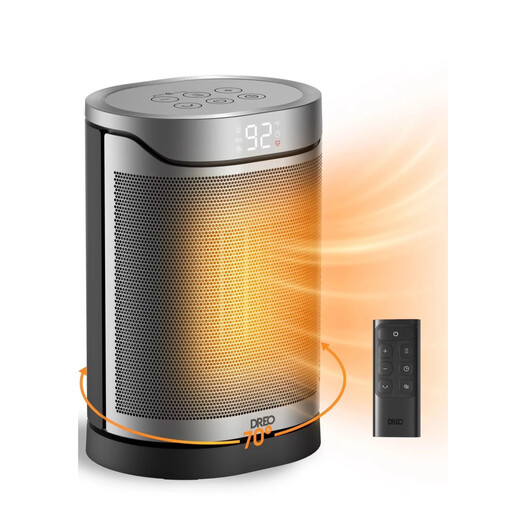
Why we recommend this product: The DREO Atom 318 combines a high heating output of 1500 W with a compact design. According to the manufacturer, its Hyperamic heating technology ensures it heats up within 2 seconds. The dual DC motor enables quiet operation and efficient heat distribution through 70° oscillation. The 8-stage safety system, including the patented FortPlug connector, offers comprehensive protection.
Pros:
Who it's for: Individuals looking for fast and efficient supplemental heating for rooms up to 20 m², such as living rooms, home offices, or medium-sized bedrooms, who value a balance of performance, noise level, and safety.
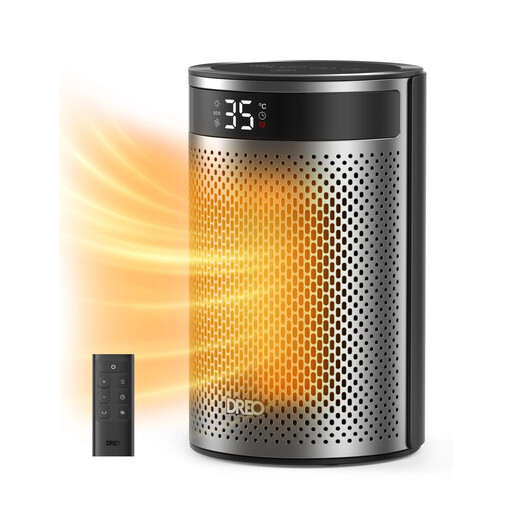
Why we recommend this product: The DREO Atom 416 is specifically designed for noise-sensitive environments. According to the manufacturer, the brushless DC motor and HyperSilent technology allow for operation at just 34 dB. Despite its quiet performance, the 1500 W PTC heating element delivers rapid heat output. Its compact and lightweight design makes it highly portable.
Pros:
Who it's for: Users for whom a minimal noise level is the top priority, for example, for use in a bedroom, nursery, or a quiet workspace.
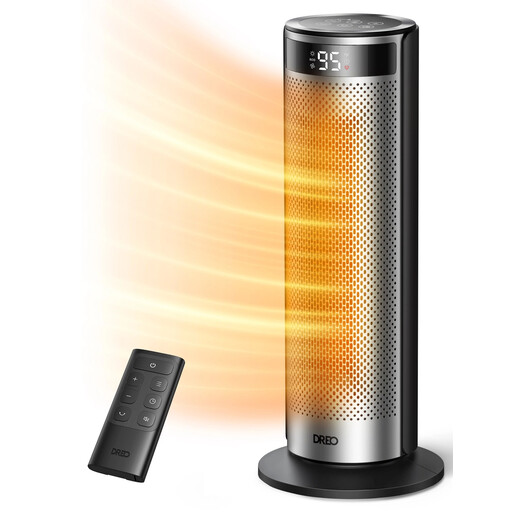
View Product: DREO Solaris 628
Why we recommend this product: With a power output of 2000 W and an enlarged PTC heating element, the Solaris 628 is designed for heating rooms up to 25 m². The tower design and 70° oscillation ensure wide and even heat distribution. Despite its high power, the noise level remains within a range of 25–42 dB thanks to the dual DC motor.
Pros:
Who it's for: Users who need a powerful heating solution for larger living areas, open-plan offices, or poorly insulated rooms, without compromising on noise level and safety.
If the models presented here do not exactly meet your requirements, you can find a wider selection of heating solutions in our main category. Discover more models in the Heating Element category.
1. How safe is it to run a ceramic fan heater overnight? Modern ceramic fan heaters with multi-level safety systems are designed for unattended operation, including at night. Features like automatic tip-over and overheat protection cut off the power supply in case of irregularities. An integrated thermostat ensures the device only heats when necessary. Nevertheless, it is advisable to place the unit on a clear, level, and fire-resistant surface.
2. How much electricity does an energy-efficient fan heater use? Power consumption depends on the set power level (in watts) and the duration of use. A 1500 W (1.5 kW) device running for one hour at its highest setting consumes 1.5 kilowatt-hours (kWh). An energy-saving fan heater is distinguished by a precise thermostat and an ECO mode. These features significantly reduce the actual runtime at full power, as the device switches off once the target temperature is reached.
3. Are quiet fan heaters also powerful? Yes, technological advancements make this combination possible. The use of brushless DC motors, aerodynamically optimised fan blades, and good housing construction reduces operating noise without compromising airflow and thus heating performance. Models like the DREO Atom 416 demonstrate that a noise level below 40 dB is technically feasible with a heating output of 1500 W.