
Lieferung heute & morgen

Qualitätsgarantie

Willkommens-Angebote freischalten: KOSTENLOSE Lieferung | Bis zu 80 % RABATT | Kostenlose 30-Tage-JoyPlus-Testphase
App herunterladen
A cold room can disrupt your concentration in the home office or spoil the comfort of your living room. Using a portable electric heater seems like a quick fix. However, the market is flooded with devices whose promises often don't match reality. Many users invest in a supposedly energy-efficient space heater, only to end up with a high electricity bill and a poorly heated room.
As your Joybuy Product Recommendation Officer, I'm here to help you identify the crucial features and avoid common purchasing traps.
Before you make a decision, you should be aware of the most common issues that lead to dissatisfaction and unnecessary costs.
To make an informed choice, focus on three technical aspects that directly determine efficiency, comfort, and safety.
Modern space heaters increasingly use PTC heating elements (Positive Temperature Coefficient). Unlike traditional heating coils, these are made of self-regulating ceramic stones.
PTC fan heater heats up quickly and automatically reduces its power output when a certain temperature is reached. This prevents overheating at the source and ensures more even heat distribution. This characteristic makes a ceramic heater inherently safer and more durable.space heater with a thermostat is EssentialThe most important feature for truly energy-efficient operation is an integrated, adjustable thermostat.
Beyond the basic functions, other features determine everyday convenience.
quiet space heater in practice means a value below 50 dB, ideally around 40 dB for use in quiet rooms.space heater for large rooms.space heater with a remote control and a programmable timer allow for convenient operation without having to get up, and automatic shut-off after a preset time.Here are some recommendations tailored to specific use cases that meet the criteria mentioned above.

Why This Fits Their Persona: Ideal for users who need a heat source in their home office or bedroom that won't disturb their concentration or sleep. The compact design fits discreetly on or under a desk.
This model avoids the noise trap with its brushless DC motor, which allows for operation as low as 34 dB, according to the manufacturer. The precise thermostat (5–35°C) and ECO mode also prevent unnecessary continuous operation.
Extremely Quiet Operation: At 34 dB, it's suitable for noise-sensitive environments.
Comprehensive Safety: Features tip-over and overheat protection, as well as a flame-retardant casing.
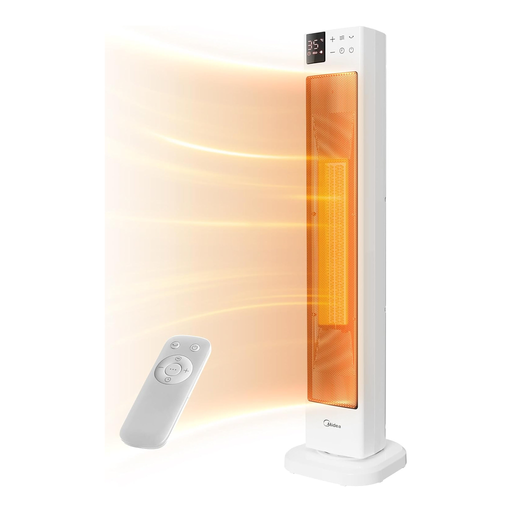
Why This Fits Their Persona: Suitable for users who need a flexible supplementary heater for larger living rooms or open-plan areas. Its tower design and high power output ensure effective heat distribution.
This model combines a high output of 2000W with an ECO mode and a thermostat to manage energy consumption. The 75° oscillation distributes heat efficiently and prevents cold spots, making it a great choice as a space heater for large rooms.
Powerful Heating Performance: 2000W PTC ceramic heating technology for rapid heating.
Wide Heat Distribution: The 75° oscillation ensures even heating for rooms up to 30 m?, according to the manufacturer.
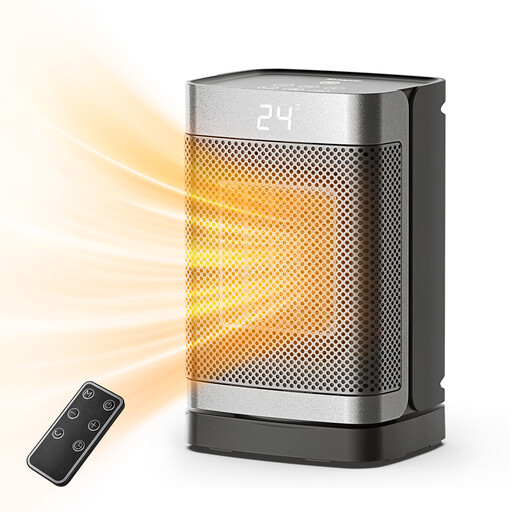
Why This Fits Their Persona: A solid choice for users looking for a straightforward, safe, and portable heat source for various spaces like the office, bedroom, or desk area, without needing a premium budget.
This device makes no compromises on safety, offering both tip-over and overheat protection. The PTC heating technology and adjustable temperature control ensure controlled operation instead of inefficient continuous running.
Good Feature Set: Offers a comprehensive package with PTC heating, two heat settings, a timer, oscillation, and a remote control.
Compact and Portable: The lightweight and compact design makes it easy to move between different rooms.
If you want to control your central heating more intelligently, we have curated a selection of products that meet strict selection criteria.
1. How much electricity does an energy-saving space heater really use? Consumption depends on the power rating (watts), duration of use, and thermostat settings. A 1500-watt space heater running continuously for one hour consumes 1.5 kilowatt-hours (kWh). However, thanks to a thermostat, the device doesn't run constantly but only cycles on to maintain the temperature. As a result, the actual consumption can be significantly lower than that of a device without a thermostat.
2. Is a ceramic heater objectively better than one with a heating coil? A ceramic heater offers objective advantages. The PTC technology provides self-regulation of the temperature at the heating element, which reduces the risk of overheating. Additionally, the heat is often perceived as more even and pleasant, and the elements are considered more durable because they don't burn out like classic heating coils.
3. Can a space heater replace central heating? No. A space heater is designed as a supplementary or transitional heat source for specific, targeted areas. It's ideal for quickly warming up a room without having to turn on the entire central heating system. For permanently heating an entire apartment or house, a central heating system is a far more efficient and cost-effective solution.