
Lieferung heute & morgen

Qualitätsgarantie

Willkommens-Angebote freischalten: KOSTENLOSE Lieferung | Bis zu 80 % RABATT | Kostenlose 30-Tage-JoyPlus-Testphase
App herunterladen
An ergonomic baby carrier can make everyday life easier: on walks, for short trips or whenever you want to keep both hands free. At the same time, baby carriers vary considerably in terms of fit, weight range, materials and adjustability. Focusing only on terms such as “comfortable” or “lightweight” can mean overlooking important details.
This buying guide explains which specifications matter before purchasing a baby carrier suitable from 3 months and which product features suit different everyday situations.
A specification such as “3 to 24 months” is only a guideline. The child’s weight, their ability to hold their head independently and the carrier’s adjustment are also crucial. A model suitable for 3 to 20 kg may be usable for a long time, but it must be correctly adjusted at every stage of development.
Babies who cannot yet hold their head independently should not be carried without suitable support and without following the manufacturer’s instructions.
The term alone does not explain how the child sits or how their weight is distributed. Look for an M-position, in which the knees are higher than the bottom, as well as a supportive C-position for the back. These terms describe the intended sitting and body position, but they do not guarantee correct use.
For the person carrying the baby, adjustable shoulder straps, sensible weight distribution and a baby carrier with lumbar support are important points to check.
Spit-up, food and outdoor dust are all part of normal baby carrier use. A washable baby carrier is therefore often more practical than a model that requires extensive hand washing only. Before buying, check whether machine washing is actually recommended and which temperature or fastening position is required according to the instructions.
A baby carrier for parents should not only be suitable for the child’s current weight. For families looking for a baby carrier up to 20 kg, a clearly stated minimum and maximum weight is essential. For the Momcozy models featured here, the stated range is approximately 3.18 to 19.96 kg, or around 7 to 44 lbs.
An age range of approximately 3 to 24 months does not replace checking the weight. Read the manufacturer’s instructions before first use and check that the head, airways and sitting position are properly supported.
An ergonomic baby carrier should support the legs adequately without putting pressure on the backs of the knees. Padded leg openings can make contact more comfortable. The baby’s face must remain visible; their nose and mouth must not be covered by fabric or body parts.
The models mentioned here are designed for front carrying. If you need a back or hip carrying position, do not automatically assume that it is possible. The relevant instructions for each product are the deciding factor.
A lightweight baby carrier weighing approximately 771 to 810 g may be appealing for everyday journeys. However, the actual carrying experience also depends on the width of the straps, the seat area, the padding and the individual wearer’s body shape.
According to the product details, the Momcozy versions are made from 100% cotton. One version is also described as being made from OEKO-TEX Standard 100 certified cotton. Always check such material information directly on the relevant product page and in the care instructions. Cotton can feel pleasant against the skin, but depending on the weave and care method, it may take longer to dry.
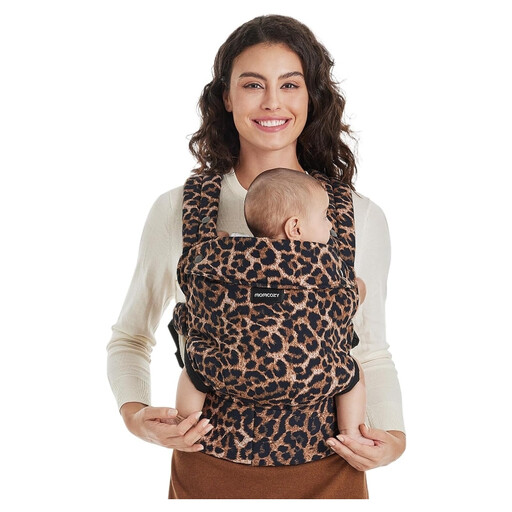
Why this product suits this profile: This carrier combines a stated weight of 771 g, 100% cotton and machine washing with a weight range of approximately 3.18 to 19.96 kg. It offers a straightforward set of features for parents looking for an uncomplicated carrier for everyday use.
The specific weight range and machine-washable design are clearly stated. Before use, you still need to check the buckles and make sure the carrier is correctly adjusted.
100% cotton, a net weight of 771 g, front carrying and a foldable neck support according to the product details.
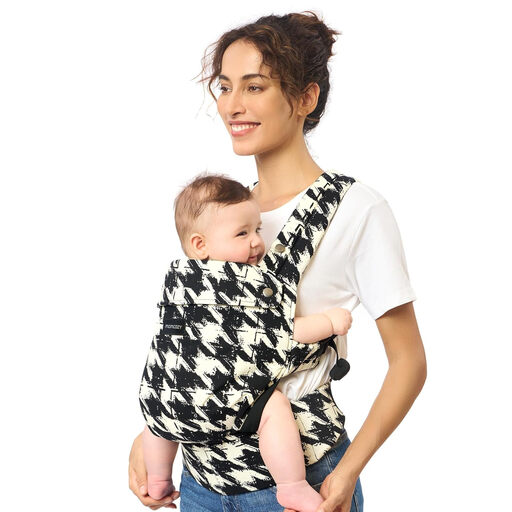
Why this product suits this profile: This version is described as featuring OEKO-TEX Standard 100 certified cotton, cross-back straps and three adjustable size positions. It is aimed at parents who compare material and adjustment details particularly carefully.
The product description specifies the material certification, weight limits and washability, rather than relying only on general comfort claims.
OEKO-TEX Standard 100 according to the product details, cross-back straps, a padded seat and machine washing.
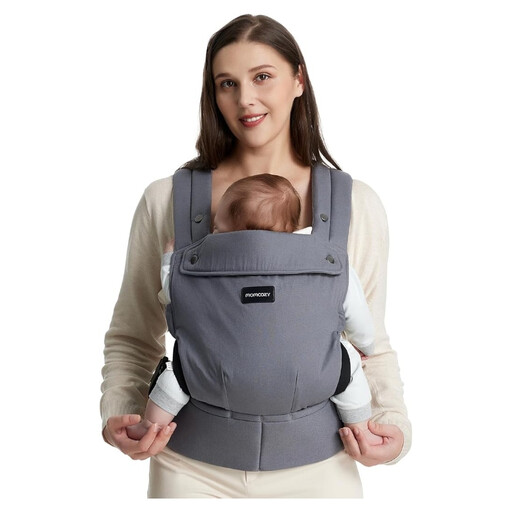
Why this product suits this profile: The grey version is suitable for parents who prefer a subtle colour and a hands-free baby carrier for regular journeys. The specifications include front carrying, cotton material and additional lumbar support.
The straps and buckles must be checked before every use and adjusted to suit both the wearer and the child. This ensures that a general comfort claim does not replace essential safety checks.
A net weight of 771 g, an EVA panel for lumbar support and a foldable neck support according to the product description.
We have put together a complete, regularly updated list of products that fully meet these strict selection criteria and the safety regulations applicable in the EU.
It does not depend on age alone. The manufacturer’s specifications, the baby’s weight and their ability to hold their head independently are the decisive factors. The models mentioned here are described as suitable from approximately 3 months or from 3.18 kg. The instructions must be followed before every use.
The maximum period of use depends on the child’s weight, size, stage of development and the fit of the carrier. A model with an upper limit of approximately 20 kg may be used across several stages of development, provided that the child is sitting correctly and the carrier is not damaged. Regular checks of the stitching, buckles and straps are still essential.
Besides the purchase price, the main costs are detergent and, where applicable, additional washing cycles. A machine-washable cotton baby carrier can be more practical to care for in everyday life. Wash it only according to the manufacturer’s instructions and allow it to dry completely before using it again.