
Lieferung heute & morgen

Qualitätsgarantie

Willkommens-Angebote freischalten: KOSTENLOSE Lieferung | Bis zu 80 % RABATT | Kostenlose 30-Tage-JoyPlus-Testphase
App herunterladen
If you work, play or stream at your PC every day, you need more than just eye-catching looks. An ergonomic gaming chair should suit your height, how long you sit, and your workspace. However, marketing jargon, unclear weight limits or poorly thought-out features often lead to the wrong purchase.
This buying guide explains which technical specifications actually matter and which models suit different usage profiles.
A backrest with a wide tilt angle may seem versatile. But for focused work, what really counts is whether the backrest can lock securely in an upright position. A gaming chair with a recline function can be useful for breaks and relaxing back, but it shouldn't tempt you to sit in a poor posture for long periods.
Look for a clearly stated range, for example 90 to 170 degrees, as well as an easy-to-use mechanism.
The terms gaming chair with lumbar support and gaming chair with headrest alone tell you little about the adjustment options. Check whether it's a loose cushion or an integrated, adjustable support. The seat width and the shape of the backrest also affect whether the features suit your body shape.
A breathable gaming chair may have a mesh backrest, while the seat and side wings are upholstered in solid faux leather. For a warm room, you therefore need to consider the material for the backrest and seat cushion separately. PU leather is usually easy to wipe clean, but can feel different to mesh in summer.
A gaming chair 150 kg is of interest to buyers who need a higher maximum load capacity. This figure is a product limit, not a recommendation for a particular body type. You should also consider the frame, gas lift, castor base and fixings.
Before use, check all screws. The chair should stand on a level, stable surface. A footrest is intended only for resting your legs, not for standing on.
An adjustable-height gaming chair should be set so that your feet are flat on the floor and your knees are at roughly a right angle. What matters is not just the height adjustment, but also the minimum and maximum seat height. Compare these values with your desk height and your own height.
For a home office, an ergonomic office chair may be more suitable if you prefer a discreet look, long upright working sessions and finer adjustments.
A backrest with adjustable tilt allows for different sitting positions. Models with 3D or 4D lumbar support offer more adjustment options than simple cushions. However, the support shouldn't press too hard. After assembly, test whether your shoulders and pelvis remain relaxed and whether the armrests bring your forearms to desk height.
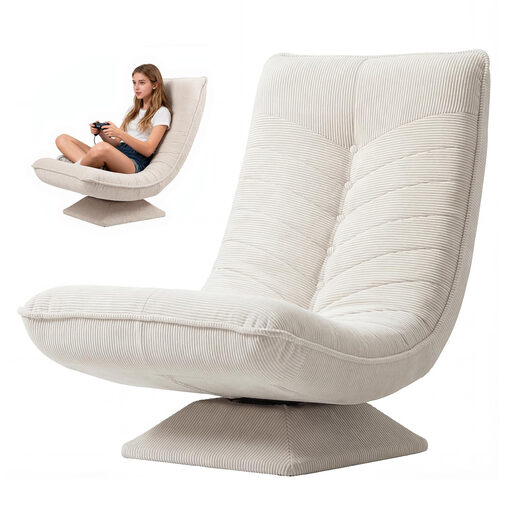
Why this product fits the profile: This foldable floor chair is designed for the living room, reading, watching TV or occasional gaming. It comes without assembly required and can be stored away to save space.
The specifications state a maximum weight capacity of 150 kg, 360-degree rotation and a backrest adjustment of up to 120 degrees. This makes the usage limits clearer than general comfort promises.
13 cm cushion thickness, corduroy cover, foldable design and no assembly required. Not classed as a traditional office chair with castors, armrests or separate lumbar support.
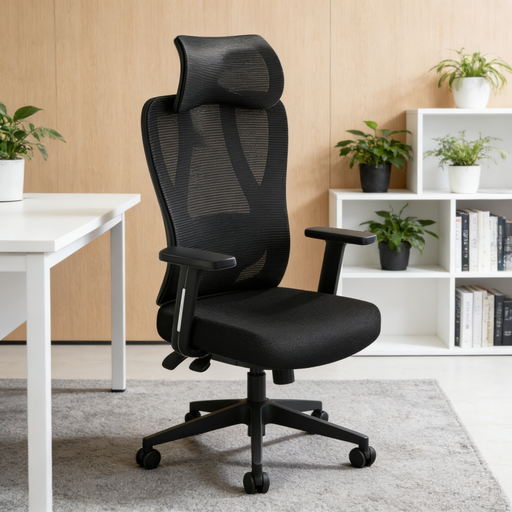
Why this product fits the profile: This chair combines office and gaming use with dual-layer mesh, adjustable backrest height, headrest and 4D lumbar support.
The features are described with specific values: 105 to 140 degrees tilt, 40 mm backrest adjustment and a 10.5 cm thick seat cushion. This makes it easier to compare with your own workspace.
Breathable dual-layer mesh, 4D lumbar support, adjustable headrest and suitability as a swivel chair for both office and gaming.
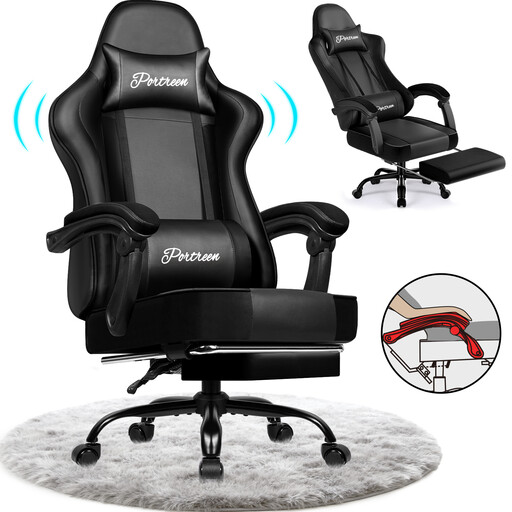
Why this product fits the profile: For long gaming or work sessions, this gaming chair with footrest offers an extendable leg support, headrest, lumbar cushion and adjustable seat height.
According to the product specifications, the backrest is adjustable between 90 and 170 degrees, and the seat height by 10 cm. The maximum weight capacity is 150 kg; the footrest should only be used when stationary.
Extendable footrest, high-density foam, water-repellent PU cover and, according to the supplier, BIFMA and SGS certifications.
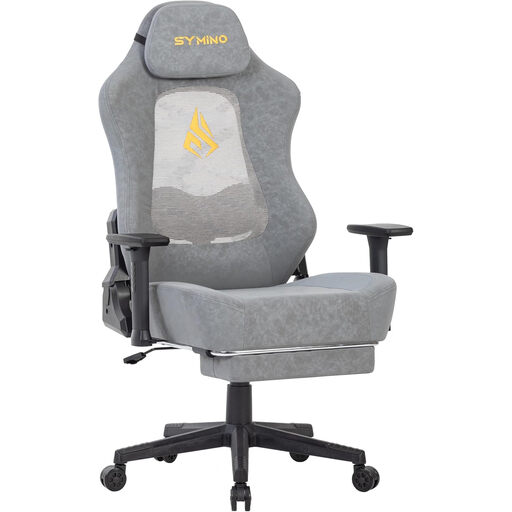
Why this product fits the profile: The open mesh backrest is aimed at PC users who prioritise airflow and flexible sitting positions. The 3D lumbar support is designed for dynamic use.
Instead of using the term "breathable" only in a general sense, the open mesh backrest is specifically named. Additionally, 90 to 155 degrees tilt and a 12-degree rocking function are specified.
Steel frame, 3D lumbar support, open mesh backrest, Class-3 gas lift according to product specifications and a maximum weight capacity of 150 kg.
We've put together a complete, regularly updated list of products that fully meet these strict selection criteria and the safety regulations in force in the EU.
First, adjust the seat height so that both feet are firmly on the floor. Your knees should not be pushed upwards. Then, straighten the backrest and adjust the lumbar support and headrest. The armrests should support your forearms without raising your shoulders. The monitor and keyboard must also match your sitting position.
The lifespan depends on usage time, body weight, material, care and mechanical stress. Regularly check the castors, gas lift, armrests and screw connections. Faux leather should be cleaned with a soft, damp cloth; mesh must not be treated with harsh cleaners. It's not possible to give a specific lifespan without knowing your individual usage situation.
Yes, when tilted back heavily and with the footrest extended, additional space is needed behind and in front of the chair. Measure the distance to the wall and to your desk. For small rooms, a foldable floor chair or a model without a footrest may be more practical.