
Lieferung heute & morgen

Qualitätsgarantie

Willkommens-Angebote freischalten: KOSTENLOSE Lieferung | Bis zu 80 % RABATT | Kostenlose 30-Tage-JoyPlus-Testphase
App herunterladen
An ergonomic gaming and office chair should keep you comfortable through many hours at your desk. In practice, however, design alone isn't what matters. A striking backrest, thick padding or a high weight capacity rating tell you very little about whether the chair actually suits your height, desk and how long you'll be using it.
Typical buying problems arise from three common marketing pitfalls:
For a proper sitting position, your feet should be flat on the floor while your knees form roughly a right angle. That's why an adjustable-height desk chair is especially practical for multiple users or height-adjustable desks.
Look out for the following details:
With a model that offers a seat height adjustment of up to 10 cm and a recommended user range of 158 to 190 cm, you can assess the fit far more accurately than with a vague label like "universal".
A gaming chair with lumbar support should offer a sliding or height-adjustable support. With a fixed padded area, the position can end up too high or too low depending on your height. A gaming chair with a headrest can additionally support your neck, but it's only useful if the headrest actually reaches your head in your sitting posture.
The armrests also deserve attention. A gaming chair with armrests should comfortably support your forearms without raising your shoulders. Height-adjustable armrests are far more practical than fixed ones. On some models, the stated adjustment range is 8 cm.
A gaming chair with a rocking function allows a more dynamic sitting position for short breaks. Check whether the description distinguishes between rocking and an adjustable backrest. A backrest with a range of 90 to 170 degrees offers different possibilities than a simple rocking mechanism.
For stability, look at details about the frame, base, castors and gas lift. A gaming chair up to 150 kg should only be used within the stated weight limit. The chair must stand fully assembled on a level surface. Any certification marking on the gas lift, for example, should be clearly traceable in the product information.
When it comes to upholstery, you'll usually find PVC/PU leather, fabric or mesh to choose from:
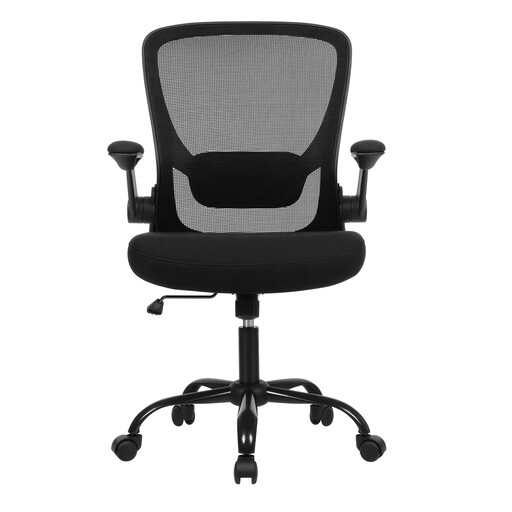
Why this product fits the profile: The fabric cover, foldable armrests and stated weight capacity of 120 kg make it suitable for office and home office users looking for a compact chair with basic adjustment options.
The product details clearly state the material, dimensions of 66 × 60 × 99–107 cm and the maximum static load of 120 kg. This makes it much easier to compare against your existing workspace.
Height adjustment, 360-degree swivel, foldable armrests and a padded fabric backrest.
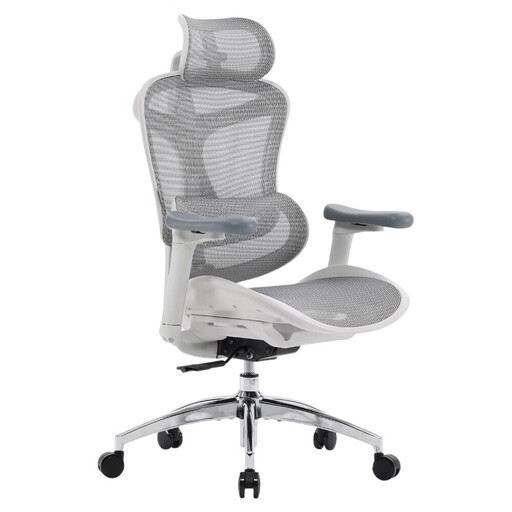
Why this product fits the profile: This model is aimed at people who prefer a breathable mesh back, multiple backrest positions and differentiated armrest adjustment for the office or home office.
The product description specifies the mesh back, four positions with 6 cm of vertical adjustment, three tilt angles and a weight capacity of 150 kg. These details make pre-purchase checks much simpler.
Self-adaptive lumbar support, 3D armrests, polyester mesh and stated standards including EN1335, TÜV and SGS BIFMA.
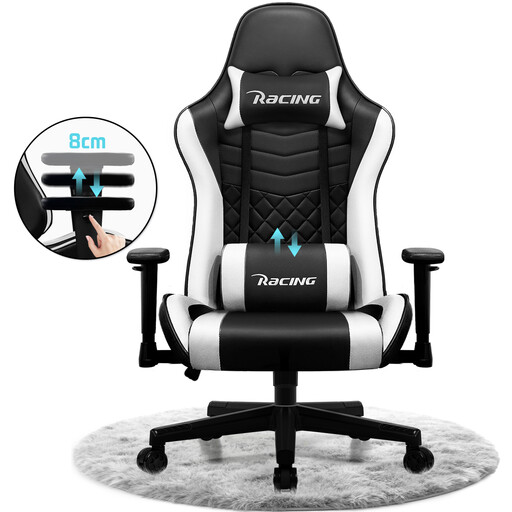
Why this product fits the profile: Gamers and heavy users get a combination of height-adjustable lumbar support, headrest, armrests and a rocking function. The stated weight capacity is 150 kg.
Rather than relying on a fixed padded shape, this model specifies concrete adjustments for the lumbar support and armrests. The frame, gas lift and castors are all listed as part of the construction.
8 cm height-adjustable armrests, height-adjustable lumbar support, 360-degree swivel, PVC/PU cover and stated 150 kg weight capacity.
We've put together a complete, regularly updated list of products that fully meet these strict selection criteria and the safety regulations in force across the EU.
Choosing an ergonomic office chair isn't about buying as many features as possible. What really matters is the combination of the right size, sensible adjustability and a material that suits your workspace. A desk chair with a footrest can be useful for breaks or reclined positions, but for correct working posture it doesn't replace a proper seat height and stable foot placement.
First, adjust the seat height so that both feet are flat on the floor. Then set the backrest upright and position the lumbar support in the area of your natural lower back curve. The armrests should support your forearms without raising your shoulders. Your monitor, keyboard and mouse then need to match your sitting position.
The lifespan depends on the construction, daily usage time, body weight, floor surface and care. Regularly check the screws, castors, base and gas lift. Never exceed the stated weight limit and don't use the chair as a step. For fabric and mesh covers, be sure to follow the respective care instructions.
No. A higher price may include additional mechanisms or more elaborate materials, but it doesn't guarantee a proper sitting position. Instead, compare specific values such as seat height range, weight capacity, adjustment ranges, backrest angle and upholstery material. That way you can assess the value for money far more objectively.