Writers with a small desk
If you mainly write, you’ll need space beside your keyboard for your mouse and manuscript.


When you’re writing long radio scripts at a small desk, the first thing to consider is how much room your keyboard, mouse and manuscript need together. A compact keyboard without a number pad you use regularly can leave more space for your mouse; BG BAU points out that it may also allow you to position the mouse closer to the keyboard. A fixed split keyboard dictates the layout, while independently positionable halves give you more flexibility over hand spacing but may take up more desk width, depending on how you arrange them. Before buying, check the dimensions of the exact model, the German keyboard layout, the key feel and its connection to your computer.
If you mainly write, you’ll need space beside your keyboard for your mouse and manuscript.
If you want to change your hand position during long typing sessions, remember to allow extra room for independently positionable halves.
If you speak or record at your desk, consider the noise made by the specific switch type.
The main differences between keyboard designs are how much desk space they take up and how easily you can adjust your hand position.
A good fit if: You prefer a fixed key layout and need room for your mouse and manuscript. Logitech lists the Wave Keys for Business as 376 mm wide.
Bear in mind: The wave-shaped design doesn’t split into two independently positionable halves. Check the exact operating system and layout version.
A good fit if: A split layout matters more to you than wireless connectivity. Perixx lists the PERIBOARD-335 as measuring 398 × 202 × 44 mm and offers a German QWERTZ version.
Bear in mind: The split is fixed within the keyboard’s casing. Also check that it has a USB-A cable and the switch type you want.
A good fit if: You want to set the distance and angle between your hands yourself, and have enough desk space. Kinesis says the Freestyle2 can be used with its modules close together or further apart.
Bear in mind: The more widely you position the halves, the more desk width you’ll need. Also check the exact key layout and whether you’ll need a tenting kit or palm supports.
A good fit if: You use the number pad regularly and still have enough room for your mouse after measuring your desk. CHERRY lists the KC 4500 ERGO as 456 mm wide and offers a German version.
Bear in mind: A full-size keyboard takes up more room to the side than the narrower models listed here, so you won’t benefit from the shorter mouse reach of a compact keyboard.
| Priority | What to check when buying | Who should pay particular attention? |
|---|---|---|
| Desk space and mouse reach | Compare the width and depth of the exact keyboard, including its palm rest, with the space available for your mouse and manuscript. | If I need my mouse and manuscript beside the keyboard while I write, free desk space matters. Around 36 % of consumers say the space a keyboard takes up is their main concern. |
| Adjustable hand position | Check whether the halves can actually be positioned independently and how wide apart they are at your preferred spacing. | If I want to adjust my hand position during long typing sessions, I need halves that I can position to suit me. Around 29 % of consumers prioritise this flexibility. |
| Key noise and typing feel | For mechanical models, check the specific switch option. For German-language text, check the legends on the keys. | If I write or record in a quiet environment, the feel and sound of the keys matter to me. Around 21 % of consumers focus mainly on quiet typing and a familiar typing feel. |
| Connectivity and device compatibility | Check your computer’s ports, operating system, exact product version and German keyboard layout. | If I want to use the keyboard with a particular computer, the connection and version need to be compatible. Around 14 % of consumers put device compatibility first. |
An integrated palm rest and the depth of the keyboard also take up desk space, potentially leaving less room for your mouse or manuscript.
Compare the width and depth of the exact model, including its palm rest, with the desk space you actually have available.
Only independently positionable modules can be moved apart; the wider you space them, the more desk width they need.
Check the design in the product details and mark out the intended spacing on your desk before you buy.
Model number 920-012404 is described as optimised for macOS, iPadOS and iOS. Don’t assume that details for the standard Wave Keys also apply to this version.
Check the full model number, operating system, QWERTZ key legends and connection for the version on offer.
The PERIBOARD-335 combines a fixed split layout with a relatively compact design. Perixx lists its dimensions as 398 × 202 × 44 mm and offers a German QWERTZ version.
Wave Keys is a one-piece wave keyboard with a palm rest, while the ERGO K860 is a larger range with a split key layout. Their space requirements and designs differ.
The Freestyle2 has two halves that can be positioned at different distances apart. It’s an option for writers who want to choose their own hand position.
The KC 4500 ERGO is an ergonomically shaped full-size keyboard with a number pad, available in a German version.
Joybuy keyboard options for writing in German, with a choice of keyboard designs, connection types and ways to control your mouse.
 No image available
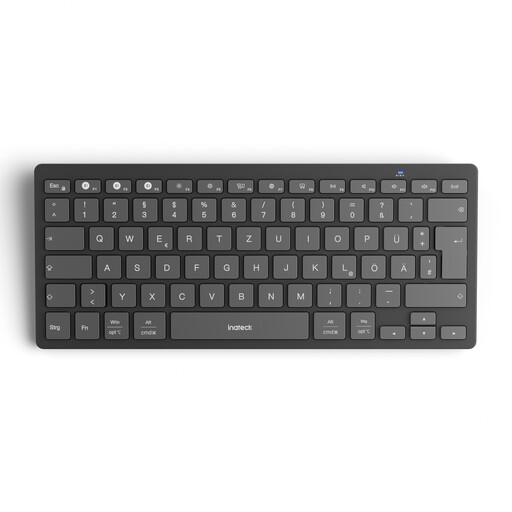
A slim keyboard with wireless connectivity for writing scripts in German.
The product name specifies a QWERTZ layout, Bluetooth and connections for up to three devices. It also lists compatibility with iPad, Windows, Android and iOS.
 No image available
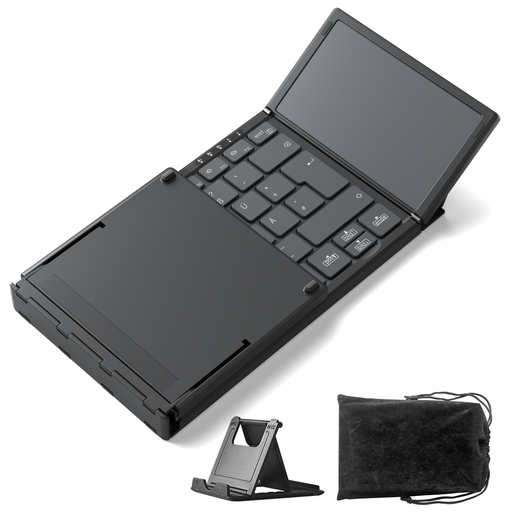
The integrated touchpad lets you work without a separate mouse when desk space is limited.
The product name specifies QWERTZ, three Bluetooth channels and compatibility with iPadOS, Android and Windows.
 No image available
For writers looking for a mechanical keyboard with quiet tactile switches.
The product name specifies Bluetooth, Logi Bolt, German QWERTZ and smart backlighting.
 No image available
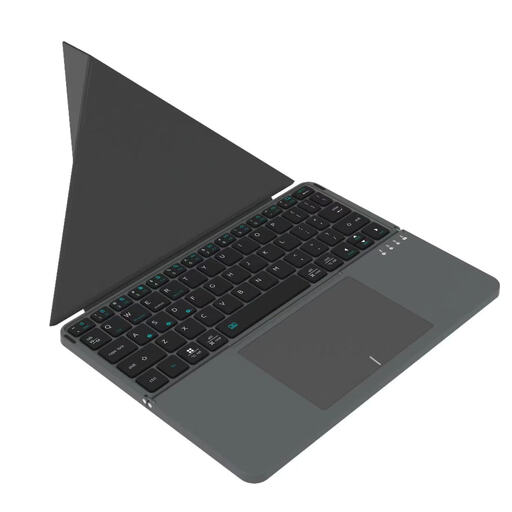
The integrated touchpad is a useful option if you want to leave space for other things instead of a separate mouse.
This version is described as a foldable keyboard with a touchpad and protective case.
 No image available
For writers who want a split key layout and an integrated palm rest. Allow room for its larger design.
The product name specifies QWERTZ, Bluetooth and a USB receiver, along with compatibility with Windows and Mac.
Position your keyboard so you can type in a neutral posture in front of your screen. Measure the space you need for your mouse and manuscript too. For computer workstations, BG BAU recommends leaving room between the edge of the desk and the keyboard so you can rest your hands. A wide or deep keyboard shouldn’t take up this space.
Not necessarily. If you only enter numbers occasionally, a compact keyboard without a number pad could suit you. According to BG BAU, this can let right-handed users position their mouse closer to the keyboard. If numbers are a regular part of your work, weigh up the benefits of a number pad against the space it takes up.
Check the care instructions for your specific model and keep liquids away from the device. The F.A.Z. Kaufkompass notes that the gap between the keyboard and palm rest on the Logitech ERGO K860 is difficult to clean. This observation applies to that model and doesn’t necessarily apply to other keyboards.
When you buy online as a consumer, you generally have a 14-day right to cancel. You must notify the retailer that you wish to cancel. If a product is faulty, your statutory rights against the seller are separate from any voluntary guarantee. Verbraucherzentrale explains these rights; check the terms of your specific purchase and be aware that some exceptions may apply.
The rules mentioned here don’t require you to buy a particular brand or a split keyboard. The workplace requirements for computer workstations within the scope of the workplace regulations cover how the workstation is set up. The DGUV summary includes a keyboard that is separate from the screen and can be tilted. ASR A6 applies to the workplaces and home-working setups it describes, not automatically to every home desk.