
Lieferung heute & morgen

Qualitätsgarantie

Willkommens-Angebote freischalten: KOSTENLOSE Lieferung | Bis zu 80 % RABATT | Kostenlose 30-Tage-JoyPlus-Testphase
App herunterladen
An ergonomic neck pillow is designed to support your head and neck in line with your sleeping position. However, a contoured pillow won’t automatically give you a comfortable sleeping position. If you focus only on terms such as ‘orthopaedic’, ‘massage function’ or ‘pain relief’, you may overlook important details.
Before you buy, make sure you avoid these three common pitfalls:
Side sleepers generally need a pillow high enough to fill the gap between their shoulder and the mattress. An ergonomic pillow for side sleepers with contoured wave-shaped sides may be a good option. The right height for you will also depend on your shoulder width, mattress firmness and preferred sleeping position.
Back sleepers often get on well with a lower neck support and a moderate curve. A pillow for back sleepers with a slight head recess can help stop your head rolling to one side. Stomach sleepers should pay particular attention to the pillow’s height, as a pronounced contour can increase the rotation of the neck.
Pillow size matters too. The 60 x 40 cm size is compact and will usually fit standard pillowcases. A longer model, such as 42 x 70 cm, gives you more room to rest your head but needs a suitably sized pillowcase.
Depending on its construction, a latex pillow can have a relatively springy feel. Natural latex may be combined with ventilation channels or an open-cell structure. If you have a known latex allergy, check the material information carefully. The product should also be kept away from open flames and high temperatures.
A memory foam pillow, also known as a viscoelastic foam pillow, moulds more closely to the shape of your head in response to pressure and warmth. This may appeal if you prefer a more settled feel. The material may also feel warmer to some people. Built-in air channels and a breathable cover are therefore useful features to check when choosing a cooling pillow.
Look for a full description of the materials. If a model is described as ‘93% natural latex’, the remaining 7% and the care instructions should also be clearly stated. A removable, washable cover makes it easier to keep the pillow clean, but the core often can’t be machine-washed.
A pillow marketed for neck pain won’t necessarily suit everyone with sensitivities. Before you buy, check:
For the products listed here, read the individual product details and warnings before placing your order. If you have a known allergy, check the materials list and seek medical advice if you’re unsure.
The selection below groups the models according to their stated features and different uses. It is not a medical assessment, nor does it guarantee any particular effect.
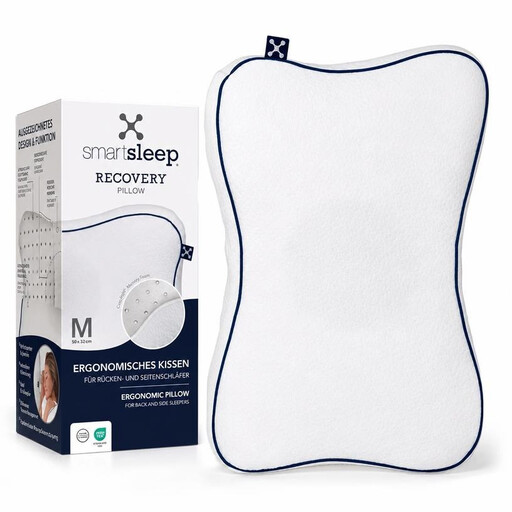
Why this product suits this profile: This model combines memory foam with a head recess and is designed for side and back sleepers. The product description also mentions air channels and OEKO-TEX-certified material.
The product information specifies the foam core, air channels and material certification. These details tell you more than a vague label such as ‘premium pillow’.
Memory foam core with a head recess; integrated air channels according to the description; 30-night trial according to the product information.
We’ve put together a complete, regularly updated list of products that meet these strict selection criteria and fully comply with the safety regulations in force in the EU.
The right height depends mainly on your sleeping position, shoulder width and mattress. Side sleepers often need a higher pillow than back or stomach sleepers. With contoured models, you should also consider where the higher and lower curves sit. A pillow should support your head without visibly pushing it upwards or downwards.
A pillow’s lifespan depends on its material, density or latex construction, how often you use it and how you care for it. A noticeable loss of shape, permanent dents or crumbling foam are practical signs that it may be time to replace it. Without specific guidance from the manufacturer, it’s not possible to give a reliable fixed lifespan.
As a rule, wash the cover separately according to its care label. Clean the core only as instructed by the manufacturer. Some latex models specifically must not be soaked or machine-washed. You may need to air the pillow after unpacking it; keep it away from direct heat and open flames.