
Lieferung heute & morgen

Qualitätsgarantie

Willkommens-Angebote freischalten: KOSTENLOSE Lieferung | Bis zu 80 % RABATT | Kostenlose 30-Tage-JoyPlus-Testphase
App herunterladen
An ergonomic neck support pillow is designed to keep your head and neck in a natural position. Even so, not every pillow marketed as “orthopaedic”, “cervical pillow” or “sleep comfort” will automatically be the right choice. What really matters are measurable features such as height, shape, material and care.
If you’re an adult with neck or shoulder discomfort, or a side or back sleeper, it’s worth examining the product details closely. A pillow can support a comfortable sleeping posture, but if symptoms persist or are severe it’s no substitute for medical assessment.
A higher pillow can work for some side sleepers, while back sleepers often prefer a lower profile. Your body width, mattress firmness and shoulder height also affect the height you need. Claims like “for all sleeping positions” shouldn’t be treated as a guarantee.
Check whether the pillow specifies an exact height or offers multiple contours. A height-adjustable pillow or a model with two differently sized sides usually lets you fine-tune it more precisely to your preferred sleeping position.
A memory foam neck pillow can adapt to your head and neck thanks to its slow rebound. However, without a supportive layer there’s a risk your head sinks too deep. More informative are details about the construction, foam structure and shape retention.
Multi-layer designs, for example, combine a softer top layer with supportive layers underneath. With a contour pillow, it’s also important that the neck recess suits your own body shape.
Foam can retain warmth. A removable cover with air channels or moisture-wicking fabric can make a real difference to comfort. Look for clear care instructions: many foam cores must not go in the washing machine or be fully submerged in water.
For a breathable sleep pillow, consider the cover, inner core and washability separately. In day-to-day use, a washable cover is usually more practical than a fully washable pillow, unless the manufacturer explicitly advises otherwise.
For side sleepers, the gap between mattress and head is crucial. An ergonomic pillow for side sleepers should fill the space between shoulder and head without noticeably pushing the neck upwards. Back sleepers should focus more on a shallow neck recess and stable support for the back of the head.
Models with a wave shape, central dip or two heights can accommodate different sleep habits. For back and side sleepers, such contours are often more practical than a completely flat standard pillow.
Labels such as “orthopaedic pillow” or “pillow for neck and shoulder pain” describe the intended function but are not proof of medical efficacy. Rely on the technical product data instead.
Dimensions of 60 × 40 cm are common for contour pillows, but not universal. Compare the pillow width with your mattress and check if a standard pillowcase fits. With a new pillow, a short adjustment period can help. Check any available return option before you buy.
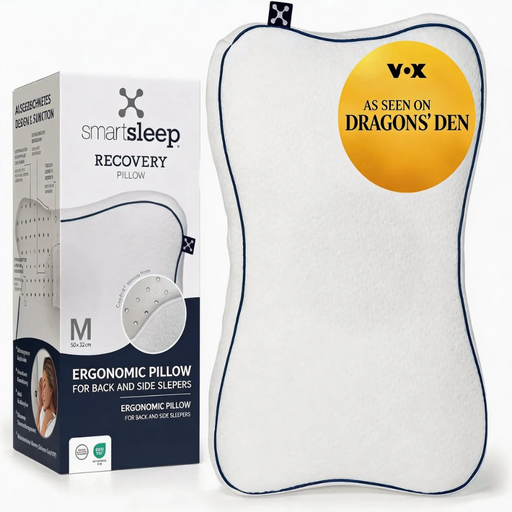
Why this product suits the profile: Designed for back and side sleepers, this model is described as using memory foam with integrated air channels and a cover that, according to the product information, has been tested for harmful substances.
The product description specifies materials, air channels and a 30-night trial. Check the exact terms before buying.
Memory foam, airflow channels in the core and claims of OEKO-TEX-certified materials.
Allow a vacuum-packed pillow to expand fully after opening. With foam, 24 to 48 hours of airing time can be helpful. Position the pillow so the higher contour supports your neck and your head doesn’t tip forward.
Also keep in mind:
We’ve compiled a complete, regularly updated list of products that fully meet these strict selection criteria and the safety regulations in force in the EU.
That depends on your sleeping position, shoulder width and mattress. Side sleepers often need more height than back sleepers. The key is to keep your head and neck as straight as possible, without bending upwards or downwards.
There’s no universal lifespan. Check the shape, rebound and surface of the material regularly. If the foam becomes permanently soft, deforms or turns brittle, it’s time to replace the pillow.
A pillow can influence your sleeping posture and perceived comfort. However, it’s not a substitute for diagnosis or treatment. If your symptoms persist, worsen or radiate, you should seek medical advice.