
Lieferung heute & morgen

Qualitätsgarantie

Willkommens-Angebote freischalten: KOSTENLOSE Lieferung | Bis zu 80 % RABATT | Kostenlose 30-Tage-JoyPlus-Testphase
App herunterladen
Long hours at a desk, whether at home or in the office, take their toll. The wrong chair can quickly lead to tension and discomfort. However, the office chair market is overwhelming and filled with marketing hype. As your Joybuy Product Recommendation Officer, I'm here to help you identify the crucial features and steer clear of common purchasing pitfalls.
Many buyers invest in a supposedly ergonomic chair, only to find after a few months that it worsens their problems rather than solving them. This is often due to three common misconceptions and design flaws:
To avoid a bad purchase, you should focus on objective and measurable criteria. These three aspects are central to a good, ergonomic desk chair.
An integrated office chair with lumbar support is essential for supporting the natural S-curve of the spine and reducing pressure on the lower back. Pay attention to whether the support is merely static or if it can be adjusted—ideally in height—to fit your individual lordosis (the natural curve of the lumbar spine). Adaptive systems that adjust to your movements provide dynamic support throughout the workday.
An adjustable-height office chair is an absolute must. Your feet should rest flat on the floor, and your knees should form an angle of about 90 degrees. The armrests are just as important. An office chair with flip-up armrests offers maximum flexibility: when flipped up, it allows for more freedom of movement and space-saving storage; when down, it relieves strain on the shoulders and neck. A rocking or tilt function can also provide relaxation during short breaks by promoting dynamic sitting.
The choice of material has a direct impact on seating comfort. A mesh office chair is particularly breathable and ensures good air circulation, which is a significant advantage on long, warm days. High-quality mesh fabrics are also durable and conform well to the body's shape. Classic foam padding, often covered with fabric or faux leather, can provide a softer feel. Here, the density of the foam is crucial for longevity and the ability to distribute pressure evenly.
Instead of making a blanket recommendation, we have identified models that are tailored to specific user profiles and their requirements.
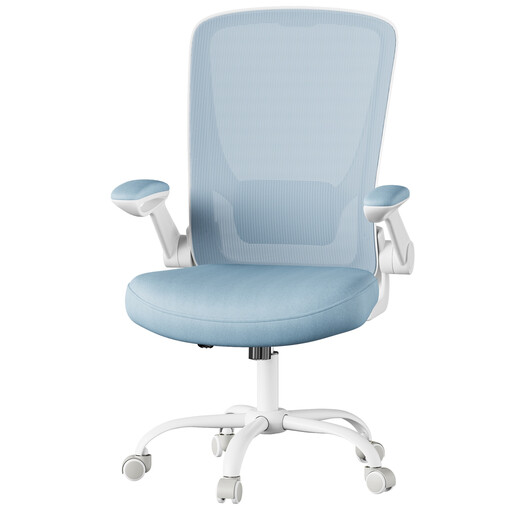
Why it's a great fit: Ideal for students or for setting up a first home office. It provides essential ergonomic features, like an adjustable lumbar support and seat height, without breaking the bank.
This model avoids the "one-size-fits-all" trap with its adjustable lumbar support and flip-up armrests, which solve the space issue common in home offices.
Delivers a solid ergonomic foundation and is exceptionally space-efficient thanks to its flip-up armrests—a practical, all-around choice for getting started.
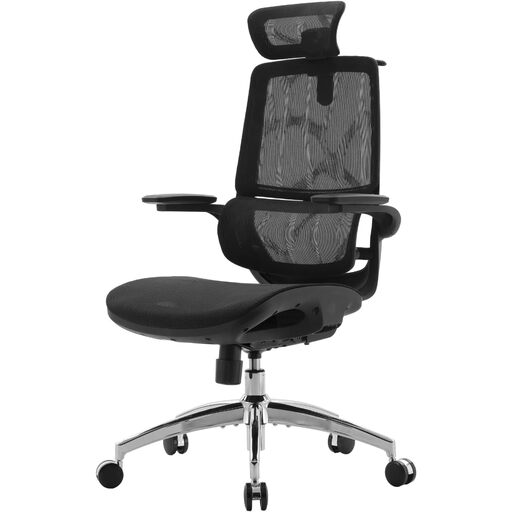
Why it's a great fit: Designed for professionals who spend long hours at their desks every day. Its dynamic support and extensive adjustment options are built for sustained, heavy use.
According to the manufacturer SIHOO, the adaptive lumbar support and split-back design adjust to the user's movements, providing continuous support that static systems cannot match.
With 3D-adjustable armrests and an adaptive backrest, it offers a high degree of customisation for demanding users who need all-day support.
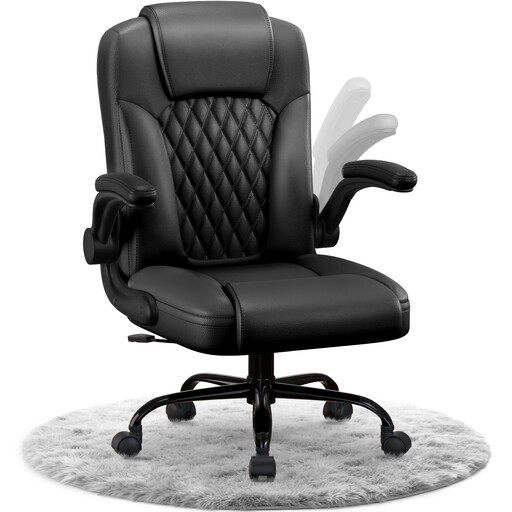
Why it's a great fit: For users who prefer a classic office aesthetic but don't want to sacrifice modern ergonomic features. The faux leather upholstery gives the chair a high-end look.
This model refutes the assumption that a classic look means functional compromises. It combines the faux leather aesthetic with a rocking function (90°-120°), lumbar support, and flip-up armrests.
Blends an executive look with practical ergonomics. The manufacturer-stated weight capacity of up to 150 kg and the sturdy metal frame suggest a durable construction.
We've compiled a complete, up-to-date list of products that meet these strict selection criteria.
Start with the seat height: your feet should be flat on the floor, and there should be about a hand's width of space between the back of your knees and the front edge of the seat. Adjust the lumbar support to fill the natural curve of your lower spine. The armrests should be positioned so that your forearms rest at a 90-degree angle and your shoulders are relaxed.
The lifespan depends heavily on the quality of the mesh fabric and the overall construction. High-quality mesh is designed to retain its tension for several years, even with daily use. Pay attention to the manufacturer's specifications for maximum weight capacity and the materials of the frame and base, as these also contribute to longevity.
Yes, on high-quality models, the folding mechanisms are robust and designed for daily use. They typically lock securely in both the up and down positions, providing the same stability as fixed armrests when lowered. This feature is a purely practical advantage for added flexibility and, when well-engineered, has no negative impact on stability.