
Lieferung heute & morgen

Qualitätsgarantie

Willkommens-Angebote freischalten: KOSTENLOSE Lieferung | Bis zu 80 % RABATT | Kostenlose 30-Tage-JoyPlus-Testphase
App herunterladen
Long workdays at a desk have become the norm for many professionals, whether in a corporate office or a home office. However, this sedentary activity can lead to tension and discomfort, especially if the workspace is not optimally equipped. A key element in promoting healthy posture is the right chair. This article serves as a guide, presenting a selection of models tailored to different needs. The goal is to provide you with an objective basis for your decision.
The selection of a chair should be based on objective criteria. Three aspects are particularly relevant: adjustability, material quality, and certified safety.
An ergonomic office chair should adapt to your body, not the other way around. Pay attention to the following adjustment features:
The materials determine not only the appearance but also the comfort and durability. A mesh backrest is breathable and prevents heat build-up. Seat cushions made of moulded foam offer stable and long-lasting support.
A crucial criterion is the maximum weight capacity. Standard chairs are often designed for up to 110 kg. If you require greater stability, you should specifically look for an office chair with a 150 kg capacity. These models feature a reinforced gas lift and a more robust base.
Seals of approval such as BIFMA or SGS provide information about the safety and longevity of a chair. These certifications are based on standardised tests that assess the load-bearing capacity of components like the gas lift and the base. They serve as an objective indicator of product quality.
Based on the criteria mentioned, we have compiled a selection of chairs that stand out for their functionality and adaptability.
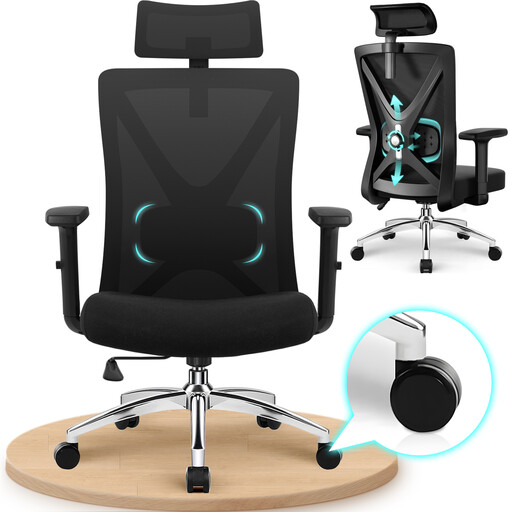
Why it stands out: This model is distinguished by its highly adaptable lumbar support, which can be adjusted in both height (up to 6 cm) and depth (up to 3 cm). This allows for a very precise fit to the individual shape of the spine.
Advantages:
Who is it for? This swivel chair for home office and corporate use is suitable for individuals who value precisely adjustable lumbar support and are looking for a robust chair with a high load capacity. It is an excellent choice for long workdays that demand continuous support.
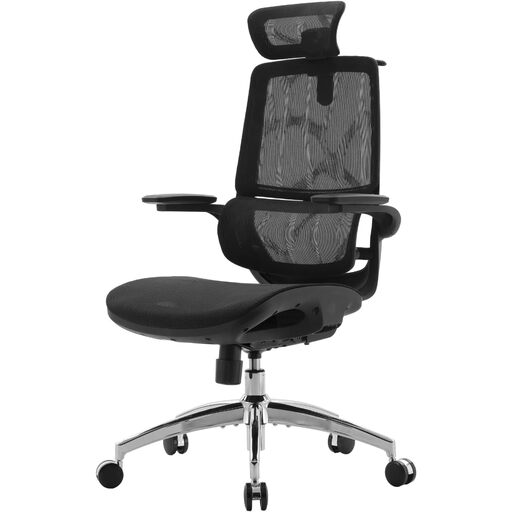
Why it stands out: The unique feature of the SIHOO M59S is its two-part backrest with adaptive lumbar support. This design dynamically adjusts to the user's movements, ensuring continuous back support.
Advantages:
Who is it for? Ideal for home office users with limited space who are looking for a flexible and dynamically supportive chair. The flip-up armrests offer additional freedom for activities that require more room to move.
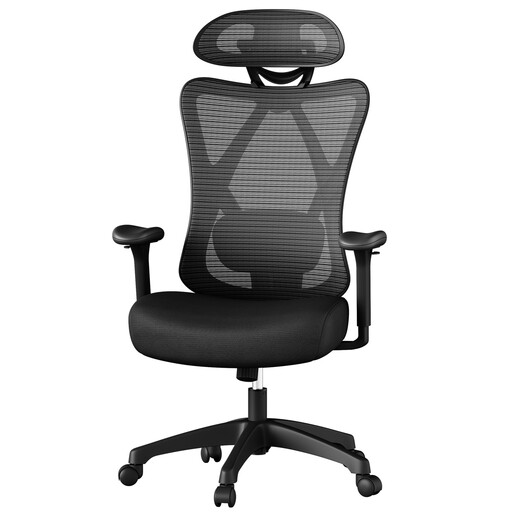
Why it stands out: This model focuses on essential ergonomic features within a straightforward design. It offers a solid foundation for comfortable sitting and easy assembly.
Advantages:
Who is it for? This chair is a great choice for users seeking a functional and reliable ergonomic desk chair without complex extra features. It is well-suited for daily use in the office or home office where basic ergonomic requirements need to be met.
An ergonomic chair is the foundation of a healthy workspace. However, its full potential is realised when paired with a suitable desk at the correct height. If you are redesigning your workspace or considering other furniture, you may find matching pieces in our category for grey-white table.
A good ergonomic office chair is characterised by a wide range of adjustment options. These include adjustable seat height and depth, a reclining backrest, customisable lumbar support for the lower back, and height-adjustable armrests. High-quality, breathable materials and a sturdy construction are also important features.
Lumbar support is very important as it supports the natural curve of the lumbar spine. This helps maintain an upright and healthy sitting posture, relieves pressure on the intervertebral discs, and can help prevent back pain caused by prolonged sitting, making it an office chair for back pain prevention.
Not necessarily. The term executive chair often describes a design focused on a prestigious appearance with a wide seat and high backrest. While some models offer ergonomic functions, many lack the specific adjustment capabilities of a dedicated ergonomic office chair, such as depth-adjustable lumbar support or 3D/4D armrests. The focus is often more on cushioning and appearance than on precise ergonomic customisation.