
Lieferung heute & morgen

Qualitätsgarantie

Willkommens-Angebote freischalten: KOSTENLOSE Lieferung | Bis zu 80 % RABATT | Kostenlose 30-Tage-JoyPlus-Testphase
App herunterladen
An ergonomic office chair should perform reliably for many hours in a home office, office, study or gaming setup. However, many products are advertised with terms such as “ergonomic”, “back-friendly” or “particularly sturdy” without clearly stating the crucial technical details. As a result, a chair may look appealing at first glance but prove impractical in everyday use.
A curved backrest alone does not make an ergonomic desk chair. Specific adjustment options are essential: the seat height, backrest, armrests and lumbar support should suit your height and desk. If these details are missing, it is impossible to tell whether the chair can actually be adjusted to your individual needs.
A 150 kg office chair is not automatically suitable for every person or workplace. The maximum weight capacity must match how the chair will actually be used, while the seat width, seat depth and height range should also be checked. A chair with a seat height of 35 to 45 cm may suit shorter people, but could be too low for taller users.
A rocking function allows the backrest to move, but says little about the precise sitting position. Buyers should check how far the backrest can recline and whether the mechanism can be locked in a particular position. A tilt of up to 120°, 125° or 135° refers to a specific product value, not a general guarantee of comfort.
When seated, your feet should ideally rest fully on the floor, while your knees remain roughly at a right angle. The distance between the front edge of the seat and the back of your knees should not cause uncomfortable pressure. An adjustable office chair is therefore generally more versatile than a model without adjustment options.
Pay attention to:
According to the product description, the GTIMEX Office Chair, with a seat height adjustment range of 43 to 53 cm, is suitable for people between 145 and 185 cm tall. Details like these are more useful than general marketing claims, but should still be compared with your own measurements.
An office chair with adjustable lumbar support allows you to position support more precisely in the lower back area. The key question is whether the support can be adjusted only in height or also in depth. An S-shaped backrest may follow the natural shape of the body, but this does not indicate any medical benefit.
Also check:
A mesh office chair may feel less warm during extended use thanks to its breathable backrest. However, mesh does not replace a suitable seat. Models with a padded seat and mesh back combine different material properties.
An office chair with armrests should have armrests that suit the desk height. For adjustable versions, height, width, depth and angle are all relevant. Flip-up armrests can be practical in small studies, as they allow the chair to be pushed further under the desk.
The maximum load is a usage limit and should not be exceeded. Details such as 136 kg or 150 kg refer to the respective product description. Some models also mention BIFMA or SGS specifications. These details should be understood as manufacturer or product information; they do not replace checking the specific model, its assembly and the instructions for use.
After assembly, check:
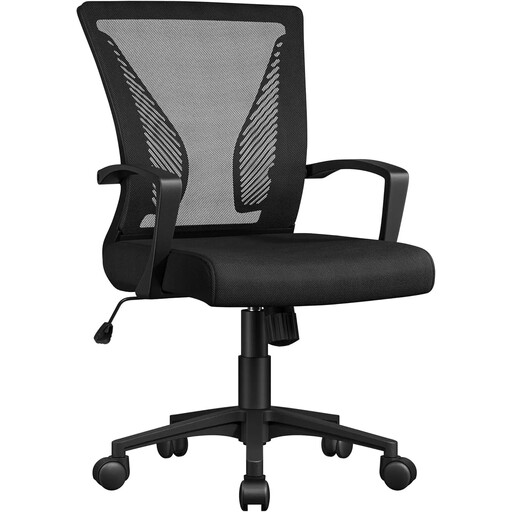
Why this product suits the profile: This height-adjustable mesh office chair is designed for home offices, studying and compact workspaces. According to the product information, the seat height can be adjusted from 35 to 45 cm.
The product description gives specific dimensions, materials and a maximum load of 136 kg, rather than making only general ergonomic claims.
Breathable nylon mesh, 360° swivel function, five castors and an adjustable seat.
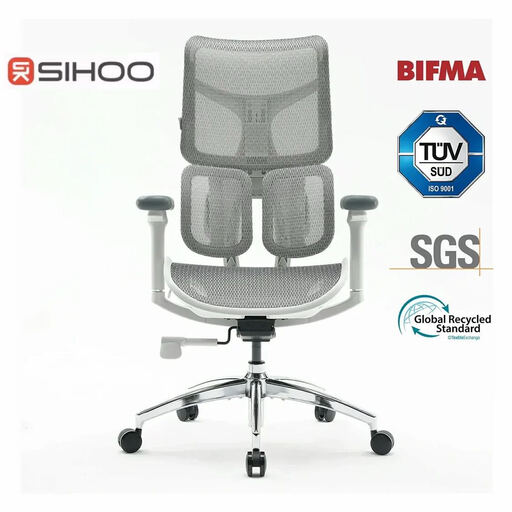
Why this product suits the profile: This model offers several independently adjustable elements for users who want to fine-tune their sitting position, arm support and back support to suit their own workspace.
The specifications include a 5 cm adjustable seat depth, an independent backrest and 4D armrests, rather than vaguely describing the chair as “ergonomic”.
Dual-Dynamic lumbar support, 4D armrests and adjustable seat depth; the product description mentions BIFMA and SGS specifications.
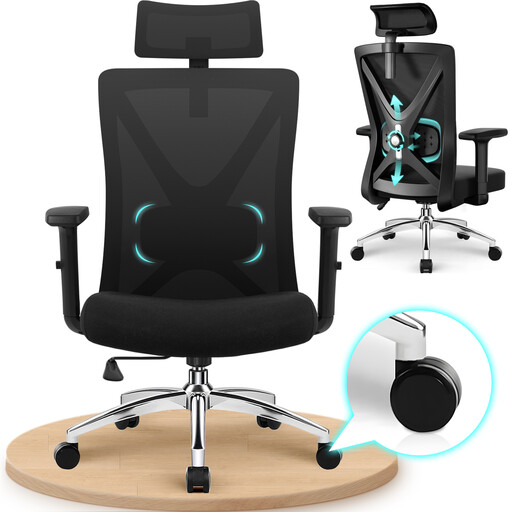
Why this product suits the profile: For long work, study or gaming sessions, this model offers several adjustment options and a backrest that reclines up to 135°, according to the product description.
Alongside the maximum load of 150 kg, specific values are provided for the lumbar support, armrests, seat height and headrest.
Up to 6 cm of lumbar support adjustment, 10 cm height-adjustable armrests, 11 cm of headrest adjustment and breathable nylon mesh.
We have put together a complete, regularly updated list of products that fully meet these strict selection criteria and the safety regulations applicable in the EU.
An ergonomic office chair can only make effective use of its features when it is adjusted correctly:
Even a comfortable office chair for prolonged sitting does not replace regular changes of position and movement breaks.
The seat height should be adjusted so that both feet rest securely on the floor and your knees do not point sharply upwards or downwards. The exact setting depends on your height, desk height and seat depth.
Its lifespan depends on the load, materials, assembly and care. Mesh, padding, castors and the gas lift may wear at different rates. Screws and moving parts should be checked regularly and tightened if necessary. The maximum load stated by the supplier must not be exceeded.
No. The rocking or tilt function is operated mechanically via the chair mechanism and does not require electricity. When choosing a chair, the adjustment range, locking function and ease of operation are therefore the most relevant factors.
A headrest is an optional feature. Whether it is useful depends on your height, sitting position, desk height and personal use. What matters most is that the seat height, backrest and armrests suit your workspace.