
Lieferung heute & morgen

Qualitätsgarantie

Willkommens-Angebote freischalten: KOSTENLOSE Lieferung | Bis zu 80 % RABATT | Kostenlose 30-Tage-JoyPlus-Testphase
App herunterladen
Long hours at a desk—whether in a home office, a corporate setting, or for gaming—are a daily reality for many people. An unsuitable chair can quickly lead to tension and discomfort. However, finding a suitable chair that supports your body without stretching your budget can be a challenge. This article serves as a guide, presenting a selection of models tailored to specific needs. The goal is to provide you with an objective basis for your decision.
Choosing the right chair depends on your individual requirements. Three key aspects can help you narrow down the options and find a model that fits you perfectly.
An ergonomic office chair is primarily defined by its adjustment capabilities. To promote a healthy posture, the chair should be adaptable to your body and your workspace. Look for the following features:
The longevity and comfort of a chair are largely determined by the materials used.
Although the basic ergonomic principles are the same, a classic ergonomic desk chair and a gaming chair often differ in design and additional features. Gaming chairs frequently have a higher backrest to support the head and shoulders, more pronounced side bolsters, and a more striking design. A chair for the home office is usually more understated and blends more discreetly into a home environment. The decision ultimately depends on your personal preferences and primary usage requirements.
Based on the criteria mentioned, we have compiled a selection of chairs that focus on different priorities.

Why it stands out: This model combines the aesthetics of a gaming chair with a focus on breathability. The open backrest with a special polyester mesh fabric ensures improved air circulation. The elastic 3D lumbar support system adapts to the movements of your back, providing dynamic support.
Pros:
Who it's for: Individuals who spend long hours at the computer—whether for gaming or work—and value good back ventilation and adaptive lumbar support.
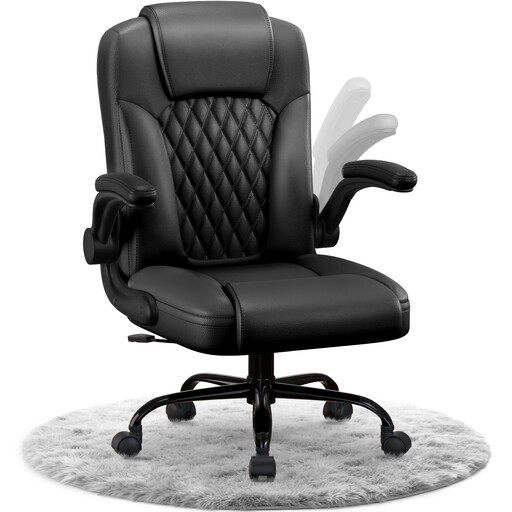
Why it stands out: This ergonomic desk chair features a classic design and practical functionality for the home office. The 90° flip-up armrests allow the chair to be pushed under the desk to save space. The seat is made of a three-layer composite material that combines memory foam, natural latex, and high-density foam.
Pros:
Who it's for: Home office users looking for a comfortable and sturdy executive chair that can be easily stored when not in use.
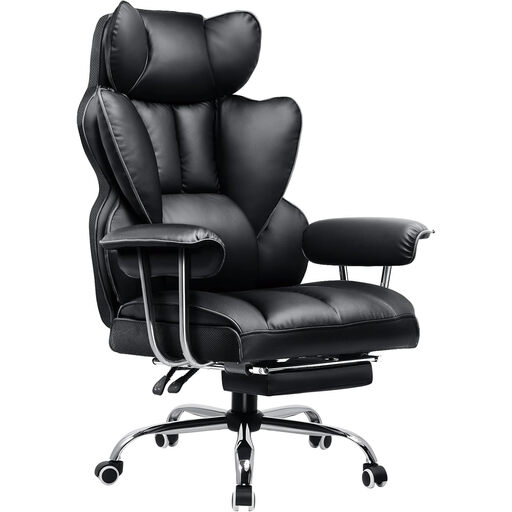
Why it stands out: This gaming chair focuses on versatile comfort that goes beyond just sitting. Its standout feature is the integrated, retractable footrest, which transforms the chair into a relaxation lounger. The high-density foam and PP cotton padding provide a soft seating experience.
Pros:
Who it's for: Gamers and home users looking for a multifunctional chair that not only supports them during work or play but also serves as a comfortable seat for relaxation.
This selection represents just a small sample of the available models. Every body and every work environment is different, which is why it's important to find the right solution for you. If you are looking for more models, especially in the leather chairs category, you will find a larger selection in our comprehensive collection.
Explore more leather chairs here
An office chair is considered ergonomic if it can be extensively adjusted to the user. This includes an adjustable seat height and depth, an adaptable backrest with lumbar support, and adjustable armrests. The goal is to support the body in a neutral, upright posture and to minimise strain.
First, adjust the seat height so that your feet are flat on the floor and your thighs are parallel to the ground. The backrest should support your lower back. The armrests should be positioned so that your shoulders are relaxed and your forearms rest on the desk at a right angle.
Yes, many modern gaming chairs offer extensive ergonomic features that are comparable to, or even more comprehensive than, those of office chairs. They often have a higher backrest and additional cushions for the neck and lumbar region. The decision depends on the desired aesthetic, specific features (e.g., a footrest), and the environment in which the chair will be used.