
Lieferung heute & morgen

Qualitätsgarantie
App herunterladen
Kategorien
Prolonged sitting at a desk places specific demands on your seating. An ergonomic office chair is engineered to support the body in a neutral posture, reduce spinal strain, and promote circulation. Selecting the right model depends on an analysis of adjustability options, materials, and mechanical features tailored to your individual body measurements and work habits. This guide highlights the technical criteria essential for making an informed decision.
A spine-friendly office chair is defined by its adaptability. The following parameters are crucial for the functionality and utility of a chair designed for extended periods of sitting.
The correct seat height is achieved when your feet are flat on the floor and your knees form an angle of approximately 90 degrees. A height-adjustable chair is therefore a fundamental requirement. The seat depth should be adjusted to leave a gap of two to three fingers' width between the back of your knees and the front edge of the seat. This prevents pressure on the blood vessels in your legs.
The backrest should support the natural S-curve of the spine. An integrated or adjustable lumbar support is of central importance here. It fills the curve in the lower back (lumbar spine) and provides stability. Models with height-adjustable lumbar support offer more precise customisation to individual anatomy.
A swivel chair with armrests relieves strain on the shoulder and neck muscles. Functionality is defined by the number of adjustment options (dimensions):
Flip-up armrests also offer the practical advantage of allowing the chair to be pushed under the desk to save space.
The choice of material affects both comfort and durability.
The mechanism determines how the seat and backrest react to movement. The synchronous mechanism is considered advanced, as the backrest and seat tilt in a coordinated ratio. This promotes "dynamic sitting." The base and gas lift must be stable and safely support the user's body weight. Certifications like BIFMA or SGS can serve as an indicator of tested safety and load capacity.
The following models have been selected based on their technical specifications and functional design for various user profiles in the home office chair segment.
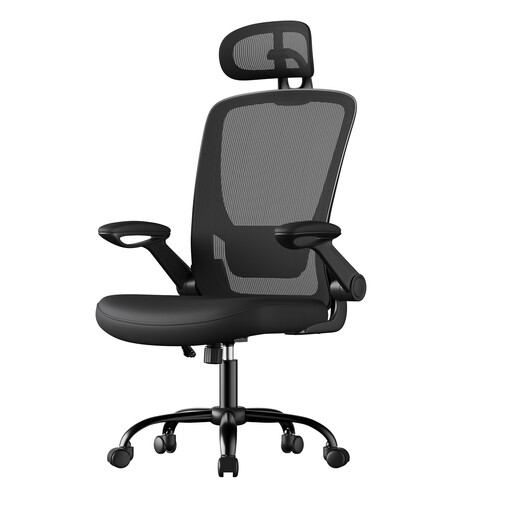
Why we recommend this product: This model combines essential ergonomic features into a well-rounded package. The S-curved backrest with adjustable lumbar and head support allows for fundamental customisation to your body's contour. The flip-up armrests are especially practical for flexible workspaces, making it easy to store the chair under a desk.
Pros:
Best for: Users looking for a functional and versatile desk chair for daily home office work who value fundamental ergonomic adjustments and a space-saving design.
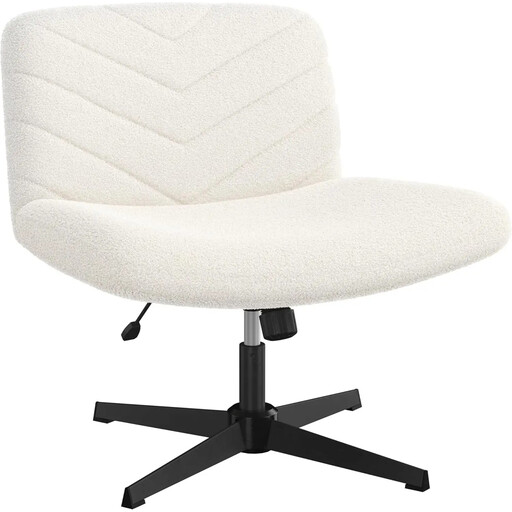
Why we recommend this product: The Yaheetech chair follows an alternative design concept. With its extra-wide seat (67.5 cm) and armless design, it allows for unconventional sitting positions, such as cross-legged. The stationary, X-shaped metal base without casters provides a solid footing, making it well-suited for living rooms or bedrooms where mobility is not a priority.
Pros:
Best for: Individuals who enjoy varying their sitting position during work, including sitting cross-legged. Also suitable for users seeking a stylish, stationary chair that blends visually into a living space.
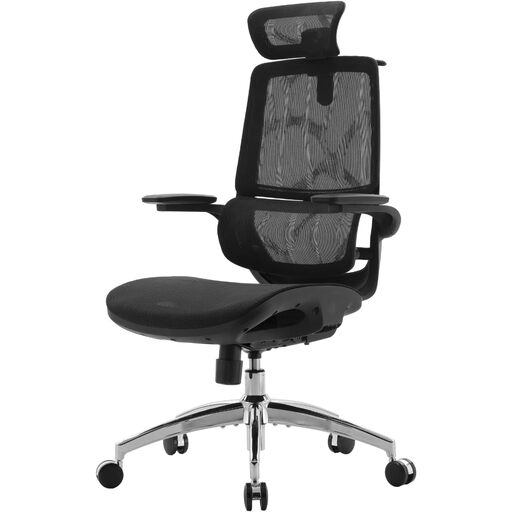
Why we recommend this product: The M59AS model from SIHOO is distinguished by its dual-panel back design with adaptive lumbar support. This design dynamically adapts to the user's movements, providing continuous lower back support. The 3D-adjustable armrests and a high weight capacity of up to 150 kg, confirmed by BIFMA and SGS certifications, indicate a robust and highly advanced construction.
Pros:
Best for: Users with high demands for dynamic back support and precise adjustability. Suitable for individuals seeking a technically sophisticated chair for intensive and long workdays.
If the featured models don't perfectly match your requirements, a broader selection of seating solutions may offer the right alternative. You can find an overview of more models in our Furniture & Seating Chairs category.
1. How do you correctly adjust an ergonomic office chair? The correct adjustment process follows these steps:
2. What is the difference between a mesh chair and an upholstered chair? A mesh chair offers high breathability, which is particularly advantageous in warmer environments or for people who tend to sweat easily. An upholstered chair is often perceived as softer and can provide excellent pressure distribution with high-quality foam. The choice is a trade-off between climate comfort and cushioning preference.
3. How important is lumbar support in an office chair? Lumbar support is a critical feature for a chair designed for extended use. It supports the natural curve of the lumbar spine and prevents an unhealthy slouched posture. Without this support, the lower back tends to flatten, which can lead to increased strain on the spinal discs and cause pain.