
Lieferung heute & morgen

Qualitätsgarantie

Willkommens-Angebote freischalten: KOSTENLOSE Lieferung | Bis zu 80 % RABATT | Kostenlose 30-Tage-JoyPlus-Testphase
App herunterladen
An ergonomic office chair should provide an adjustable sitting position in your home office, workplace or at your gaming desk. However, many models look similar at first glance, while important differences only become apparent during everyday use. An eye-catching backrest or claim about an “ergonomic” design cannot replace the right adjustment options.
A fixed contour in the lower back does not automatically suit every body size. What matters is whether the lumbar support can be adjusted in height or depth. Otherwise, the support may be too high, too low or too pronounced. If you are looking for an office chair with adjustable lumbar support, check the specific adjustment ranges in the product description.
Fixed armrests can prevent the chair from being pushed fully under the desk. This is particularly impractical in small home offices and when you regularly change your sitting position. Flip-up or space-saving armrests provide greater flexibility. Even so, the armrests should still be at a suitable height when you work and should not constantly knock against the edge of the desk.
A rocking or recline function is not automatically suitable for every use. With an office chair with rocking function, it should be clear whether only the backrest or the entire seat moves backwards, and whether the resistance can be adjusted. The seat height must also suit your body size and desk. An height-adjustable office chair is therefore a basic requirement, not merely an additional comfort feature.
When seated, your feet should ideally be fully supported on the floor, while your thighs and lower legs remain in a relaxed position. When choosing a chair, it is therefore important to consider more than just the maximum load capacity:
For example, the GTIMEX model is specified with a seat height adjustment range of 43 to 53 cm and is suitable for users between 145 and 185 cm tall. These figures are more useful than the general description “ergonomic”.
An office chair for long working hours should have a backrest of sufficient height and a clear adjustment system. The models presented here specify adjustable lumbar support in their product details. Buyers should also check whether the support can be adjusted separately or only moves together with the entire backrest.
An ergonomic swivel chair with 360-degree rotation makes it easier to switch between your monitor, documents and storage areas. The castors should be suitable for your flooring. On hard floors, suitable castors or a floor protection mat may be useful; on carpeted floors, you should expect different rolling performance.
Thick padding can affect your initial impression of the chair, but on its own it says little about its suitability for long-term use. Pay attention to the stated materials and the seat width. A breathable mesh office chair can support air circulation around your back, while a padded seat provides a different feel.
A retractable footrest can be useful for breaks or reclined sitting positions. However, it takes up additional space and should not collide with the underside of the desk when retracted. When buying an office chair with a footrest, it is therefore important to check the dimensions when the footrest is fully extended.
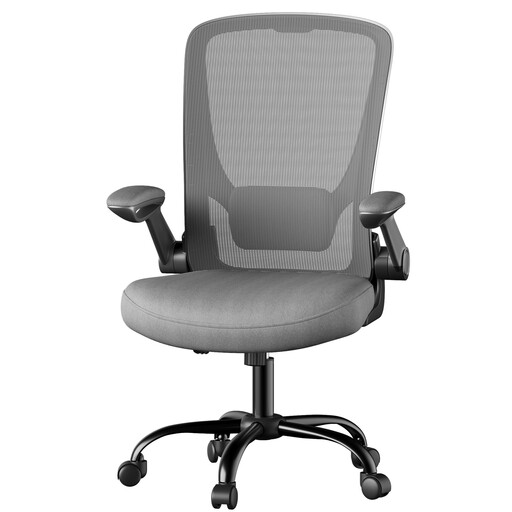
Why this product suits this profile: This grey office chair combines adjustable seat height and lumbar support with folding armrests. That makes it a practical choice for a compact home office with limited floor space.
The product details specify adjustable lumbar support and folding armrests rather than a completely fixed seat design.
Specified dimensions: 66 × 60 × 99–107 cm; maximum static load capacity according to the product description: 120 kg; mesh upholstery and rocking function.
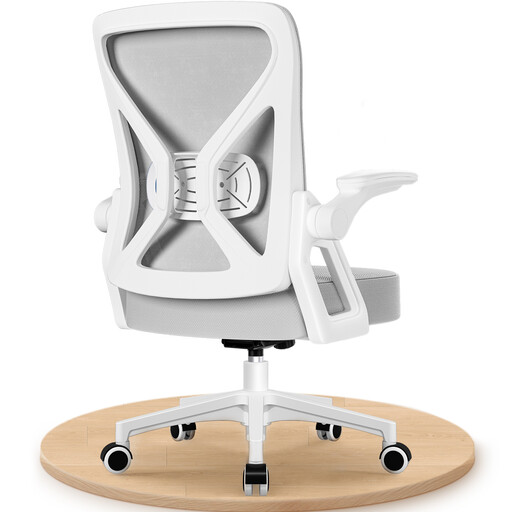
Why this product suits this profile: This model offers several clearly specified adjustments for users who want to tailor the seat height, backrest position and armrests to their workstation.
The product description specifies exact seat height and recline angle measurements. This makes it easier to compare the function with your own workstation before buying.
Seat height 43–53 cm, backrest reclines up to 125°, flip-up armrests and specified load capacity of up to 150 kg.
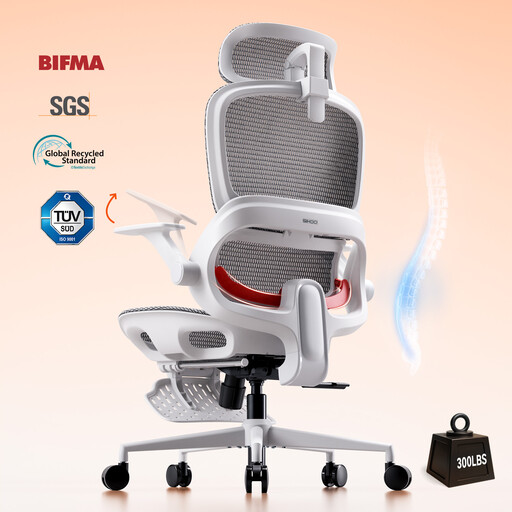
Why this product suits this profile: A footrest and high backrest are useful for users who want to switch between focused work and reclined breaks.
According to the product name, the design combines adaptive lumbar support, folding armrests and a footrest. Before buying, check the dimensions when extended and the specific adjustment options.
High backrest, adaptive lumbar support, folding armrests and integrated footrest according to the product details.
We have put together a complete, regularly updated list of products that fully meet these strict selection criteria and the safety regulations applicable in the EU.
Start with the seat height: your feet should be firmly supported on the floor. Then adjust the backrest so that it supports your lower back. The armrests should not push your shoulders upwards. The desk height must suit your sitting position; often, it is not the chair alone but the combination of chair, desk and screen that makes the crucial difference.
Its lifespan depends on how often it is used, the user’s body weight, the type of flooring, the mechanism and how well it is maintained. Before buying, check the stated maximum load capacity, frame, castors and availability of spare parts. Tighten the screws after assembly in accordance with the instructions, and regularly inspect the castors and tilt mechanism.
The price varies depending on the padding, adjustment range, footrest, armrests and mechanism. Do not compare the purchase price alone; also consider delivery, assembly effort, possible floor protection mats and suitability for your height. A clear product description with specific dimensions is more important for your buying decision than vague claims about comfort.