
Lieferung heute & morgen

Qualitätsgarantie

Willkommens-Angebote freischalten: KOSTENLOSE Lieferung | Bis zu 80 % RABATT | Kostenlose 30-Tage-JoyPlus-Testphase
App herunterladen
An ergonomic office chair should fit comfortably at your desk, whether you work from home, in a study, or in a bedroom or student room. Many models look similar in product photos, but can differ considerably in seat height, back support, castors and the space they take up. If you focus only on cushioning or modern design, you could overlook important details.
The term doesn’t describe a single, standard product feature. An ergonomic desk chair might have a curved backrest, lumbar support or an adjustable seat height. What matters, though, is whether these features can be adjusted to suit your height and desk.
A fixed backrest without adjustable support may suit one person well but be less suitable for someone else. So check the specific product details rather than relying on general marketing claims.
A thick seat may feel comfortable at first. But if the seat is too deep, you may not be able to place both feet flat on the floor. If the seat is too high, it can also put pressure on the underside of your thighs.
Check the adjustable seat height, seat depth and distance between the armrests and desk. A comfortable office chair should offer more than soft cushioning: it should also help you maintain a stable, suitable sitting position.
An office chair with castors makes it easier to move around your workspace, but it needs a suitable, level surface. A floor protection mat may be useful on delicate flooring. If you have carpet, laminate or parquet, also check that the castors roll smoothly and don’t leave visible marks.
Armrests can help support your sitting position, but they take up extra space. Office chairs with folding armrests can be tucked under the desk when not in use. This is particularly handy in smaller rooms or when your desk is in your bedroom.
You should be able to adjust a height-adjustable office chair so that both feet rest firmly on the floor and your knees are bent at roughly a right angle. The seat height needs to suit both your desk and your height. Measurements such as “99–107 cm overall height” don’t tell you the seat height. Check whether the retailer lists the seat height adjustment separately.
A curved backrest can be designed to support your back. If you’re looking at an office chair with lumbar support, check whether the support is built in or can be adjusted for height. Adjustable lumbar support gives you more scope to customise the chair. However, it’s no substitute for changing position regularly or setting your desk to the right height.
A breathable mesh office chair can improve airflow around the backrest. However, mesh isn’t automatically more hard-wearing than upholstered fabric. Check the material details, weight limit and construction of the supporting parts.
The maximum static weight capacity needs to be suitable for the person using the chair. A model with a stated weight limit of 120 kg shouldn’t be used by anyone heavier. Width, depth and height matter too, particularly if you have a small home office.
A swivel chair with a 360-degree rotation makes it easier to move between your desk, shelves and storage. A rocking or tilt function can let you change position briefly. Check whether the mechanism can be locked and whether the assembly instructions include clear safety guidance.
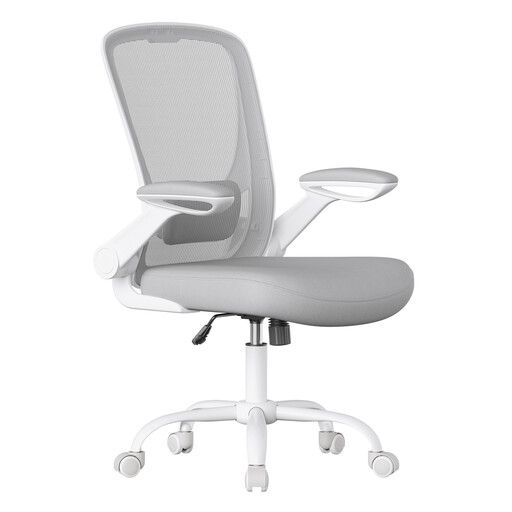
Why this product suits this profile: This chair combines an adjustable seat height with adjustable lumbar support and folding armrests. Its listed dimensions are 66 × 60 × 99–107 cm, and the product details state a maximum static weight capacity of 120 kg.
The key adjustment options are clearly specified. The folding armrests save space when the chair is tucked under the desk.
Mesh backrest, castors, rocking function, adjustable seat height and lumbar support; the grey finish suits a range of workspaces.

Why this product suits this profile: This model offers a stated seat height adjustment range of 46–54 cm, a tilt range of 90–105 degrees, a wide seat, and a headrest and lumbar support.
The relevant adjustment ranges and 120 kg weight capacity are specified. This makes it easier to compare the model with your height and desk using clear, practical details.
Mesh fabric, 8 cm foam cushioning, headrest, folding armrests and a stated tilt function.
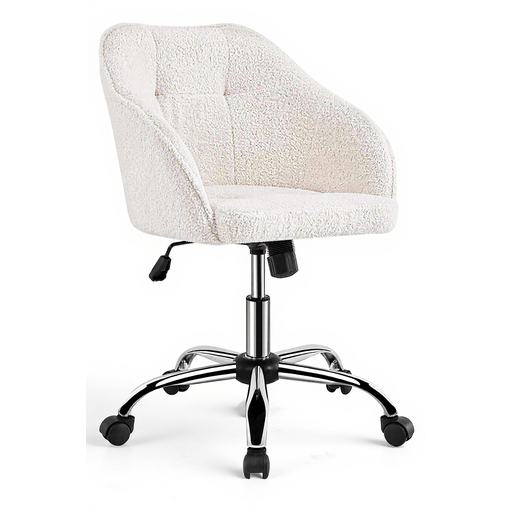
Why this product suits this profile: This height-adjustable swivel chair is designed for home offices, bedrooms, dressing tables and study areas. Its maximum weight capacity is listed as 136 kg.
This pick considers more than just looks: seat height, 360-degree swivel and castors are all listed as specific features.
Padded velvet upholstery, metal frame, 360-degree swivel and adjustable seat height; suitable for a range of living and work spaces.
We’ve put together a complete, regularly updated list of products that meet these strict selection criteria and fully comply with the safety regulations in force in the EU.
First, adjust the seat height so that both feet rest flat on the floor. Your knees should be bent at roughly a right angle. Position the backrest so that your back is supported, and align any adjustable lumbar support with your lower back. The armrests shouldn’t lift your shoulders and should ideally be level with the desktop.
Its lifespan depends on how many hours it’s used each day, the user’s weight, the materials, how it’s assembled and how well it’s cared for. Regularly check the screws, castors, gas lift and armrests. Never exceed the stated maximum weight capacity, and only use the chair on a level surface.
A traditional swivel chair with castors doesn’t need electricity during normal use. Energy is only used by models with electric adjustments or heating. For a mechanically height-adjustable office chair, regular maintenance is generally limited to cleaning and checking the moving parts.