
Lieferung heute & morgen

Qualitätsgarantie

Willkommens-Angebote freischalten: KOSTENLOSE Lieferung | Bis zu 80 % RABATT | Kostenlose 30-Tage-JoyPlus-Testphase
App herunterladen
An ergonomic office chair should help you find a suitable sitting position, whether you’re working from home, at the office or gaming. However, a label that says “ergonomic” isn’t enough to guide your purchase. What really matters is the chair’s adjustment options, dimensions and materials.
Many disappointing purchases come down to three common pitfalls:
You should be able to adjust a height-adjustable office chair so that both feet rest firmly on the floor. Your knees should be roughly level with your hips or slightly lower. The seat should also be wide and deep enough, without its front edge pressing into the backs of your knees.
Check the following before you buy:
According to the product details, the GTIMEX Office Chair has a seat height range of 43 bis 53 cm. The manufacturer says it’s suitable for people between 145 bis 185 cm tall. These specific measurements are more useful than a general description such as “ergonomic desk chair”.
A backrest should provide adequate support and help you sit upright. For an office chair with lumbar support, check whether the support is genuinely adjustable or simply built into the backrest.
Depending on the model, a tilt mechanism lets you lean back, moving the backrest and seat together. Check:
According to the product description, the GTIMEX Ergonomic Office Chair reclines to 125 Grad and has an adjustable seat height and lumbar support. The GTIMEX Gaming Chair has a backrest angle range of 90 bis 170 Grad. These figures describe the chair’s design, but they don’t guarantee that it will provide the right sitting position for everyone.
An office chair with breathable mesh may be a good choice for warm rooms or longer work sessions, as the mesh helps air circulate. A padded seat may suit you better if you prefer a softer surface. PU leather is usually easy to wipe clean, but it can feel different from mesh or fabric.
Also check:
An office chair rated for up to 150 kg shouldn’t be used above that limit on a regular basis. The GTIMEX Gaming Chair is rated for 150 kg, while the Yaheetech model is rated for 136 kg. These figures are maximum weight limits, not recommendations for active sitting, standing up on the chair or standing on the footrest.
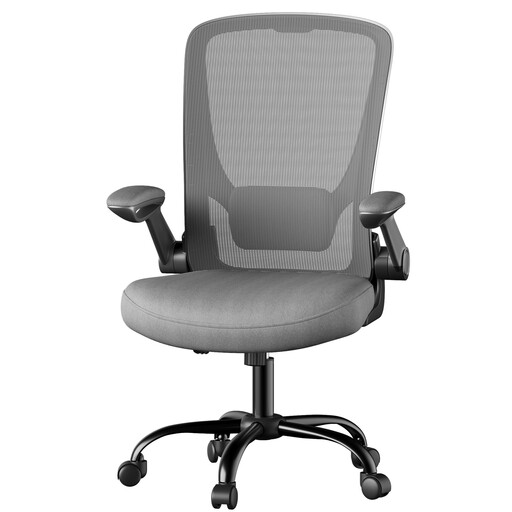
Why this product suits this profile: This swivel chair for working from home combines essential adjustment options with foldable armrests. It’s a good fit for compact workspaces, study areas or occasional use.
The product details specifically list an adjustable seat height, 360-degree swivel and foldable armrests, rather than relying on vague promises of comfort.
Breathable mesh backrest, padded seat and space-saving armrests.
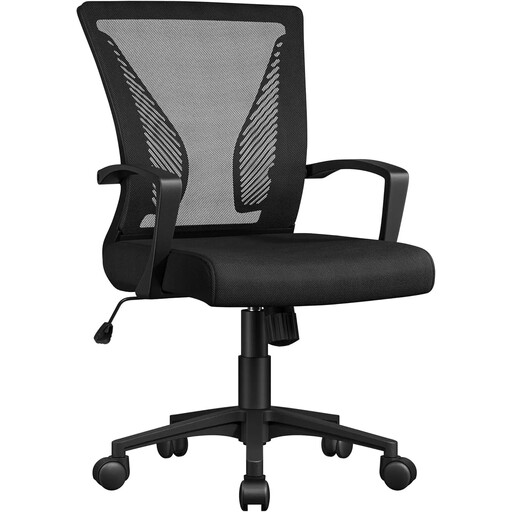
Why this product suits this profile: Its specific seat dimensions, mesh construction and stated weight capacity make it easier to choose for everyday work, studying or regular computer use.
The product details state the seat dimensions, a seat height range of 35 bis 45 cm and a maximum weight capacity of 136 kg, so you can check them for yourself.
Breathable nylon mesh, armrests, 360-degree swivel and five castors.
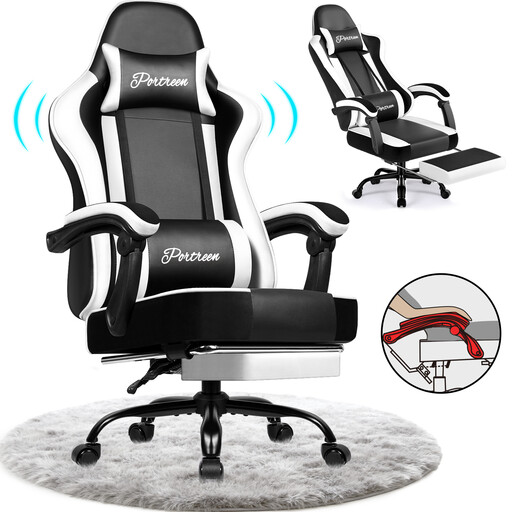
Why this product suits this profile: This gaming chair comes with a headrest, lumbar support and extendable footrest. It’s designed for changing between sitting and resting positions at your computer.
The product description gives specific figures: 10 cm of seat height adjustment, a backrest angle of 90 bis 170 Grad, a maximum weight capacity of 150 kg and a metal footrest frame.
Extendable footrest, PU leather upholstery, high-density foam and, according to the product details, BIFMA and SGS certification.
We’ve put together a complete, regularly updated list of products that meet these strict selection criteria and the safety regulations in force in the EU.
Start with the seat height: both feet should rest flat on the floor. Then adjust the backrest so that your back is supported. The armrests shouldn’t push your shoulders upwards. If the lumbar support is adjustable, position it to follow the natural curve of your lower back. Sit at your desk for a few minutes, then check that you can reach your keyboard and monitor without leaning forwards for long periods.
Lifespan depends on how often you use the chair, your body weight, its mechanism and materials, and how well you look after it. Check the castors, gas lift, armrests and screw connections regularly. Don’t exceed the stated maximum weight capacity, and use the footrest only to rest your legs on. If you notice visible damage to the mechanism or base, stop using the chair until you’ve identified the cause.
A footrest can be useful during breaks or when you’re reclining. However, for normal desk work, it’s no substitute for the right seat height or enough space at your desk. Check that the footrest extends securely, provides enough room and is intended only as a leg rest. If you want to switch regularly between working and reclining, a chair with a tilt mechanism may be a better choice than a fixed chair.