
Lieferung heute & morgen

Qualitätsgarantie

Willkommens-Angebote freischalten: KOSTENLOSE Lieferung | Bis zu 80 % RABATT | Kostenlose 30-Tage-JoyPlus-Testphase
App herunterladen
Anyone who spends many hours at a desk needs more than a padded seat and an attractive design. An ergonomic office chair should suit your height, workspace and daily use. Models are most commonly compared by lumbar support, headrest, armrests, mesh material and reclining function.
However, some marketing claims can lead to the wrong purchase. The following criteria will help you assess technical promises objectively and choose a suitable office chair.
The term ergonomic office chair is not, on its own, a sufficient indicator of quality. What matters is which components can actually be adjusted. An office chair with lumbar support can be useful if the support can be adjusted in height or depth. By contrast, a fixed, integrated contour will not automatically suit every body shape.
Check the following before buying:
A reclining office chair can be useful for breaks or reading. For concentrated work, however, a stable, upright position remains important. A backrest that reclines to 140 or 170 degrees is therefore not automatically better suited. Check whether the recline range can be used in fixed stages or continuously, and whether the mechanism locks securely in the desired position.
An breathable mesh office chair can improve air circulation around your back. However, mesh materials differ in terms of tension, elasticity and feel. A mesh back also does not replace adequate lumbar support. With a padded seat, you should consider the material thickness and seat width rather than focusing solely on appearance.
Your feet should rest firmly on the floor when seated. As a practical guide, your thighs and lower legs should form approximately a right angle, without the front edge of the seat pressing uncomfortably into the backs of your knees. It is therefore worth comparing the stated seat-height range with the height of your desk.
An height-adjustable office chair is particularly useful if several people use it or the desk height cannot be changed. Also check the seat width, seat depth and backrest dimensions.
An adjustable lumbar support should be positionable so that it gently supports your lower back without creating pressure points. With a swivel chair with backrest, the range of movement and reclining mechanism are also important. A backrest that only moves slightly is more suitable for upright working, while a wider range can provide additional resting positions.
A desk chair with armrests should not push your shoulders upwards. Ideally, the armrests should allow your forearms to rest comfortably while keeping the keyboard close to your body. Folding armrests save space when you want to push the chair under the desk.
An office chair with headrest can provide additional support when reclining. It is not essential for sitting upright and typing. An integrated footrest is particularly useful for taking breaks, reading or gaming. It should extend smoothly and remain stable without restricting your freedom of movement under the desk.
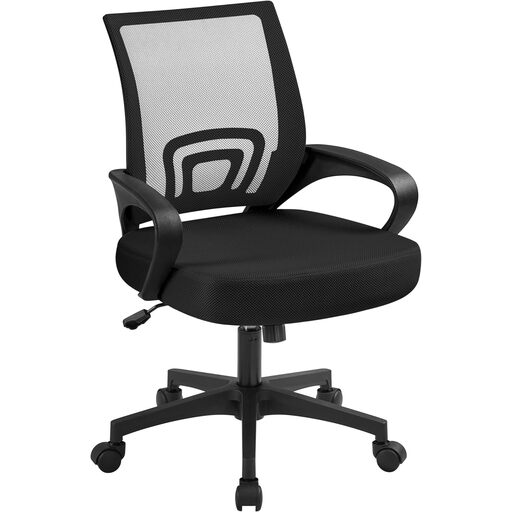
Why this product suits the profile: This chair combines a breathable backrest with adjustable seat height, making it suitable for a home office, study room or dedicated workstation.
The product specifications state precise dimensions, a seat-height range of 35 to 45 cm, a rocking function and a maximum load capacity of 136 kg.
Mesh back, padded seat, height-adjustable seating position and, according to the product specifications, SGS and BIFMA certifications.
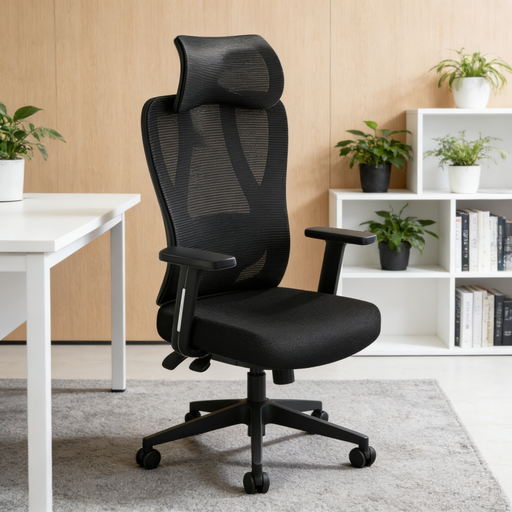
Why this product suits the profile: This model is aimed at people who need plenty of adjustment options for office work and gaming, and who value soft, breathable cushioning.
Rather than simply advertising the term “ergonomic”, this model specifies a 4D lumbar support, 40 mm of backrest height adjustment and a recline range of 105 to 140 degrees.
Dual-layer mesh, 10.5 cm seat cushion, adjustable headrest and 4D lumbar support according to the product description.
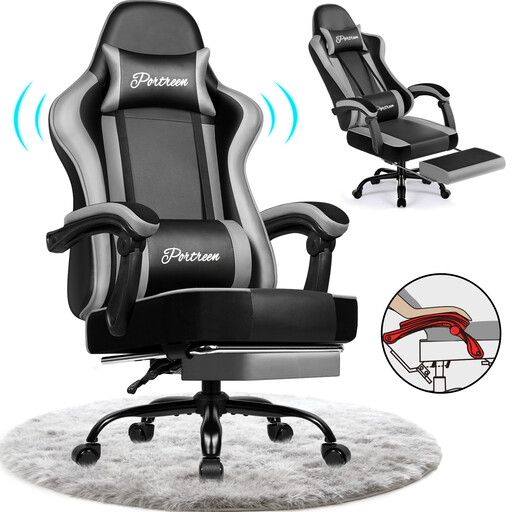
Why this product suits the profile: This model is ideal for long gaming sessions, changing rest positions and users looking for an office chair with a footrest and headrest.
The specifications state a recline range of 90 to 170 degrees, 10 cm of height adjustment and a load capacity of 150 kg. This makes it possible to compare key purchasing criteria in advance.
Retractable footrest, padded headrest and lumbar support, plus BIFMA and SGS certification according to the product specifications.
We have compiled a complete, regularly updated list of products that fully meet these strict selection criteria and the safety regulations applicable in the EU.
After assembly, check all screws, castors and connections. The seat should not wobble, and the castors must roll safely on the intended floor surface. A floor-protection mat can be useful on delicate parquet or laminate flooring.
Then adjust the chair in the following order:
Also pay attention to the stated load limit. This generally refers to body weight and should not be exceeded. A chair is intended for sitting only and is not suitable for use as a step or ladder.
Your feet should rest completely on the floor, while your thighs and lower legs form approximately a right angle. The seat height must also be compatible with the desk height. If the armrests obstruct the edge of the desk, folding or low-adjustment models may be more practical.
Its lifespan depends on the construction, load, duration of use and care. Regularly check the screws, gas lift, castors and reclining mechanism. If the chair is used every day for many hours, clear information about load capacity, materials and replacement parts is more useful than general promises about durability.
An ergonomic gaming chair can be used in a home office if the seat height, armrests, back support and desk position are suitable. However, models with substantial padding retain more heat than a mesh chair. For a combined workspace, an office chair for home office and gaming with an adjustable backrest and suitable seat width is an obvious option.