
Lieferung heute & morgen

Qualitätsgarantie

Willkommens-Angebote freischalten: KOSTENLOSE Lieferung | Bis zu 80 % RABATT | Kostenlose 30-Tage-JoyPlus-Testphase
App herunterladen
An ergonomic office chair should support you for many hours at your desk, without important features existing only on paper. When buying, many people initially focus on the design, a large backrest or particularly soft padding. However, the crucial factors are suitable dimensions, adjustable elements and clear information about the construction.
The term office chair with lumbar support alone says little about practical use. If the support cannot be adjusted in height or depth, it may not suit your height and sitting position. A fixed contour can also place uncomfortable pressure on the lower back.
Make sure the manufacturer provides specific adjustment ranges. Details such as ‘adjustable by 6 cm’ are more meaningful than a general claim about an ergonomic shape.
A height-adjustable office chair is only useful if the seat height, seat depth and backrest suit your height. An office chair with a headrest or armrests can also be unsuitable if the armrests are too high or the headrest cannot be adjusted sufficiently.
Check the following before buying:
Thick padding may feel comfortable at first, but during long periods of sitting it may provide too little support or lose its shape quickly. Useful product information includes the seat cushion’s construction, the materials used and the weight limit.
With an office chair for long working hours, you should also look for a breathable backrest, a sturdy base and easy-to-reach adjustment mechanisms. A gaming office chair is not automatically suitable for every working situation: generous padding and a wide recline angle cannot replace a suitable sitting position.
Your feet should rest completely flat on the floor when sitting, while your knees should form roughly a right angle. The seat height must therefore suit both your desk and your height. Some models specify precise ranges, such as a seat height of 43 to 53 cm or suitability for people between 145 and 185 cm tall. Such details make it easier to choose the right model.
A height-adjustable desk chair is particularly practical if several people use it or if the working height of the desk varies. With a height-adjustable desk, the desk and seat heights can be matched to suit each individual.
An S-shaped backrest can follow the back’s natural contours. However, it is important that it is not merely shaped, but adjustable wherever possible. Product specifications may include adjustable lumbar supports with a 6 cm range or dynamic support.
Your choice of an office chair with lumbar support should therefore not be based solely on the word ‘ergonomic’. The key factors are the specific adjustment options, the stability of the backrest and the distance between the seat and the back support.
Adjustable armrests can help support your forearms at the desk. Depending on the model, they may be adjusted in height, sideways or by folding them up. An office chair with armrests is particularly practical for everyday use if the armrests fit beneath the desk or can be folded away when required.
With an office chair with headrest, consider both the height and recline angle. Some models offer, for example, 11 cm of height adjustment and rotation or reclining of up to 120°. The headrest should not press constantly against your head, but should be adjustable to suit your sitting posture.
A recline function from 120° to 140° can allow you to switch between an upright working position and a laid-back break. Check whether the backrest can be locked in a working position and whether the resistance can be adjusted.
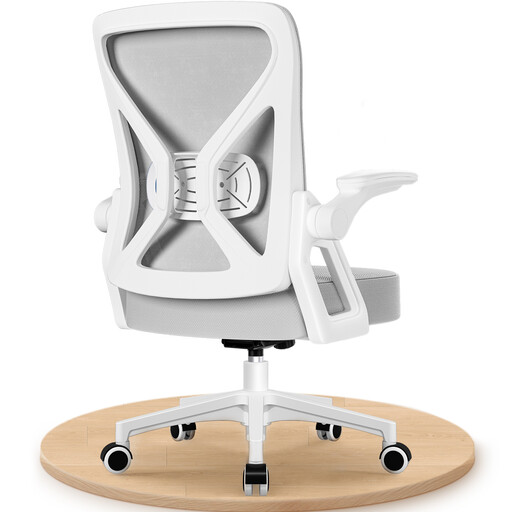
Why this product suits this profile: This model combines a seat height adjustable from 43 to 53 cm with adjustable lumbar support and a backrest that reclines to 125°.
The product details specify exact dimensions, a weight capacity of up to 150 kg and an adjustable seat, rather than making only general comfort claims.
Breathable mesh fabric, padded armrests and 360° casters are listed in the product details.
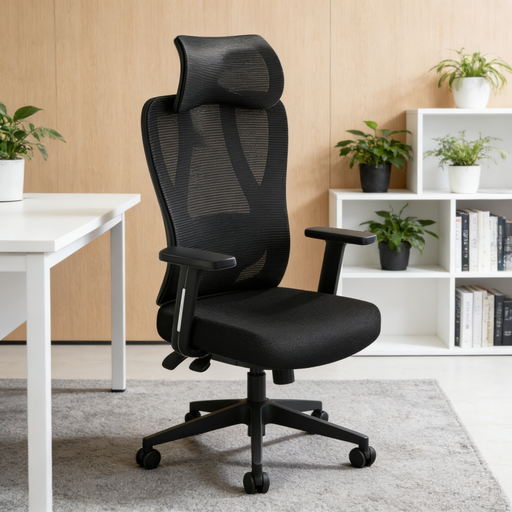
Why this product suits this profile: The combination of 4D lumbar support, an adjustable headrest, 40 mm of backrest adjustment and a recline range of 105° to 140° is designed for people who need plenty of adjustment options.
Multiple adjustment points make it easier to adapt the chair to different sitting positions, rather than providing just one fixed position.
Two-layer mesh, a 10.5 cm thick seat cushion and a wide range of uses for work and gaming.
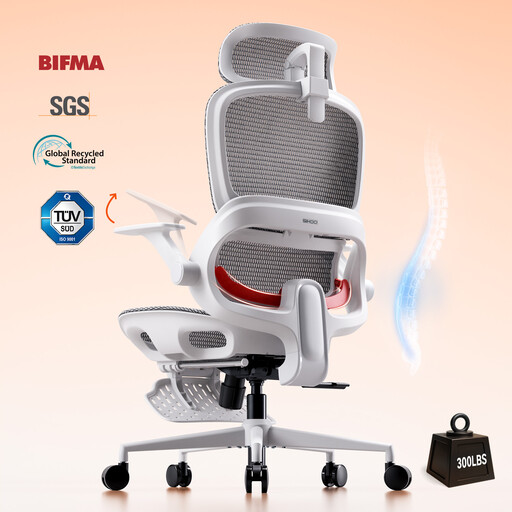
Why this product suits this profile: This office chair with footrest, high backrest, adaptive lumbar support and fold-up armrests is suitable for home working, breaks and long periods of sitting.
The footrest is clearly listed as a specific feature, while the armrests can be folded up when the chair needs to be stored compactly.
Adaptive lumbar support, a wide headrest and an integrated footrest for changing usage situations.
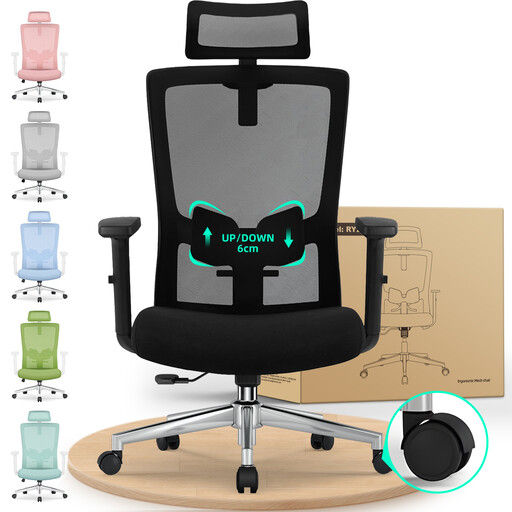
Why this product suits this profile: This model offers an adjustable headrest, 6 cm of adjustable lumbar support, armrests and a rocking function of up to 135°.
The product description specifies exact adjustment ranges, a 90° working angle and a robust construction with BIFMA and SGS certifications.
Breathable mesh, a 50 × 53 cm seat and a stated weight capacity of up to 150 kg.
We have put together a complete, regularly updated list of products that fully meet these strict selection criteria and the safety regulations applicable in the EU.
For the office chair for home working scenario, room size and noise levels are just as important as ergonomics. Fold-up armrests can be useful in smaller workspaces. Quiet casters and a suitable floor mat help protect delicate flooring.
Students often need a height-adjustable desk chair that can adapt to different desks. Gamers should also check whether the seat width, backrest recline and padding are suitable for long gaming sessions. Whatever the use, the maximum weight capacity must not be exceeded, and all screws and adjustment mechanisms should be checked regularly.
Start with the seat height: both feet should rest completely flat on the floor. Then adjust the armrests so that your forearms can rest comfortably. The lumbar support should touch your lower back without creating pressure points. Finally, adjust the backrest, recline resistance and headrest.
Its lifespan depends on how frequently it is used, the user’s weight, material quality, assembly and care. Specific details such as a maximum weight capacity, tested gas lift or warranty period provide better guidance than general claims about durability. Check the casters, screws, seat mechanism and gas lift regularly.
A footrest can be practical for breaks or reclined sitting positions. However, it cannot replace the correct seat height and should not encourage poor posture over extended periods. Before buying, check whether it folds out securely and can be stored compactly after use.