
Lieferung heute & morgen

Qualitätsgarantie

Willkommens-Angebote freischalten: KOSTENLOSE Lieferung | Bis zu 80 % RABATT | Kostenlose 30-Tage-JoyPlus-Testphase
App herunterladen
An ergonomic office chair with footrest should offer more than just a pull-out platform beneath the seat. For home workers, office employees, students and gamers, the most important features include a suitable seat height, stable adjustment mechanisms and a backrest that suits your build.
However, many product descriptions sound very similar. Terms such as “ergonomic”, “comfortable” or “durable” have limited meaning without specific details. The following points will help you avoid common buying mistakes and choose an ergonomic office chair based on clear, understandable criteria.
A footrest can be practical during breaks or when sitting in a reclined position. However, it cannot replace the correct seat height or a properly adjusted backrest. Check whether the platform can actually be pulled out, is securely attached and is suitable for your leg length. If the footrest is too short or narrow, your legs may not be fully supported.
A desk chair with a footrest should at least allow you to adjust the seat height, backrest angle and, ideally, the armrests. An office chair with headrest or lumbar support is only useful if these elements can be adjusted to your sitting position. For example, a fixed headrest may sit too high or too low.
The stated load capacity is an important technical specification, but it is not the only one. Seat width, overall height, base and the amount of space required at your desk should also be taken into account. If you are looking for an office chair up to 150 kg, check the manufacturer’s stated maximum load directly on the product page rather than relying solely on the term “Big and Tall”.
A height-adjustable office chair should be capable of being set so that both feet rest on the floor or on a footrest. Your knees should not remain sharply bent for long periods. For changing tasks, several backrest tilt positions and a lockable rocking or reclining function are useful.
Also look for:
A breathable mesh backrest can improve air circulation and is particularly useful in warm workspaces or during long periods of sitting. Upholstery made from faux leather or PU leather, on the other hand, is generally easier to wipe clean. However, depending on the room temperature, it may feel warmer.
A high backrest provides more support for your back and shoulders. What matters is that the backrest is not only high, but also wide enough and adjustable. With a reclining executive chair, you should also check whether the footrest remains stable when the chair is reclined.
Manufacturers may specify materials such as metal, aluminium alloy, plastic, mesh or high-density foam. These details can help you assess a product, but they do not replace checking the construction itself. In particular, check:
Certifications should be treated as specific information provided by the manufacturer. A stated test or inspection does not mean that every user will experience the same sitting position or level of comfort.
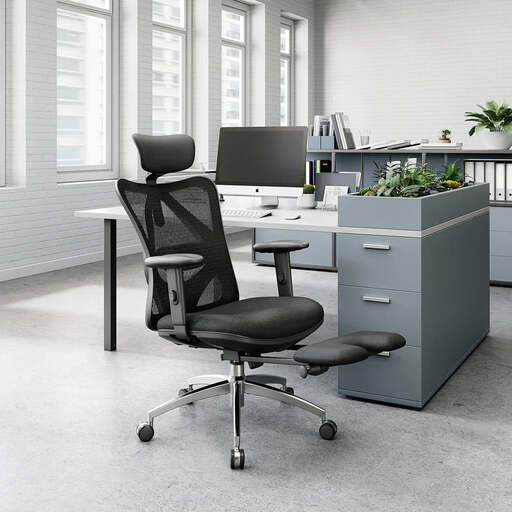
Why this product suits the profile: This chair combines a breathable mesh backrest with several adjustment options, making it suitable for working from home, studying and general desk work.
The product details specify an adjustable back support, headrest, seat height, tilt, armrests and footrest. The maximum load is stated as 150 kg.
Mesh backrest, W-shaped seat, aluminium base and stated load capacity of up to 150 kg.
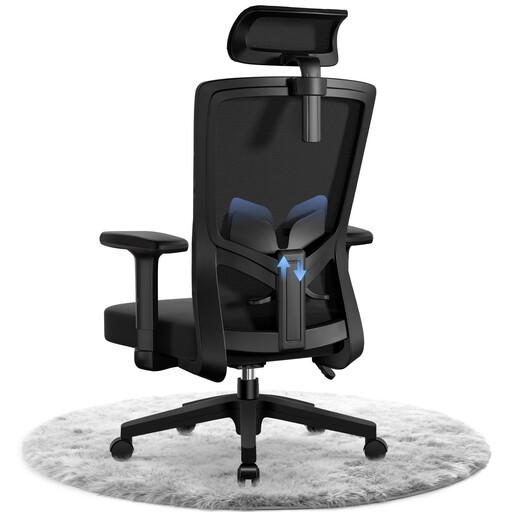
Why this product suits the profile: The wide range of adjustment options appeals to users who want to set up their office chair ergonomically for different working positions.
The specifications list precise adjustment ranges: 10 cm for the seat height, 11 cm for the headrest, 6 cm for the lumbar support and 10 cm for the armrests.
Nylon mesh backrest, height-adjustable elements, rocking function and stated load capacity of up to 150 kg.
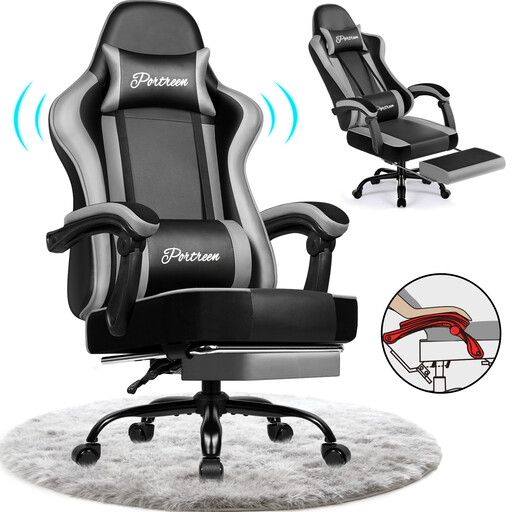
Why this product suits the profile: For gaming, reading and longer breaks, this chair offers a pull-out footrest and a large backrest with an extensive recline range.
The product description specifies a backrest angle of 90 to 170 degrees, 10 cm of height adjustment and a footrest with a metal frame.
Headrest, lumbar support, padded upholstery, pull-out footrest and stated load capacity of up to 150 kg.
Even the best range of features cannot replace regular changes of position. Standing up, taking short walks and varying your sitting posture can ease your working routine, regardless of the chair model.
Yes, provided that the seat height, backrest, armrests and footrest are suitable for the user and the desk. The footrest is primarily designed for breaks and reclined positions. For focused screen work, your sitting position should still provide stable foot support and the correct distance from the monitor.
Its lifespan depends on daily usage time, body weight, material quality, assembly and care. Check the screws, castors, gas lift and locking mechanisms regularly. Mesh upholstery should be vacuumed or cleaned with a suitable cloth; PU surfaces can generally be cared for with a slightly damp cloth.
The price depends, among other things, on the adjustment range, upholstery, base, load capacity and certification details. Do not compare the purchase price alone; also consider the features. A model with adjustable lumbar support, a headrest and a sturdy footrest may be more suitable for frequent users than a cheaper chair with a fixed seat height בלבד.