
Lieferung heute & morgen

Qualitätsgarantie

Willkommens-Angebote freischalten: KOSTENLOSE Lieferung | Bis zu 80 % RABATT | Kostenlose 30-Tage-JoyPlus-Testphase
App herunterladen
Anyone who spends several hours a day at a desk has different requirements for an ergonomic office chair than for a basic swivel chair. The backrest, seat height, armrests and padding need to suit your body, desk and intended use. However, marketing terms such as “ergonomic”, “premium” or “particularly comfortable” reveal little on their own about the actual specification.
An office chair with numerous levers and adjustment options can be useful. What matters, however, is whether these functions can be adjusted in a clear and practical way. For example, a lumbar support should not merely be included; it should also be height-adjustable and, where applicable, depth-adjustable. A headrest is only useful if its position suits your height.
A breathable mesh chair can support air circulation around the backrest. However, many models have a foam seat or a padded cover. If you tend to sweat quickly in summer, check whether only the backrest or also the seat is made from breathable material.
A model can appear sturdy and still be unsuitable for your build. Before buying, check the maximum weight capacity, seat height, seat depth and seat width. A seat that is too high prevents secure contact with the floor, while a seat that is too deep can put pressure on the backs of your knees. The manufacturer’s specifications are the key reference here.
With a height-adjustable office chair, both feet should be able to rest fully on the floor. Ideally, your knees should form an angle of approximately 90 degrees. The seat height must also suit the desk surface, so that your shoulders and forearms are not held up continuously while typing.
Also pay attention to the seat depth. There should be a small gap between the front edge of the seat and the back of your knees. For shorter users, a more compact seat or adjustable seat depth is often more practical than an especially wide executive chair.
An office chair with lumbar support should support the natural curve of your lower back without pressing uncomfortably. A height-adjustable backrest or lumbar support makes it easier to adapt the chair to different body heights.
A rocking or reclining function can be helpful when switching between focused work and short breaks. Check whether the recline angle can be locked and whether the mechanism is designed for your body weight.
Office chairs with armrests can take the strain off your arms while you work, provided they are positioned correctly for the desk height. Folding or flip-up armrests are practical in smaller rooms. With an office chair with an adjustable headrest, you should be able to control both the height and the angle of inclination.
A swivel office chair makes it easier to reach documents and equipment. The castors should be suitable for your flooring. On parquet or laminate, softer castors or a floor protection mat may be worthwhile. A secure, level surface is important for all models.
The following selection is based on the specific features, dimensions and weight capacities stated in the respective product information.
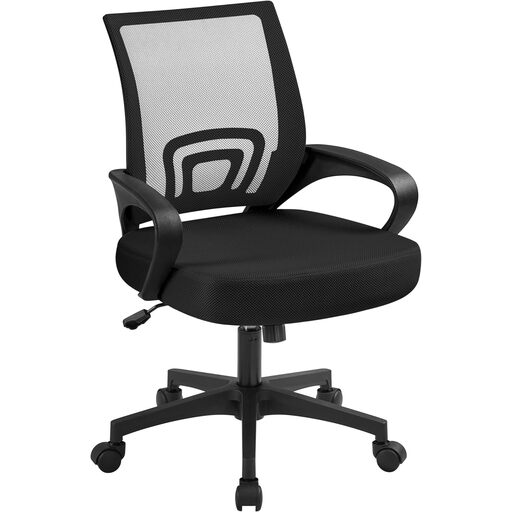
Why this product suits this profile: This mesh desk chair combines a seat height adjustable from 35 to 45 cm with a rocking function, padded seat and integrated lumbar support. The stated weight capacity is up to 136 kg.
The technical specifications state the seat height range and weight capacity clearly, rather than relying only on general promises of comfort.
Breathable mesh backrest, adjustable seat height and stated SGS and BIFMA certifications.
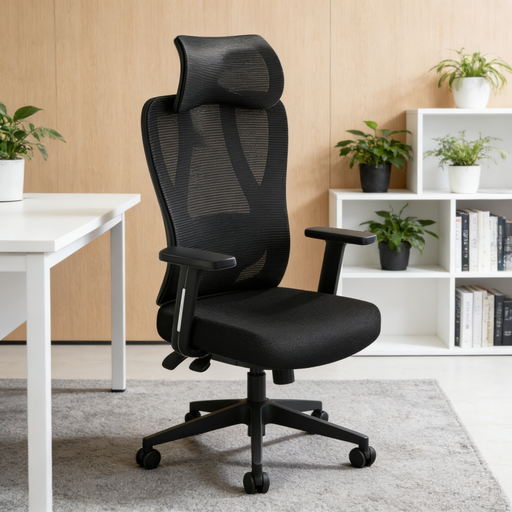
Why this product suits this profile: This model features 4D lumbar support, an adjustable headrest, 40 mm of backrest height adjustment and a recline range of 105° to 140°. It is designed for people who want several adjustment options for office work and gaming.
The adjustment ranges are stated clearly. This allows you to check before buying whether the desired seating position can actually be achieved.
Two-layer mesh, 4D lumbar support and 10.5 cm-thick seat padding according to the product description.
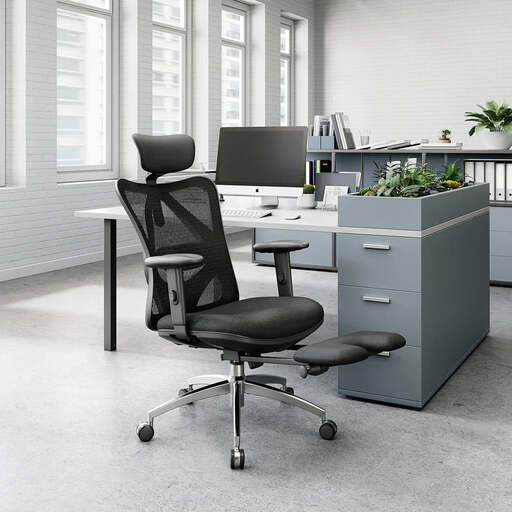
Why this product suits this profile: This office chair with footrest has an adjustable headrest, lumbar support, seat height, backrest and armrests. The recommended maximum weight capacity is stated as 150 kg.
The footrest is identified as a specific additional feature. This makes it easier for buyers to assess whether they need it for breaks or reclining.
High backrest, breathable mesh and 360-degree castors according to the product specifications.
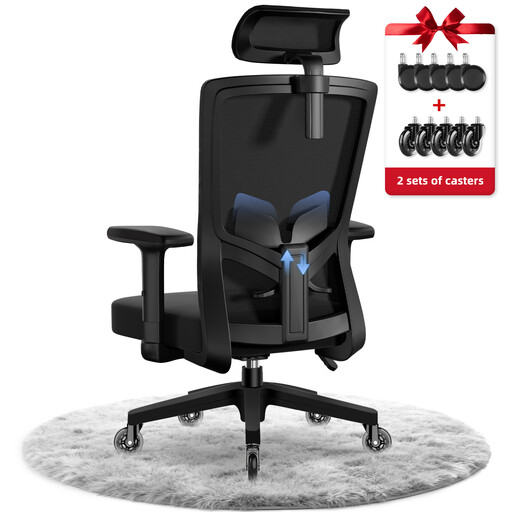
Why this product suits this profile: This model features a height-adjustable seat, adjustable armrests, headrest and lumbar support, as well as a rocking function. The maximum weight capacity is stated as 150 kg.
The adjustment ranges are described using specific figures: 10 cm of seat height adjustment, 11 cm of headrest adjustment and 6 cm of lumbar support adjustment.
Breathable nylon mesh, folding armrests and quiet castors with stated BIFMA and SGS certification.
We have put together a complete, regularly updated list of products that fully meet these strict selection criteria and the safety regulations applicable in the EU.
After assembly, do not simply adjust the chair to your preferred seat height. Proceed step by step:
After assembly, check all screw connections and observe the stated maximum weight capacity. An office chair is intended for sitting only and must not be used as a step stool.
The seat height is suitable when both feet rest securely on the floor and your knees are bent at approximately a right angle. At the same time, your forearms should rest on the work surface without your shoulders being raised. The combination of chair height and desk height is therefore crucial.
Its lifespan depends on daily usage, body weight, material quality, floor conditions and maintenance. Regularly tightening the screws, cleaning the chair carefully and using suitable castors can help maintain its performance. Without specific information from the manufacturer, it is not possible to state a reliable general lifespan.
The price mainly depends on the materials, mechanism and number of adjustment options. Models with basic height adjustment are usually specified differently from an office chair with 4D lumbar support, a headrest, several recline settings or a footrest. Therefore, do not compare only the purchase price. Also consider the weight capacity, spare-part information, warranty terms and the functions you actually need for your workspace.