
Lieferung heute & morgen

Qualitätsgarantie

Willkommens-Angebote freischalten: KOSTENLOSE Lieferung | Bis zu 80 % RABATT | Kostenlose 30-Tage-JoyPlus-Testphase
App herunterladen
An ergonomic office chair should help you find the right sitting position, whether you're working from home, in a study or at a desk. However, many products make big promises without giving you the important details. What really counts isn't just buzzwords like "ergonomic" or "back support" – it's the verifiable information about seat height, backrest, weight capacity and adjustment options.
A curved backrest might look ergonomic, but it tells you very little about how well it will fit you personally. Check whether the office chair is height-adjustable and whether the backrest, seat or lumbar area can be adapted. If specific adjustment ranges aren't given, it's impossible to know whether the chair will suit your height and your desk.
An office chair with a mesh back or a breathable office chair can help air circulate around your back. However, the seat cushion is often made from a different material. So pay attention to the whole construction: the mesh back, padding, seat width and edge shape all affect how the chair feels. A mesh cover alone doesn't guarantee proper support.
The maximum load is a technical limit, not a promise of quality. It should match your intended use and shouldn't be pushed to its limit permanently. A stable base, suitable castors and a correctly fitted gas lift are also important. With a high-weight-capacity office chair, these details should be clearly listed in the product specifications.
With an ergonomic desk chair, your feet should be able to rest flat on the floor while your knees form roughly a right angle. The seat height therefore needs to match both your desk and your height. With the Yaheetech model, the stated seat height adjustment range is 35 to 45 cm. That gives buyers a concrete reference point, but it doesn't replace checking against your own measurements.
Also look out for:
An office chair with lumbar support can offer more targeted adjustment in the lower back area. What matters is whether the support is fixed or adjustable. A flexible backrest or a tilt mechanism can make it easier to change position. It should be controllable and shouldn't cause your body to tip backwards permanently while you're working.
For longer periods of sitting, it's a good idea to change your sitting position regularly. An office chair can help with this, but it doesn't replace taking breaks or setting up your workstation properly for your individual needs.
An office chair with armrests can relieve your forearms while you work, provided the height matches your desktop. Flip-up armrests are practical if you want to push the chair fully under your desk. A swivel office chair should rotate smoothly through 360 degrees and roll stably on your particular floor surface.
For parquet, laminate or vinyl flooring, a suitable floor protector mat can be a good idea. On carpet, the castors should roll smoothly without sliding uncontrollably.
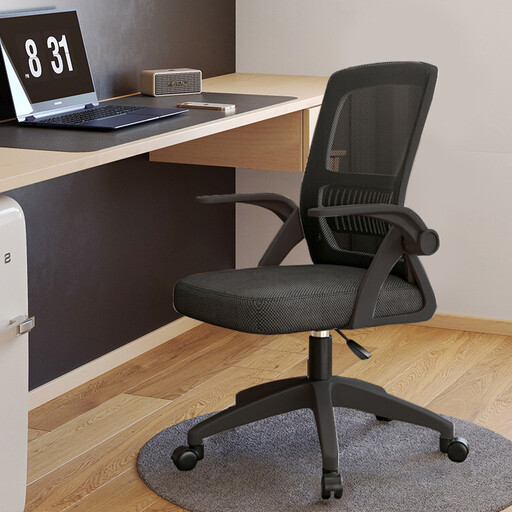
Why this product fits the profile: The product name mentions a breathable mesh chair, flip-up armrests and lumbar support. That makes it suitable for users looking for basic adjustment and space-saving features.
The features listed are more concrete than a simple marketing claim about ergonomics. Still, check the dimensions, adjustment ranges and stated weight capacity on the product page before buying.
Mesh back, flip-up armrests and stated lumbar support according to the product name.
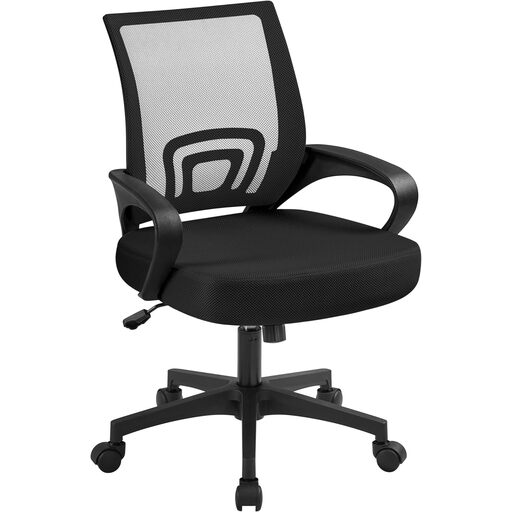
Why this product fits the profile: According to the product details, this model offers a mesh back, padded seat, integrated lumbar support, adjustable seat height and a tilt mechanism. The stated seat height range is 35 to 45 cm.
Concrete measurements and features make it easier to compare with your own workstation. According to the manufacturer, SGS and BIFMA certifications have been mentioned; check the exact scope in the product documentation.
Stated weight capacity up to 136 kg, mesh back, padded seat and height-adjustable sitting position.
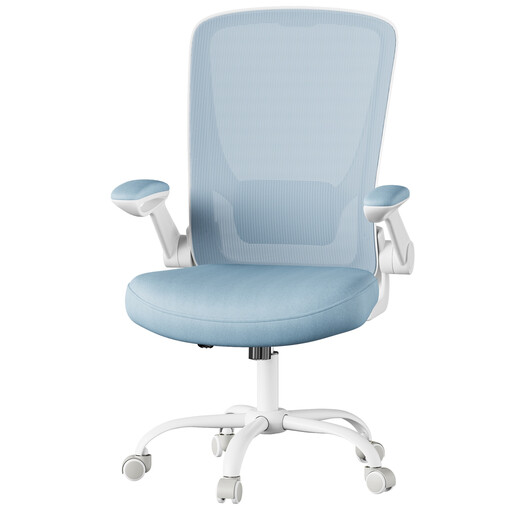
Why this product fits the profile: This model features an adjustable lumbar support, flip-up armrests, a tilt mechanism and a total height of 103 to 110 cm. The stated maximum static load capacity is 120 kg.
The product description lists several verifiable parameters rather than just general comfort terms. The weight capacity should be checked against your body weight and intended use.
Adjustable lumbar support, flip-up armrests, tilt mechanism and stated weight capacity of 120 kg.
We've put together a full, regularly updated list of products that fully meet these strict selection criteria and the safety regulations in force in the EU.
After assembly, check that all screws are tight and the castors are fully clicked into place. With several models, it's a good idea to re-check the screw connections after a few weeks. The chair should only be used for sitting and should stand on a level surface.
Mesh backs and fabric covers can usually be cleaned with a vacuum cleaner attachment or a slightly damp cloth. Harsh cleaning products can damage the material and surface. Spill any liquids promptly.
Your feet should be flat on the floor while your upper and lower legs form roughly a right angle. The armrests should be adjusted so that your shoulders aren't permanently raised. The desk height must also match your sitting position.
The lifespan depends on the construction, daily usage time, body weight, floor surface and care. A stated weight limit is not a promise of longevity. Regularly checking the castors, screws, padding and gas lift helps you spot wear and tear early.
In addition to the purchase price, you may need to budget for a floor protector mat, replacement castors or occasional spare parts. With an office chair with a mesh back, you should also follow the manufacturer's care instructions. Clear information about spare parts and warranty can be more important when choosing than a single comfort feature.