
Lieferung heute & morgen

Qualitätsgarantie

Willkommens-Angebote freischalten: KOSTENLOSE Lieferung | Bis zu 80 % RABATT | Kostenlose 30-Tage-JoyPlus-Testphase
App herunterladen
An ergonomic office chair should provide practical support throughout your working day at a desk. But terms such as ‘ergonomic’, ‘premium’ and ‘for long periods of sitting’ can make many models sound more convincing than their specifications justify. Whether you work from home, in an office, study or game, it’s worth looking at measurable features rather than relying on marketing claims alone.
An ergonomic desk chair won’t automatically suit every height. If details such as seat height, seat depth or backrest adjustment are missing, it may be difficult to adapt the chair to your body and workspace. An adjustable-height office chair should at least have clearly stated seat-height settings.
The term lumbar support simply describes support for the lower back. What matters is whether you can adjust its height, depth or tension. A fixed shape may suit some users, but sit too high or too low for others. The presence of lumbar support alone doesn’t mean the chair has any medical benefits.
A gaming chair with a footrest can be handy for breaks or leaning back. But the footrest is no substitute for the right seat height or a stable backrest. Thick padding alone also says little about how well it will hold its shape over time. Check the materials, weight capacity, care instructions and base construction too.
When sitting normally, your feet should ideally rest firmly on the floor. Check the stated seat-height adjustment and compare it with the height of your desk. If the seat is too high, your feet may not rest flat on the floor. If it’s too low, it may be harder to position your arms comfortably at the desk.
Also check the seat width and depth. Wider models give you more room to move, but take up more space. In a small room, an office chair with flip-up armrests may be more practical.
For an office chair with lumbar support, the product description should make it clear whether the support is adjustable or simply built into the chair’s shape. A flexible backrest with a tilt function can be useful when switching between focused work and short breaks.
If you’re looking for an office swivel chair, check the castors and base too. A 360-degree swivel function, five castors and a sturdy base are features you can verify. Depending on your flooring, a protective floor mat may also be useful.
A mesh office chair promotes airflow around the backrest and may suit warmer rooms. Fabric and faux leather, on the other hand, differ in how they feel, how easy they are to clean and how much care they need. Check whether the cover is removable and washable. Many models aren’t designed to be.
The maximum weight capacity should be suitable for the person using the chair. Don’t mistake it for a general guarantee of stability. For example, a Yaheetech model is listed with a maximum weight capacity of 136 kg, a seat height of 35 to 45 cm and a seat measuring 51 × 49,5 cm. Specific figures like these are more useful when choosing a chair than vague claims about comfort.
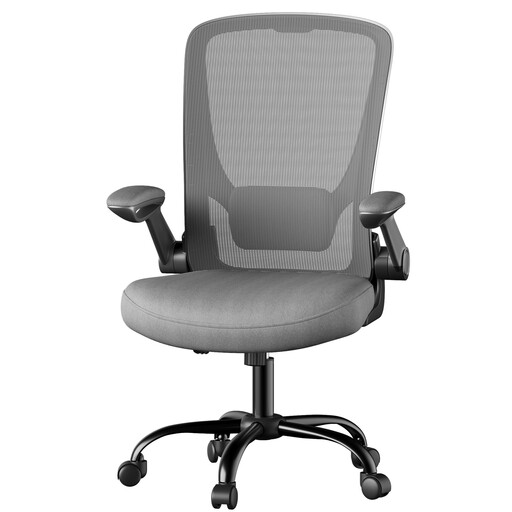
Why this product suits this profile: The height-adjustable seat, breathable mesh backrest and fold-up armrests cover the essentials for working from home, studying and smaller workspaces.
The product details list specific features rather than relying on a general ‘ergonomic’ label: adjustable seat height, 360-degree swivel, five castors and fold-up armrests.
Mesh back, padded seat, fold-up armrests and a weight of 9 kg, according to the product description.
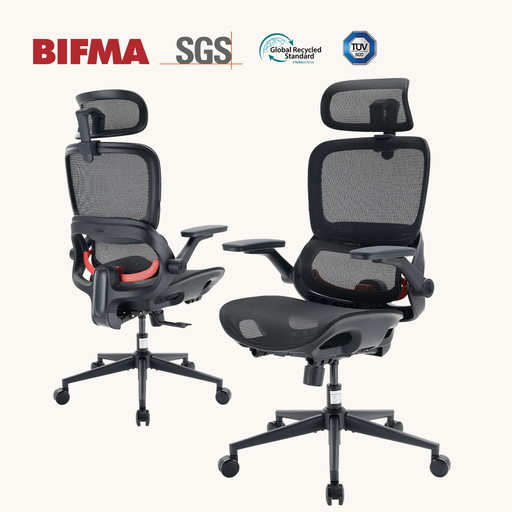
Why this product suits this profile: This model is for people who value adaptive lumbar support, a wide headrest and adjustable armrests in a computer chair.
The adaptive lumbar support and 360-degree swivel, flip-up armrests address two common shortcomings: limited adjustability and inefficient use of space.
Mesh back, wide headrest, adaptive lumbar support and flip-up armrests, according to the product name.
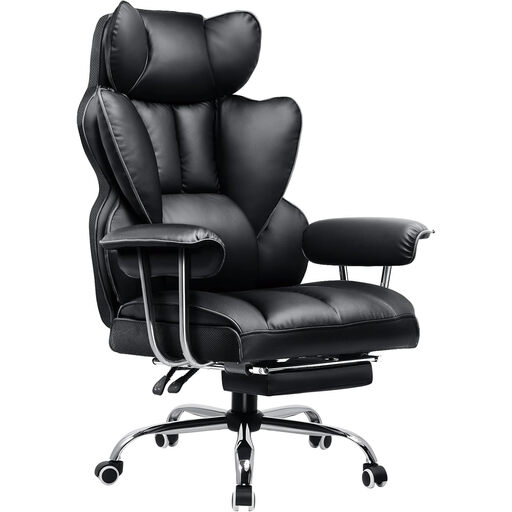
Why this product suits this profile: For gamers and anyone who likes to switch between focused sitting and leaning back for a break, this model combines an adjustable backrest with a retractable footrest.
The features are clearly described: the backrest reclines to 135 degrees, the seat height is adjustable and the footrest retracts. The footrest is an extra feature, not a replacement for adjusting the seat.
Retractable footrest, 135-degree recline, 360-degree swivel and faux leather upholstery, according to the product description.
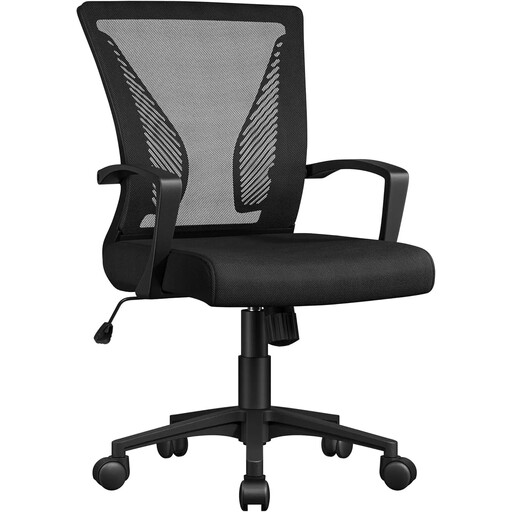
Why this product suits this profile: The listed dimensions and maximum weight capacity make it easier to choose a chair for workspaces where a sturdy design and clearly specified seat size matter.
The product description lists a maximum weight capacity of 136 kg, a seat height of 35 to 45 cm and the seat dimensions. This makes it easier to judge whether the chair will suit you before buying.
Breathable nylon mesh, armrests, tilt function, 360-degree swivel and five castors, according to the product details.
We’ve put together a complete, regularly updated list of products that meet these strict selection criteria and the safety requirements in force in the EU.
Start with the seat height: both feet should rest firmly on the floor. Then adjust the backrest so that your back is supported by it. The armrests shouldn’t push your shoulders up. Position your monitor so you don’t have to keep tilting your head down. Changing position regularly and taking breaks are still important, whatever chair you use.
Its lifespan depends on how often it’s used, the load it bears, the materials and how well it’s maintained. Check the screws, castors and gas lift regularly. Never exceed the stated maximum weight capacity. For mesh and fabric models, remove dust and dirt according to the care instructions.
The price mainly depends on the range of adjustments, materials, weight capacity and extra features. Don’t compare just the purchase price; consider which features you actually need. For a small home office, an adjustable-height chair with fold-up armrests may be enough. If you spend many hours at your desk, you may also want to look for adjustable lumbar support, a backrest and armrests.