
Lieferung heute & morgen

Qualitätsgarantie

Willkommens-Angebote freischalten: KOSTENLOSE Lieferung | Bis zu 80 % RABATT | Kostenlose 30-Tage-JoyPlus-Testphase
App herunterladen
An ergonomic office chair is meant to support your working day without you paying for vague promises. Many models look similar at first glance, but differ significantly in adjustment options, seat dimensions and load capacity. For professionals working from home, freelancers, students and gamers, clear product data matters more than terms like "premium" or "comfortable".
An office chair with an adjustable lumbar support isn't automatically the right fit. What matters is how far the support can move up, down, forwards or backwards. Even with an office chair that has a headrest, you should check whether the height and tilt suit your own height. A headrest you can't reach or a lumbar support in the wrong position won't help you in daily use.
Specifications like 150 or 200 kg refer to the maximum load capacity and don't replace a check of the construction. Also important are a stable base, a suitable gas lift, durable castors and an even standing surface. The stated load capacity must not be exceeded. The chair is not designed for standing, climbing or kneeling.
A breathable mesh office chair can promote air circulation around your back. However, this says nothing about seat firmness, seat width or the actual stability of the frame. A mesh backrest and padded seat can also feel quite different. If you sit for many hours, you should consider the material, seat shape and care instructions together.
A height-adjustable swivel chair should be adjustable so that your feet rest fully on the floor and your knees aren't permanently bent at a sharp angle. As a guide, choose a seat height that suits your desk and your height. A seat with a rounded front edge can reduce pressure on your thighs; however, this feature should not be understood as having a medical effect.
Pay attention to:
An office chair with adjustable lumbar support can be better adapted to different body heights and sitting postures than a model with a fixed lumbar pad. Check whether the support can actually move vertically or also in depth.
A tilt mechanism can allow movement changes when leaning back. What matters here are the tilt range, any locking options and the adjustable tension. With the models available, the specifications range, for example, from 90° to 126° or up to 135°. A larger number alone is not proof of quality: for focused work, an upright lock can be more important than a wide tilt angle.
An office chair with adjustable armrests should offer at least a clear height adjustment. 3D or 4D armrests also allow movement forwards, backwards or sideways. This can be practical for changing activities like typing, video calls and gaming.
Before buying, you should also check the maximum load capacity, certifications, warranty, assembly effort and spare parts information. BIFMA, SGS, TÜV or EN1335 are mentioned with individual offers. These details refer to the specific test or conformity stated and should not be interpreted as a blanket guarantee for every use scenario.

Why this product suits the profile: For home office workstations with limited space, this model offers an adjustable seat height from 46 to 54 cm, a tilt from 90° to 105° and fold-up armrests.
The relevant adjustment ranges and the maximum static load capacity of 120 kg are clearly stated. This makes it easier to assess suitability before buying.
Mesh backrest, 8 cm foam padding and fold-up armrests; dimensions: 62 × 62.4 × 120.4–127.4 cm.
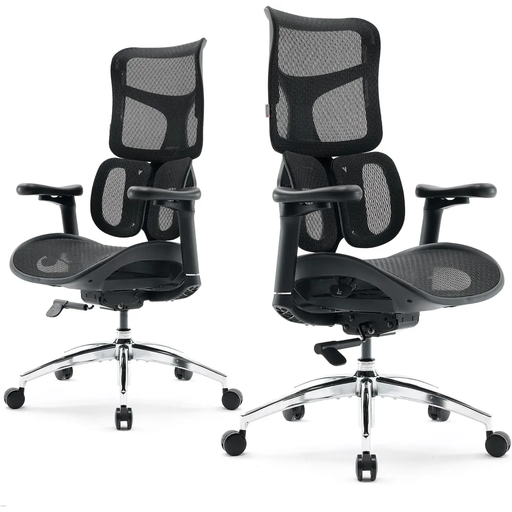
Why this product suits the profile: This model is aimed at people who want multiple adjustment options from an office chair with adjustable armrests and who regularly work in the office or from home.
The product description mentions an aluminium frame, 4D armrests, five backrest levels and BIFMA and SGS certifications.
Dual dynamic lumbar support, 4D armrests and a seat height with waterfall edge; the product is delivered assembled and is intended for indoor use.
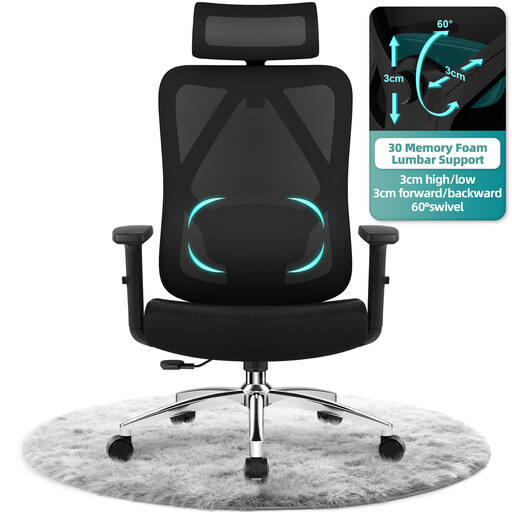
Why this product suits the profile: For long working days, changing sitting positions or a generously equipped ergonomic executive chair, this model offers several separately described adjustment ranges.
Instead of using only general comfort terms, the offer states concrete values for lumbar support, armrests, seat height and tilt angle.
Up to 200 kg stated load capacity, lockable positions at 90°, 115° and 135°, 3D lumbar support and aluminium base.
We have put together a complete, regularly updated list of products that fully meet these strict selection criteria and the safety regulations in force in the EU.
After assembly, check all screws, castors and connection points. Adjust the seat height so that your feet rest securely on the floor. Then adjust the backrest, lumbar support and armrests. The armrests should not push your shoulders upwards permanently. With a tilt mechanism, choose the tension so that the backrest returns in a controlled manner.
Mesh can usually be cleaned with a soft cloth or brush. Abrasive cleaners, excessive moisture and direct heat can damage materials. Check the gas lift, castors, base and armrests regularly. If you notice visible damage, the chair should not be used further.
Your feet should rest fully on the floor while your knees remain at roughly a right angle. Additionally, the seat height must match the desk height. With adjustable desks, adjustment is usually easier because the desk and chair can be coordinated with each other.
The lifespan depends on frequency of use, body weight, material, assembly and care. The stated warranty, maximum load capacity and quality of the castors are important points for comparison. Loose screws or damaged gas lifts should be checked early.
The price depends mainly on material, adjustment range, load capacity and construction. A higher price does not guarantee a suitable sitting position. When choosing, you should give more weight to concrete measurements and features like lumbar support, armrests, seat height and tilt lock than to the model name.