
Lieferung heute & morgen

Qualitätsgarantie

Willkommens-Angebote freischalten: KOSTENLOSE Lieferung | Bis zu 80 % RABATT | Kostenlose 30-Tage-JoyPlus-Testphase
App herunterladen
An ergonomic office chair should help you find a comfortable sitting position at home, in the office or at your desk. However, many listings use terms such as ‘ergonomic’, ‘back-friendly’ or ‘premium’ without clearly explaining the product details that matter. If you focus only on the design or extra-soft padding, you may not notice potential drawbacks until you’ve been using the chair for a few weeks.
Three common buying mistakes are particularly easy to make:
An height-adjustable office chair should be adjustable so that both feet rest firmly on the floor. Ideally, your knees should be roughly level with your hips or slightly lower. The seat height also needs to work with the height of your desk.
When comparing chairs, check:
The Yaheetech Ergonomic Office Chair is one example of a chair with specific measurements. According to the product description, its seat height adjusts from 35 to 45 cm, the seat measures 51 × 49,5 cm, and its maximum load capacity is 136 kg. Details like these are more useful when choosing a chair than general marketing claims.
An adjustable lumbar support can help you adapt the backrest to your body shape. It should not only be included, but also adjust in height or depth, where this is stated in the product details.
Also check:
A breathable office chair with a mesh backrest can be useful in warm rooms and during long periods of sitting. But mesh alone is no guarantee of quality. The design, adjustment options and measurements stated by the manufacturer still matter.
An office chair with armrests can support your forearms at your desk. To avoid hunching your shoulders, make sure the armrests are at the right height for your desk. Flip-up armrests are particularly useful in small workspaces, as they let you tuck the chair under the desk.
For a swivel chair for your home office, the following are also worth considering:
A tilt or rocking function is useful if you want to switch between focused work and short breaks. It should be easy to adjust in a controlled way, and shouldn’t be seen as a substitute for setting the seat height correctly.
The models below vary in their features, dimensions and intended use. Before buying, check the latest product details, delivery terms and load capacity on the relevant product page.
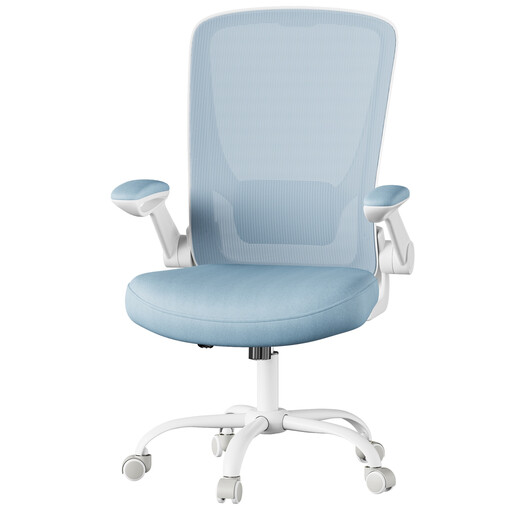
Why this product suits this profile: This chair combines adjustable seat height and lumbar support with folding armrests. Measuring 64 × 60 × 103–110 cm, with a stated static load capacity of 120 kg, it’s suited to basic home-office and study spaces.
The product details include specific measurements, a tilt mechanism and adjustable lumbar support, rather than relying solely on general comfort claims.
Folding armrests, breathable upholstery, 360-degree swivel and a stated load capacity of 120 kg.
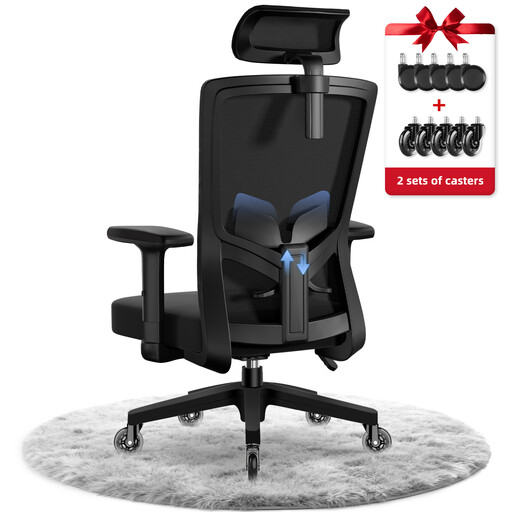
Why this product suits this profile: The product description lists an adjustable headrest, lumbar support, armrests and seat height. This makes it easier to tailor the chair for long working days in the office or at home.
Several adjustable features reduce the risk of a fixed backrest or unsuitable armrest height limiting your choice.
Nylon mesh backrest, lumbar support adjustable by 6 cm, 10 cm of seat-height adjustment and a stated maximum load capacity of 150 kg.
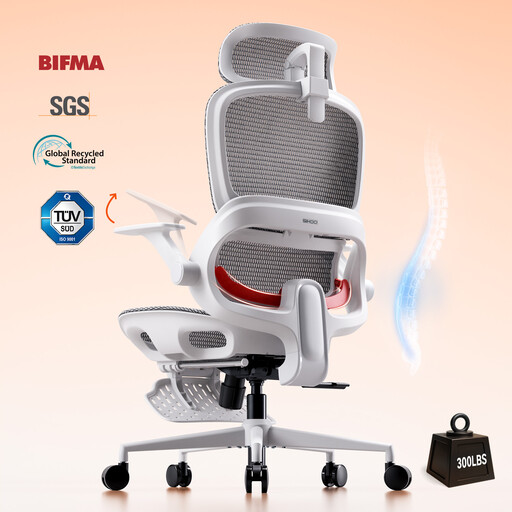
Why this product suits this profile: This office chair with footrest is designed for people who want to switch between focused work and reclining during breaks. The product name indicates that it has a headrest, a high backrest and folding armrests.
The footrest adds another way to adjust your sitting position, but it doesn’t replace checking the seat height, back support and space required. Make sure these suit your needs before buying.
Footrest, adaptive lumbar support, wide headrest and flip-up armrests, according to the product details.
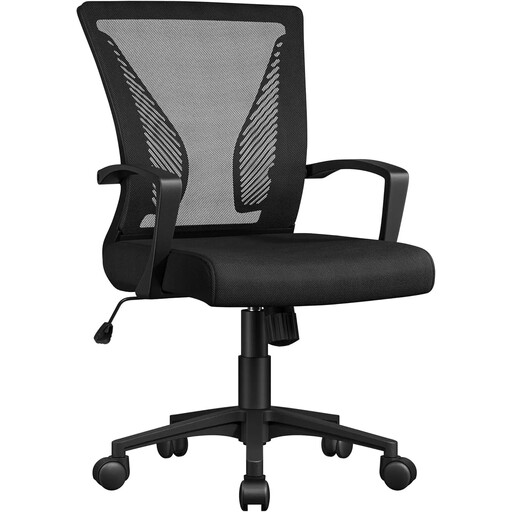
Why this product suits this profile: For study rooms, home offices or gaming spaces where floor space is limited, compact dimensions, adjustable height and 360-degree swivel are useful features to consider.
The product description gives the seat measurements, height range, material and load capacity. This makes it easier to check in advance whether the chair will suit your desk and height.
Mesh material, armrests, seat height adjustable from 35–45 cm, five castors and a stated load capacity of 136 kg.
We’ve put together a complete, regularly updated list of products that meet these strict selection criteria and fully comply with the safety regulations in force in the EU.
Assemble your ergonomic desk chair exactly as instructed and check all screw connections before using it for the first time. If it has castors, place it on a level surface. A suitable floor protector may be useful for delicate flooring.
A chair’s lifespan depends on factors including daily use, body weight, materials, care and the strain placed on its mechanisms. Check the following regularly:
For mesh, plastic and metal, a soft, slightly damp cloth is usually suitable. If the upholstery can’t be removed, check the product description before buying to see whether it’s machine washable.
First, adjust the seat height so that both feet rest flat on the floor. Then adjust the lumbar support, backrest and armrests. Your shoulders should stay relaxed, with your forearms as horizontal as possible on the desk or armrests.
There’s no one-size-fits-all answer. It depends on the chair’s construction and materials, how often you use it and how well you look after it. Check whether spare parts are available, along with the load limits and assembly instructions. Regularly tightening the screws can help keep the chair safe to use.
Mesh can improve airflow around the backrest, making it useful in warm rooms. Whether the chair is suitable for long working hours also depends on the seat padding, seat depth, lumbar support and adjustment range. Always consider the product details as a whole.