
Lieferung heute & morgen

Qualitätsgarantie

Willkommens-Angebote freischalten: KOSTENLOSE Lieferung | Bis zu 80 % RABATT | Kostenlose 30-Tage-JoyPlus-Testphase
App herunterladen
An ergonomic office chair should adapt to the user and the workspace – not the other way round. Especially during long hours of computer work at home or in the office, clear information about seat height, backrest, armrests and weight capacity is essential. An attractive design alone tells you little about whether an ergonomic desk chair will truly suit your daily needs.
A label like "ergonomic" is not a uniformly protected quality mark. What really matters is how far and in which direction the chair can be adjusted. A height-adjustable seat is of little use if the lowest setting is still too high for shorter people, or if the backrest cannot be tilted enough.
So look for specific values, for example:
An office chair up to 200 kg may be of interest to larger or heavier users. However, the maximum weight capacity does not replace checking the seat width, seat depth and stability of the base. A sturdy gas lift and suitable castors must also match the intended use.
Important: The stated maximum load must not be exceeded. Heavy objects should not be placed on the armrests or backrest. When choosing, you should also check whether the weight capacity is explicitly stated for the entire chair or only refers to individual components.
A "breathable office chair" often has a mesh backrest. This can support air circulation, but says nothing about the seat cushioning, frame or castors. A padded seat with foam, a robust base and quiet, floor-friendly castors are equally important for daily use.
With the seat height correctly adjusted, your feet should be able to rest firmly on the floor. There should be a small gap between the front edge of the seat and the back of your knees. A seat width of 51 cm, as with the GTIMEX model with 150 kg weight capacity, can be suitable for many workstations; the actual fit, however, depends on your body shape and clothing.
An S-shaped backrest can follow the natural curve of your spine. With an office chair with adjustable lumbar support, it is particularly important whether the support can be adjusted not only in height but also in depth. The GTIMEX model with 150 kg offers up to 6 cm of height adjustment and up to 3 cm of depth adjustment.
The tilt should suit your activity: a more upright position is good for focused typing, while a reclined setting can be more comfortable during meetings or short breaks. An office chair with a rocking function allows movement while sitting, provided the resistance can be adjusted appropriately.
An office chair with armrests can relieve your forearms during work if the height matches your desk. Armrests that are too high, on the other hand, can easily lead to raised shoulders. Check whether the armrests are adjustable only vertically or also laterally and in depth.
An office chair with a headrest is not automatically suitable for every body height. The height adjustment and tilt angle are what matter. For the models listed below, headrests are specified with a height range of 10 or 11 cm and an angle of up to 120 degrees, depending on the version.
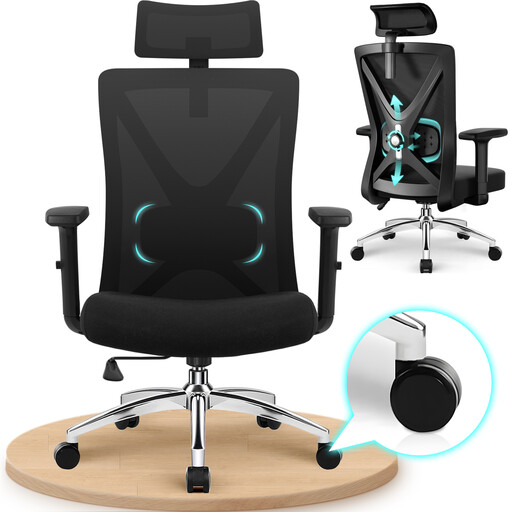
Why this product fits the profile: This chair combines a 10 cm height-adjustable seat with adjustable armrests, headrest and lumbar cushion. It is therefore suitable for users who need several adjustment options without requiring an overly complex setup.
The product details specify concrete adjustment ranges: up to 135° backrest tilt, 10 cm seat height and armrest adjustment, and up to 6 cm height and 3 cm depth adjustment for the lumbar support.
8 cm thick seat cushion, nylon mesh backrest, 150 kg maximum weight capacity and 360° swivel castors.
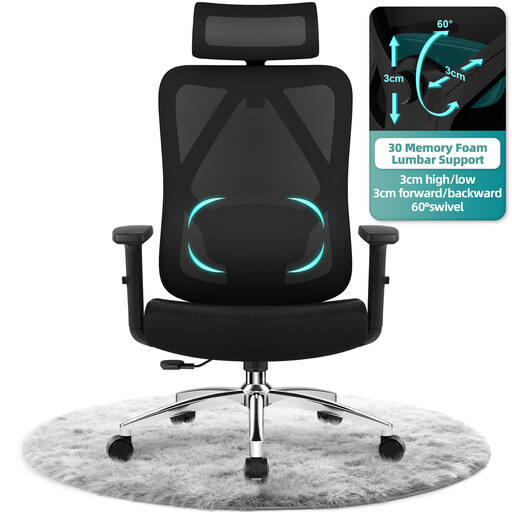
Why this product fits the profile: The combination of a mesh backrest, aluminium base and multiple locking angles is aimed at people looking for an individually adjustable executive chair for long working sessions.
Instead of a vague ergonomics claim, 90°, 115° and 135° are given as backrest positions, along with specific values for lumbar support, headrest, armrests and seat height.
Up to 200 kg stated weight capacity, aluminium base, 3D lumbar support and 10 cm seat height adjustment.
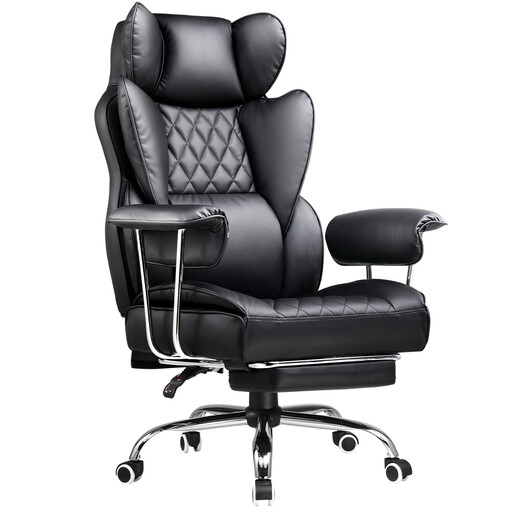
Why this product fits the profile: The design with a high backrest and footrest is aimed at users who want to use the chair not only for desk work but also for short breaks or longer gaming sessions.
The footrest is listed as a specific feature. Before purchasing, you should check the seat width, seat height and actual weight capacity in the full product details.
High backrest, integrated footrest, adjustable lumbar support according to the product name and swivel construction.
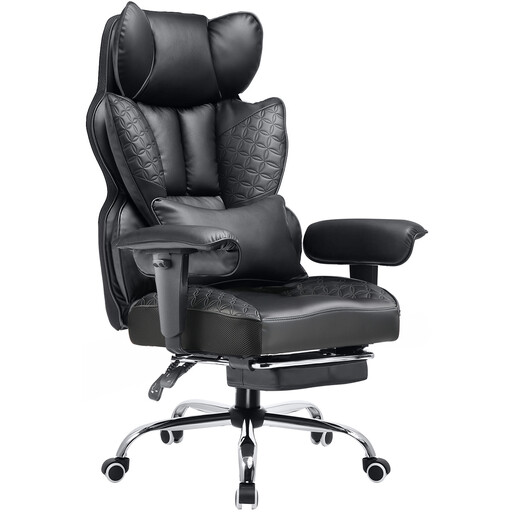
Why this product fits the profile: The "Big and Tall" designation and the high backrest appeal to users who often find standard chairs lack sufficient space or back support.
The product name explicitly indicates a version for larger people. Before ordering, you should check the exact dimensions and the stated maximum weight capacity.
High backrest, PU leather upholstery, footrest and reclining design according to the product description.
We have put together a complete, regularly updated list of products that fully meet these strict selection criteria and the safety regulations in force in the EU.
Even a suitable ergonomic office chair only works when it is correctly adjusted. Follow these steps in order:
Your feet should be placed fully and comfortably on the floor. Your thighs should be as horizontal as possible or sloping slightly downwards. Because body height and desk height vary, a specific centimetre measurement alone is not sufficient.
The lifespan depends on load, materials, assembly and care. Regularly check the screws, castors, gas spring and base. If the stated maximum load is exceeded or the chair is frequently used as a storage surface, wear and tear can increase.
The chair itself does not require electricity. Running costs mainly arise from cleaning, occasional replacement of castors or wear parts, and possibly assembly. A breathable office chair with a mesh backrest should be regularly dusted; harsh cleaning agents can damage surfaces and upholstery.