
Lieferung heute & morgen

Qualitätsgarantie

Willkommens-Angebote freischalten: KOSTENLOSE Lieferung | Bis zu 80 % RABATT | Kostenlose 30-Tage-JoyPlus-Testphase
App herunterladen
An ergonomic office chair should adapt to your sitting position rather than impressing you with modern design alone. For home workers, office staff, students and gamers, adjustable features, suitable dimensions and clearly stated weight capacity are therefore particularly important.
However, many purchasing decisions fall foul of three typical pitfalls:
With the seat height correctly adjusted, your feet should rest firmly on the floor. A small gap between the front edge of the seat and the back of your knees is advisable, so that the seat does not press uncomfortably into your legs. An adjustable-height office chair is therefore particularly practical for several people in the household or a shared workspace.
Look for specific measurements rather than general terms such as “ergonomic”. According to the product description, the GTIMEX model with flip-up armrests has a seat height of between 43 and 53 cm and is recommended for people measuring 145 to 185 cm. Such details make it easier to narrow down your options, but they do not replace checking how well the chair suits your own sitting position.
A lumbar support should not merely be included; it should also be adjustable in height or depth. With an office chair featuring lumbar support, it is also important to consider whether the backrest follows your upper body as you recline or simply holds you in a fixed position.
An S-shaped backrest can accommodate the body’s natural shape. However, this does not imply any medical or therapeutic effect. What matters is whether the support sits in the right place and whether the backrest remains comfortably flexible in everyday use.
An office chair with armrests does not automatically relieve tension in your shoulders and neck. You should be able to adjust the armrests so that your forearms rest loosely on them without raising your shoulders. Folding armrests are useful if you want to push the chair fully under the desk.
A rocking function or a tilt range of, for example, 105 to 140 degrees is suitable for short breaks and changing position. For concentrated work, you should be able to lock the upright position securely.
When choosing materials, consider the following:
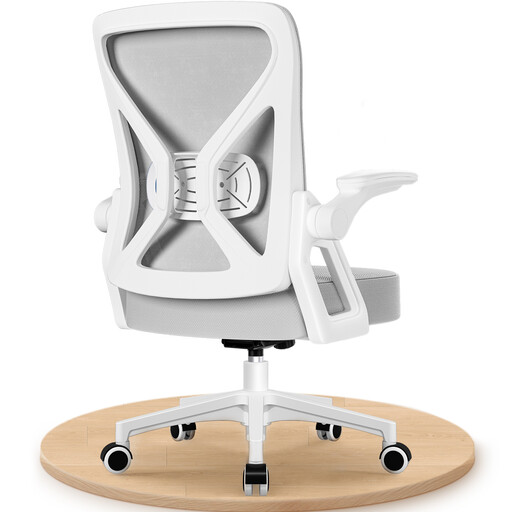
Why this product suits this profile: The adjustable seat height and folding armrests offer practical flexibility for working from home, studying or using a compact desk space.
The product description specifies a seat height of 43 to 53 cm and a recommended user height of 145 to 185 cm. This makes it easier to check the fit before buying.
Adjustable lumbar support, 125° tilt function, padded armrests and a stated load capacity of up to 150 kg.
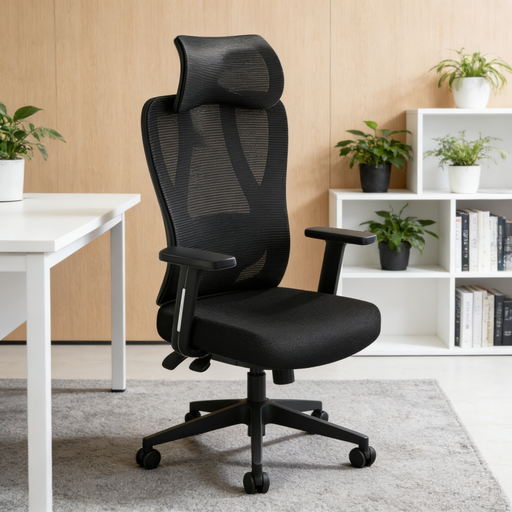
Why this product suits this profile: If you are looking for a swivel chair for working from home and gaming with plenty of adjustment options, this model provides details on backrest height, headrest and 4D lumbar support.
The description does not simply rely on the term “ergonomic”; it specifies a tilt range of 105° to 140°, 40 mm of backrest height adjustment and 10.5 cm of seat padding.
Breathable two-layer mesh cover, 4D rotating lumbar support and an adjustable, soft headrest.
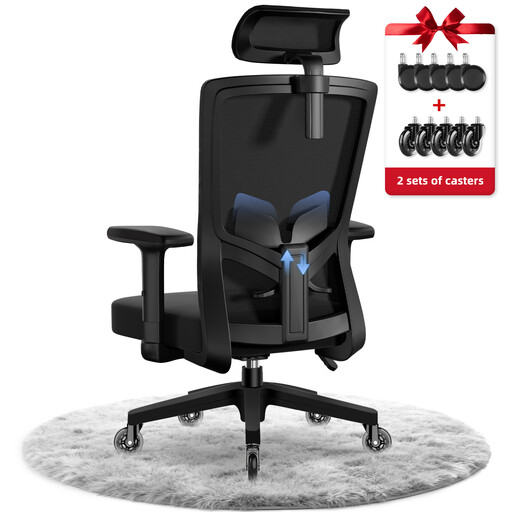
Why this product suits this profile: For long work, study or gaming sessions, this model offers several adjustment options and a stated load capacity of up to 150 kg.
Alongside the load capacity, the description specifies 6 cm of lumbar-support adjustment, 10 cm of seat-height adjustment and 10 cm of armrest adjustment.
Breathable nylon mesh backrest, rotating headrest, rocking function and, according to the description, a BIFMA- and SGS-certified gas lift.
We have put together a complete, regularly updated list of products that fully meet these strict selection criteria and the safety regulations applicable in the EU.
Start with the seat height: both feet should rest fully on the floor. Then adjust the backrest and lumbar support so that they provide comfortable support without applying pressure. Set the armrests to the height of your loosely resting forearms. Use the tilt function to change position, not as a permanent working position.
The lifespan depends on usage, body weight, materials, mechanism and care. A fixed number of years is therefore not a reliable guide. Check the screws, gas lift, castors and tilt mechanism regularly. The product warranty, availability of spare parts and stated maximum load capacity are also important factors.
Normal use does not generally incur any significant energy costs, as an office chair does not require electricity. Typical ongoing costs may include a floor-protection mat, replacement castors or wear parts. Before buying, it is therefore worth checking the warranty terms, assembly requirements and whether individual components can be replaced.