
Lieferung heute & morgen

Qualitätsgarantie

Willkommens-Angebote freischalten: KOSTENLOSE Lieferung | Bis zu 80 % RABATT | Kostenlose 30-Tage-JoyPlus-Testphase
App herunterladen
An ergonomic pocket-sprung mattress H2/H3 needs to meet several requirements at once: a medium-firm feel, stable support for different sleeping positions and minimal transfer of movement wherever possible. Particularly with double beds measuring 160 × 200 cm or 180 × 200 cm, differences in construction, edge support and delivery can become very noticeable.
The designations H2, H3 and H2/H3 are not completely standardised measurements in the German market. They are primarily intended as a guide. The actual feel also depends on body weight, body shape, the bed base and your preferred sleeping position.
A mattress with a firmness rating of H2/H3 is often described as medium-firm to fairly firm. This middle rating can be useful for couples who want to balance different preferences. However, it does not replace checking the returns policy and the precise product specifications.
With a 5-zone mattress, the spring core is divided into five areas offering different levels of support. The shoulder, lumbar and pelvic areas are typically treated separately. However, the zones need to suit your height and sleeping position. If you are significantly shorter or taller than the average mattress user, you should examine the zone layout particularly carefully.
The term ergonomic on its own is not proof of quality either. More meaningful details include the type of springs, foam layers, mattress height, cover, edge reinforcement and permitted load.
Many pocket-sprung mattresses are rolled and delivered in a box. Once unpacked, they need to expand fully on a suitable base. For the 180 cm version, the product information recommends allowing 24 to 48 hours for ventilation and expansion.
The protective film should be removed completely. The room should be well ventilated during this time. If you use the mattress immediately after opening it, it may not yet have reached its intended shape completely.
With individually packaged pocket springs, each spring element reacts comparatively independently. According to the product description of the selected Ochama models, this construction is intended to provide more targeted support and reduce the transfer of movement. This can be particularly relevant for couples if one person moves frequently during sleep.
However, a mattress with motion isolation cannot prevent all movement transfer. The bed base, bed construction and body weight also affect the result. Therefore, look for the specific wording “individually packaged pocket springs” rather than relying solely on general marketing claims such as “undisturbed sleep”.
A mattress with reinforced edges can make sitting down and getting up easier, while also providing greater stability around the edges of the usable surface. This is practical with a shared mattress measuring 160 × 200 cm or 180 × 200 cm, particularly if both sleeping areas are to be used as evenly as possible.
Check whether the product specifications actually refer to reinforced edges or an edge-support construction. A tall mattress or firm cover alone does not prove that the edges are reinforced.
According to the product information, the models described here feature a 4-layer construction with pocket springs, elastic support foam and a cover. The materials listed for the 180 × 200 cm version are steel, polyurethane foam, polyester and non-woven fabric.
For everyday care, the supplier recommends rotating the mattress every three to six months. Stains should be treated with a damp cloth and a mild cleaning product. According to the information available, the cover is not intended for machine washing. A suitable mattress protector helps maintain hygienic use, but does not replace regular cleaning and ventilation.
The following cards categorise the available options by bed size and intended use. The information is based on the respective product descriptions. A mattress described as relieving pressure should be understood as product positioning and does not constitute a medical promise.
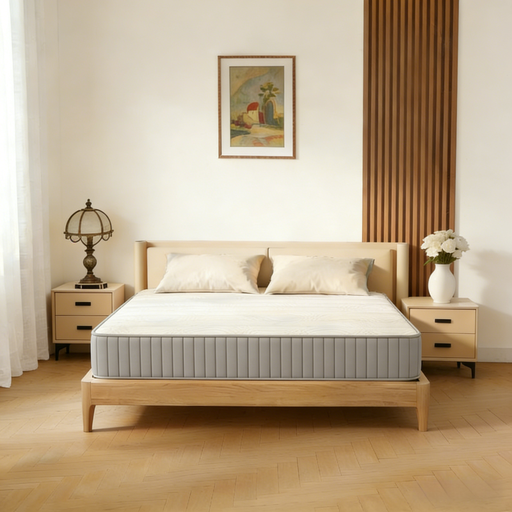
Why this product suits this profile: The size is suitable for many double beds and combines H2/3 with a 5-zone pocket-spring core and elastic support foam.
The product description specifies the H2/3 firmness rating, individually packaged springs and reinforced edges, rather than making only a general comfort claim.
160 × 200 cm, 4-layer construction, 5-zone pocket springs and an edge-support construction described by the supplier as reinforced.
Why this product suits this profile: The larger sleeping surface gives couples more personal space. Its construction is described in detail, including H2/3, pocket springs, support foam and edge reinforcement.
The specifications cover the materials, care instructions, expansion time and motion isolation. This makes it easier to plan for delivery and use.
180 × 200 cm, individually packaged pocket springs, reinforced edges and an H2/3 firmness rating described as medium-firm.
Why this product suits this profile: The 180 cm width is an appealing option for spacious double beds. The product page lists home and hotel use as possible applications; the safety information should be checked before commercial use.
The information highlights rolled delivery, the need for expansion, a suitable base and regular rotation.
Generous sleeping surface, pocket-spring core, H2/3 and reinforced edges. Hotels and other commercial operators should also clarify the applicable commercial safety and hygiene requirements.
H2/H3 can be a compromise for people who prefer a medium-firm feel. However, whether the mattress is suitable depends on body weight, height, sleeping position and personal preference. If there are significant differences between partners, two separate mattresses with suitable firmness ratings may be a better option.
For the described 180 × 200 cm model, 24 to 48 hours is specified for complete expansion and airing. The mattress should be placed on a supportive, well-ventilated bed frame. The packaging film must be removed completely before use.
Rotate the mattress regularly in accordance with the care instructions, use a suitable bed base and protect the surface with a suitable mattress protector. Moisture and intense heat should be avoided. It is not possible to give a reliable general lifespan, as the load, frequency of use, base and care all have a decisive impact.