
Lieferung heute & morgen

Qualitätsgarantie

Willkommens-Angebote freischalten: KOSTENLOSE Lieferung | Bis zu 80 % RABATT | Kostenlose 30-Tage-JoyPlus-Testphase
App herunterladen
An ergonomic office chair should provide a suitable seating position in the home office, at work, while studying or gaming. However, many products are advertised with terms such as “ergonomic”, “back-friendly” or “suitable for long periods of sitting” without clearly explaining the key adjustment options. If you focus only on the design or a low price, you may not notice important limitations until you use the chair every day.
An office chair with lumbar support, a headrest and armrests may initially seem versatile. What really matters, however, is how far and in which direction the components can be adjusted. A lumbar support that can only be moved a few centimetres will not automatically suit every body size. Likewise, a headrest without height or tilt adjustment can be impractical for different seating positions.
Pay attention to specific details about seat height, backrest height, armrests and lumbar support. Product images alone are not enough to assess these features.
A breathable mesh office chair can support air circulation around the back. That does not automatically mean that the seat, edges and padding will suit your personal habits. Tightly stretched mesh can feel different from a padded seat. For people who spend many hours at a desk, seat height, seat depth, padding thickness and the stability of the covering are therefore important.
The specification “office chair up to 150 kg” describes an important technical limit, but it is not the only indicator of quality. Check whether this figure refers to actual use or merely to a static test. The base, castors, gas lift and seat width should also suit your build. A chair with a high load capacity can still be unsuitable if the seat is too narrow.
A height-adjustable office chair should be capable of being set so that your feet rest firmly on the floor and your knees remain at roughly a right angle. The desk height must also be taken into account. Shorter people need a sufficiently low seating position, while taller users often require more adjustment range upwards.
For example, GTIMEX specifies a seat height adjustment range of 43 to 53 cm for the relevant model and recommends it for people measuring 145 to 185 cm. Details like these are more useful than the general description “ergonomic desk chair”.
An adjustable lumbar support should not merely be present; it should be possible to position it at the appropriate height. The GTIMEX Friendly Mesh Office Chair is specified as having a 6 cm adjustable lumbar support. Its S-shaped backrest and headrest, which is height-adjustable by 11 cm and swivels through 120 degrees, are specific features that can be compared before buying.
Important: A seating aid is not a substitute for individually adjusting your workstation. If you already have any discomfort, seek medical advice. Product claims about support or seating comfort are not promises of effectiveness.
An office chair with armrests can support your forearms while you work at a keyboard and mouse. Check whether the armrests are height-adjustable, foldable or movable sideways. Fold-up armrests can be practical if space is limited in your home office.
The recline function should suit how you use the chair. A model with a range of 105 to 140 degrees is generally suitable for alternating between working and resting positions. A gaming office chair with a greater recline angle, on the other hand, is mainly worthwhile if you regularly use the backrest to relax. Also consider the care requirements: mesh needs to be cleaned differently from PU faux leather or fabric.
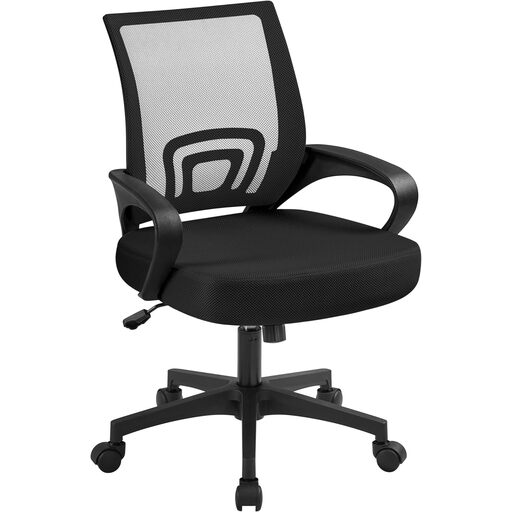
Why this product suits this profile: This chair combines a breathable mesh backrest with a padded seat, adjustable seat height and a stated load capacity of up to 136 kg. It is therefore suitable for home working, studying and everyday desk work.
The product details include specific measurements, a seat height adjustment range of 35 to 45 cm, as well as SGS and BIFMA certifications. This makes it easier to assess the product objectively than a chair relying solely on promotional ergonomic claims.
Breathable mesh backrest, padded seat, rocking function and stated load capacity of up to 136 kg.
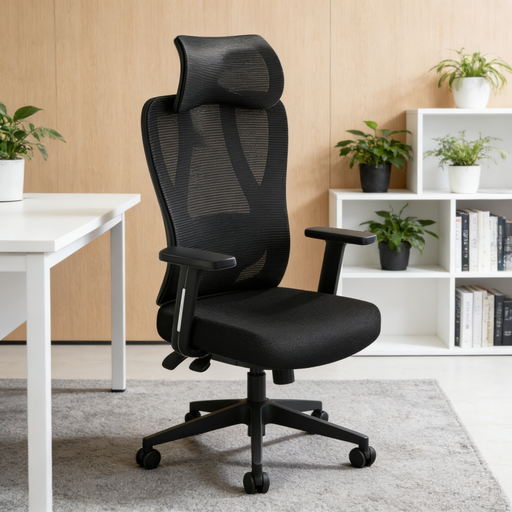
Why this product suits this profile: This model is aimed at users who want plenty of adjustment options for working and gaming. It features a 4D lumbar support, an adjustable headrest, 40 mm of backrest adjustment and a recline range of 105 to 140 degrees.
Rather than simply promoting the term “ergonomic”, the product specifies several adjustable areas and the exact recline angle. Before buying, you should still compare the seat width with your own measurements.
4D lumbar support, double-layer mesh, 10.5 cm-thick seat padding and a versatile recline range.
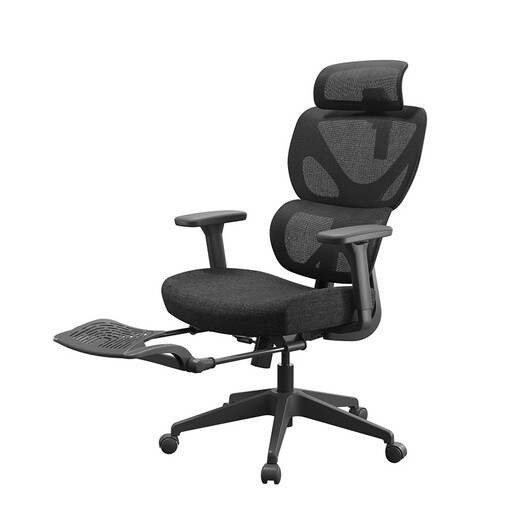
Why this product suits this profile: The integrated footrest is useful for people who switch between focused work and taking a reclined break. It also features an adjustable headrest, rotating armrests, elastic lumbar support and a recline angle of up to 132 degrees.
The footrest is listed as a separate feature. This makes it easier to assess whether you genuinely need it or whether it simply increases the price and space required.
Footrest, 10 cm-thick seat padding, adjustable armrests and 132-degree recline function.
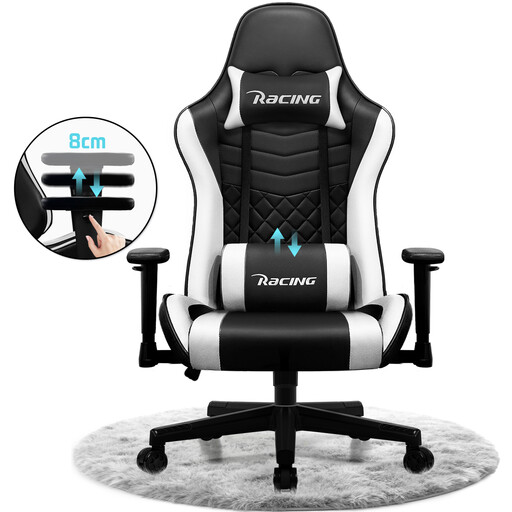
Why this product suits this profile: This gaming office chair combines a padded backrest with adjustable lumbar support, a headrest and armrests. According to the product details, it is designed to support up to 150 kg, and the gas lift’s SGS certification is also specified.
The load limit, adjustable components and certification details are clearly stated. Before buying, you should compare the seat width and covering material with your personal sensitivity to heat.
Stated load capacity of 150 kg, height-adjustable armrests, lumbar support, headrest and 360-degree rotation.
Even a well-equipped ergonomic office chair only works properly when paired with a suitable workstation. First adjust the seat height so that both feet rest completely on the floor. The backrest should support your back without restricting your freedom of movement. Position the screen and keyboard so that your shoulders and wrists remain as relaxed as possible.
Do not use the rocking or recline function continuously in one fixed position. Regular short breaks and changing your seating position are sensible during the working day. After assembly, also check all screws, castors and the gas lift. Keep the assembly instructions and the permitted load limit for the particular model.
We have put together a complete, regularly updated list of products that fully meet these strict selection criteria and the safety regulations applicable in the EU.
Start with the seat height. Both feet should rest firmly on the floor. Then adjust the lumbar support, backrest and armrests so that your shoulders are not raised. The ideal setting depends on your height, desk height and personal seating position.
Its service life depends on how frequently it is used, body weight, materials, assembly and care. Check the screws, castors and gas lift regularly. A stated warranty, availability of spare parts and clear information about load capacity and materials can help you make your purchasing decision.
A headrest can provide additional support when reclining, but it is not required for every working position. A footrest is particularly useful during periods of rest or for users who want to raise their legs occasionally. Both features require additional space and should only be chosen if they suit the way you actually use the chair.