For making several espressos in a row with the same beans, an on-demand grinder is an obvious choice. If team members often bring their own beans, a single-dose model may be a better fit – provided weighing the beans and adjusting the settings work with your office routine. Also check whether the specific model is intended for commercial use, how noisy it is at your planned location, and who will be responsible for cleaning and maintenance.
Which types of grinder suit different teams?
Teams making lots of espressos
If you use the same beans and share an espresso machine, a clear workflow and a grinder suited to the level of use are key. Rocket Espresso lists offices as a potential setting for the Giannino, while Mahlkönig positions the E65S for high-volume use.
Teams working near quiet areas
If you grind within earshot of conversations or focused work, consider noise levels and where the grinder will be placed together. The Eureka Mignon Specialità’s silent design is a feature claimed by the manufacturer, but it is not a comparable decibel rating.
Colleagues who bring their own beans
If you often switch between bean varieties or roasts, weighing out individual portions may better suit your routine. With single dosing, however, you’ll need to weigh the beans and adjust the settings when needed.
What should you look for when buying?
First, decide whether shared beans and quick shots or frequent changes to individual beans matter more to your team. Then check the grind adjustment, noise level, cleaning requirements and whether the specific machine is suitable for office use.
| Buying priority |
What to check |
Who is most affected? |
| Espresso grind size |
Adjustment range and ease of use; agree how the team will record a suitable setting. |
If you want to find the right setting for your espresso beans and make it easy for the whole team to follow, control over grind size is essential. Around 29% of consumers prioritise adjustability for espresso. |
| Shots made by the team |
Expected number of shots at busy times, dosing programmes and the space available. |
When making several espressos in a row with the same beans, a straightforward routine that colleagues can repeat is important. Around 24% of consumers put throughput first. |
| Grinding noise |
Only compare noise figures measured using the same method, or assess the model at your planned location. |
If the office kitchen is next to conversation areas or focused work, consider how disruptive the grinder will be in its actual surroundings. Around 18% of consumers prioritise a quiet workplace. |
| Changing beans |
Check that weighing individual portions fits with the process for changing settings. |
If colleagues regularly bring their own beans, grinding them separately may matter more than keeping a shared supply. Around 18% of consumers prioritise being able to change beans. |
| Cleaning and maintenance |
Check the instructions for the specific model, which areas need cleaning and are accessible, and who will be responsible. |
When a grinder is shared, decide in advance who will remove residue and arrange maintenance. Around 11% of consumers see care and maintenance as their top priority. |
Which common buying mistakes can you avoid?
-
Assuming a home-use grinder is suitable for the office
The EU instructions for the Sage Smart Grinder Pro state that the appliance is intended for household use only. A recommendation for home use does not confirm whether the specific model is suitable for commercial use.
Check the usage information for the exact model and confirm the planned use with the appropriate person or team at your workplace.
-
Assuming “quiet” means a measured noise level
Eureka’s description of its silent technology refers to the design, but does not provide a decibel rating for comparison with other grinders. The location and frequency of grinding also affect how disruptive it is in an office.
Only compare measurements taken under the same conditions, or assess the grinder at its intended location.
-
Treating single dosing and using a bean hopper as the same routine
A single-dose model is designed for individual portions of beans, while an on-demand model with a hopper follows a different workflow. Weighing beans and adjusting the settings frequently takes time.
Before buying, decide whether your team is more likely to use shared beans or switch between individual varieties. Also agree who will coordinate changes to the beans and settings.
Which brands are worth considering?
Rocket Espresso
Rocket Espresso also recommends the Giannino, an on-demand grinder, for offices and small businesses.
- According to the manufacturer, it offers three dose settings and continuous operation.
- The manufacturer’s claims about productivity and suitability for offices are not independent assessments of performance under load or noise levels at your location.
Mahlkönig
The E65S is positioned as a professional grinder for high throughput and multiple saved recipes.
- The manufacturer lists up to six recipes.
- At 58,3 cm tall, it needs enough space. The manufacturer’s stated rate of 4–7 g/s is based on laboratory conditions.
Eureka
According to the manufacturer, the Mignon Specialità combines stepless adjustment with silent technology; the Mignon Single Dose is a separate option for individual portions of beans.
- The Specialità offers stepless adjustment and a vibration-dampening design.
- The silent claim does not confirm a specific noise level or a general noise advantage. The single-dose features apply to the separate model.
Mazzer
Mazzer positions the Mini as a compact on-demand grinder for light commercial use and spaces where room is limited.
- According to the manufacturer, it has 64-mm burrs, stepless adjustment and a removable coffee chute.
- The manufacturer’s claims about speed and dosing consistency are not independent comparisons with other office grinders.
Sage
According to its German product page, the Smart Grinder Pro offers 60 settings and can grind directly into a portafilter.
- The number of settings and the ability to grind directly into a portafilter may be relevant when choosing a grinder for espresso.
- Sage Appliances’ EU instructions state that the appliance is intended for household use only. Before choosing it, check with the manufacturer and the appropriate person or team at your workplace whether it can be used in an office.
Espresso grinders at Joybuy
The grinders below are described in their product details as offering adjustable grind sizes for espresso. For shared office use, you should also check commercial suitability, noise levels at your location, and cleaning and maintenance requirements.
 No image available
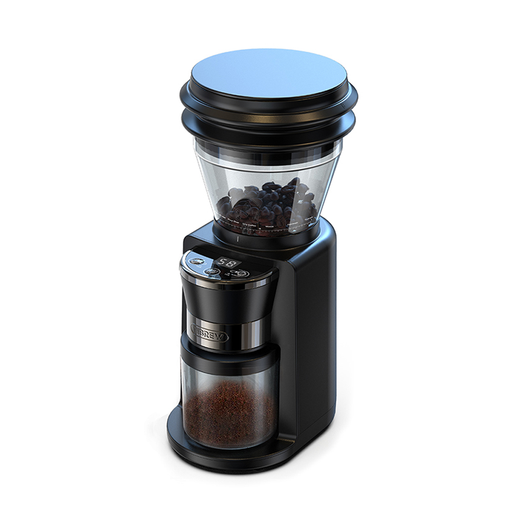
HiBREW G3 coffee grinder
The listed grind settings and memory slots give you options for making repeatable espresso shots.
40-mm conical burrs, 31 grind settings, six memory settings, plus manual and automatic operation.
View at Joybuy
 No image available
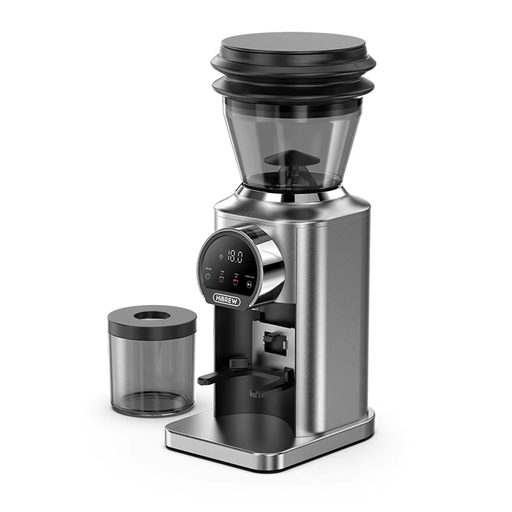
HiBREW G3 Plus coffee grinder
According to the product description, the portafilter holder lets you grind directly into the portafilter.
31 grind settings, an adjustable and saveable grinding timer, and titanium-coated stainless steel burrs.
View at Joybuy
 No image available
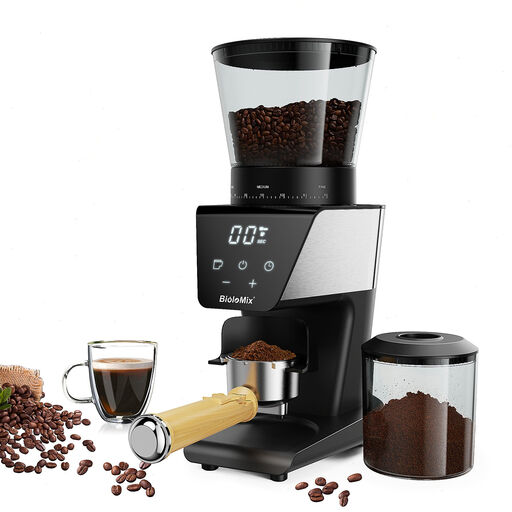
BioloMix BG706
The adjustable grind settings and timer may suit teams looking to establish a consistent dosing routine.
40-mm conical burrs, 30 grind settings, 160 W and a cup selector from 2 to 12.
View at Joybuy
 No image available
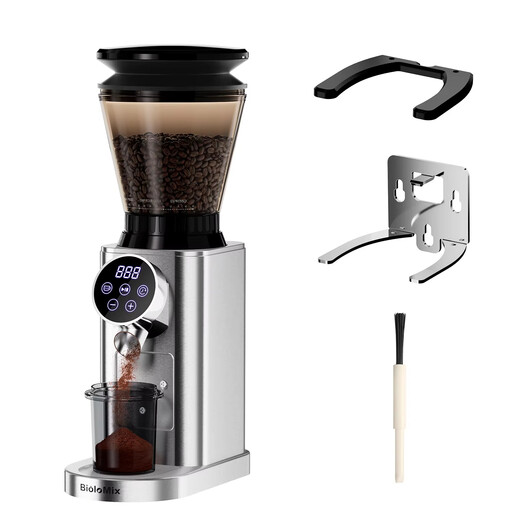
BioloMix CG210
The timer and cup selector offer different dosing settings, according to the product description.
48 grind settings, conical burrs, an electronic timer and a cup selector from 2 to 12.
View at Joybuy
 No image available
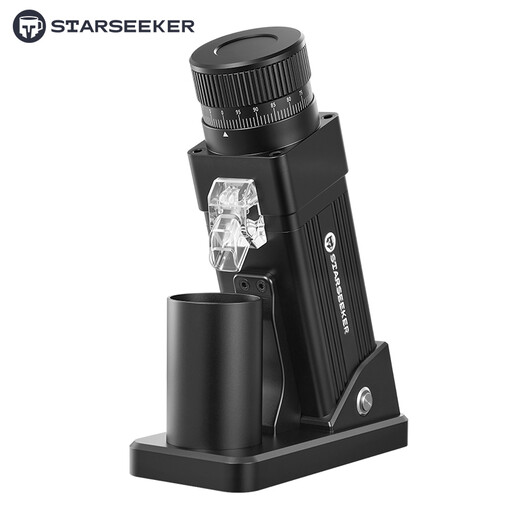
Starseeker E55 Pro
Stepless adjustment is described as allowing fine-tuning of the espresso grind size.
55-mm conical burrs and a removable coffee chute. The product description recommends adjusting the dial while the motor is running; check the instructions for your specific model before use.
View at Joybuy
Frequently asked questions
Which setting should everyone in the office use?
You can’t determine a universal setting from the model specifications alone. Choose a starting point for the beans you use and your shared espresso machine, and write it down. Rocket Espresso lists three dose settings for the Giannino, while Mahlkönig lists up to six recipes for the E65S. You may need to check the setting again after changing beans.
How can you clean a shared grinder safely?
Follow the instructions for the specific model and decide who will be responsible for cleaning it. The Eureka Mignon instructions say to unplug the grinder before working on the burrs. Sage instructions warn against immersing the housing, cable or plug in water. These directions apply to the respective appliances and are not general cleaning instructions for all grinders.
Who arranges electrical safety checks in the office?
The company must ensure that equipment used at work is in proper electrical condition. The German Social Accident Insurance (DGUV) recommends regular checks by appropriately qualified people; how often they are needed depends, among other things, on the appliance, how heavily it is used and the working environment. This does not establish a single inspection interval for every office grinder.
Is CE marking enough to approve a grinder for workplace use?
No. Section 3 of the German Ordinance on Industrial Safety and Health makes clear that CE marking does not replace the employer’s risk assessment for work equipment. The CE requirements that apply to a specific appliance depend on its product category; the marking is not an independent quality seal either.
Are statutory rights and a manufacturer’s warranty the same thing?
No. The German consumer advice centre distinguishes statutory rights against the seller from a voluntary guarantee. Before placing your order, check who your contracting party is and which guarantee and service terms apply to your specific purchase. General consumer information cannot be used to determine the terms of a business purchase in every case.


