
Lieferung heute & morgen

Qualitätsgarantie

Willkommens-Angebote freischalten: KOSTENLOSE Lieferung | Bis zu 80 % RABATT | Kostenlose 30-Tage-JoyPlus-Testphase
App herunterladen
Purchasing a portafilter espresso machine is a decision that should be based on an analysis of technical parameters. Unlike fully automatic systems, a semi-automatic espresso machine gives you manual control over key brewing variables such as grind size, coffee dose, and tamping pressure. The result is an espresso whose flavour profile can be precisely controlled. This article highlights the fundamental technical specifications relevant when choosing a portafilter machine for home use or for light commercial applications.
The quality of an espresso is largely determined by pressure, temperature, and the freshness of the coffee grounds. The following criteria form the basis for an informed purchasing decision.
Brew pressure, measured in bar, is crucial for extracting flavours from the coffee grounds. A pressure of around 9 bar at the group head is considered the industry standard for preparing espresso. Many manufacturers list a maximum pump pressure of 15 to 20 bar. This higher value indicates the pump's capability and ensures that the target pressure of 9 bar is consistently maintained at the portafilter, even with a finer grind and a firm tamp. Therefore, a 20-bar coffee machine has a pump with sufficient performance reserves.
The heating system is responsible for the stability of the water temperature.
A portafilter machine with a grinder offers the advantage of grinding coffee beans fresh, immediately before brewing. This maximises the aroma. When choosing, consider the type of grinder (conical or flat burr) and the number of grind settings. A hardened steel conical burr grinder is considered durable and produces a uniform grind size. More than 25 grind settings offer high flexibility for adjusting to different bean varieties and roasts.
The portafilter diameter is an indicator of the machine's class. While 51 mm or 54 mm portafilters are often used in the home sector, the 58 mm standard has become established in the professional sphere. A larger diameter allows for more even water distribution over a wider surface area of the coffee puck, which can optimise extraction.
A PID (Proportional-Integral-Derivative) controller is an advanced system for digital temperature control. It keeps the brew temperature constant with minimal fluctuations, which is essential for reproducible results. Machines with this feature often allow for precise, degree-by-degree temperature adjustments to specifically influence the flavour profile of different coffee beans.
Based on the technical criteria above, we present a selection of models that cater to different user profiles.
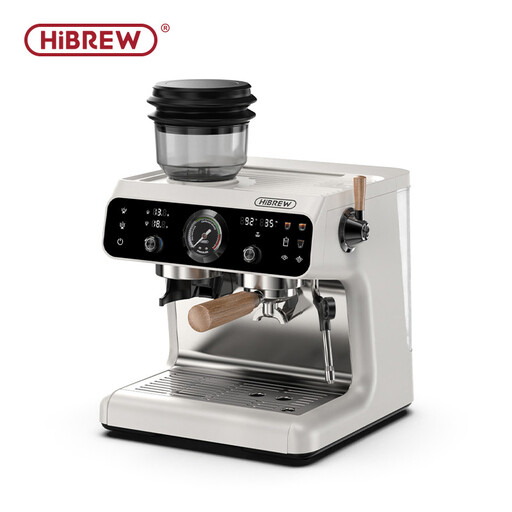
Why we recommend this product: The HiBREW H7B is an all-in-one solution that combines professional features in a single unit. The dual boiler system allows for simultaneous espresso extraction and milk frothing. Its PID temperature control and 58 mm group head provide a level of control and consistency typically found in professional barista espresso machines.
Pros:
Best for: Advanced home baristas and small cafés looking for a powerful, all-in-one solution with precise adjustment capabilities.

Why we recommend this product: The HiBREW H11 focuses on the core functions of an espresso machine in a compact package. With 19 bars of pump pressure and a fast-heating thermoblock, it reliably delivers great espresso. Its simple operation makes it an ideal machine for entering the world of portafilter coffee.
Pros:
Best for: Beginners and users with limited kitchen space who want a straightforward and efficient semi-automatic espresso machine.

Why we recommend this product: The HiBREW H10B strikes a balance between simple operation and advanced programming options. With 20 bars of pressure and the ability to adjust cup volume, extraction temperature, and pre-infusion time, it's aimed at hobby baristas who want to refine their brewing technique.
Pros:
Best for: Coffee enthusiasts who want to move beyond the basics and experiment with different brewing parameters without investing in a dual boiler system.
The models presented here represent a selection from the available range. For a more comprehensive overview of different machine types, including fully automatic and capsule machines, you can find more options in our Coffee Machine Maker category.
1. What does 20 bar mean for an espresso machine? A 20-bar rating refers to the maximum pressure the built-in pump can generate. For the actual espresso extraction at the group head, around 9 bar is ideal. The higher maximum pump pressure provides a performance reserve to consistently maintain this ideal pressure, even with very finely ground and firmly tamped coffee.
2. Does a portafilter machine need an integrated grinder? An integrated grinder is not essential, but it offers significant advantages in terms of freshness and convenience. The beans are ground immediately before brewing, which maximises aroma. Alternatively, a separate coffee grinder can be used, which allows for more flexibility in choosing a grinder but requires additional counter space.
3. How important is water temperature in espresso preparation? Water temperature is a critical factor. The ideal range is between 90°C and 95°C. Water that is too hot can cause over-extraction, making the espresso taste bitter. Water that is too cold leads to under-extraction, resulting in a weak and sour espresso. Machines with PID control or adjustable temperature offer the greatest control for consistent results.