
Lieferung heute & morgen

Qualitätsgarantie

Willkommens-Angebote freischalten: KOSTENLOSE Lieferung | Bis zu 80 % RABATT | Kostenlose 30-Tage-JoyPlus-Testphase
App herunterladen
Matte PETG filament combines PETG’s technical properties with a less glossy surface. This can be useful for functional parts, prototypes and decorative objects where visible layers should be less noticeable and reflections reduced. According to the product description, eSUN Matte PETG Filament 1.75 mm 1 kg is designed for FDM 3D printers and is available in several colours.
However, it is worth taking a close look at the technical specifications before buying. Marketing terms such as ‘water-resistant’, ‘stable’ or ‘easy to print’ do not replace checking printer compatibility and your own requirements.
For many FDM 3D printers, 1.75 mm is the correct diameter. However, devices using a different filament standard require a different size. An incorrect diameter can lead to inconsistent material flow, under-extrusion or feeding problems.
Before placing your order, check the following:
Matte PETG can reduce visible reflections and make layer lines less noticeable. However, the surface finish still depends on layer height, nozzle calibration, print speed, part cooling and retraction. A matte filament surface does not eliminate mechanical or geometric printing defects.
For consistent results, a properly levelled print bed, dry material and a suitable slicer profile are more important than the colour name alone.
According to the product descriptions for the eSUN matte PETG variants, the material offers reliable water resistance. However, a printed object may still allow liquid to pass through gaps between lines, defective layers, holes or insufficient wall thickness.
If a part will come into contact with water, you should also consider:
The PETG filament for FDM printers must match the extruder exactly. The material described here has a diameter of 1.75 mm. This specification is particularly relevant for beginners, as it must not be confused with the spool weight.
FDM stands for a process in which thermoplastic filament is deposited layer by layer. PETG generally requires different slicer settings from PLA. The manufacturer’s specifications and the recommendations for your printer model are the key points to follow.
A spool containing 1 kg of PETG filament is suitable for regular printing jobs and larger components. Actual consumption depends on model size, infill, wall thickness, support structures and failed prints.
If you frequently produce prototypes or functional parts, you should monitor the remaining spool weight. This makes it easier to assess whether there is enough material for the next print.
Matte PETG is a material variant with a reduced gloss effect. This can create a more even appearance on technical housings, model parts and visible prototypes. Available colours include Light Khaki and Mint Green, as well as Dark Grey, White, Lilac and Concrete Grey.
According to the respective product descriptions, the eSUN matte PETG variants are described as offering properties such as high strength, toughness, water resistance and printing stability. These specifications depend on the material and its application. The final load-bearing capacity of a component also depends on its design, print orientation and settings.
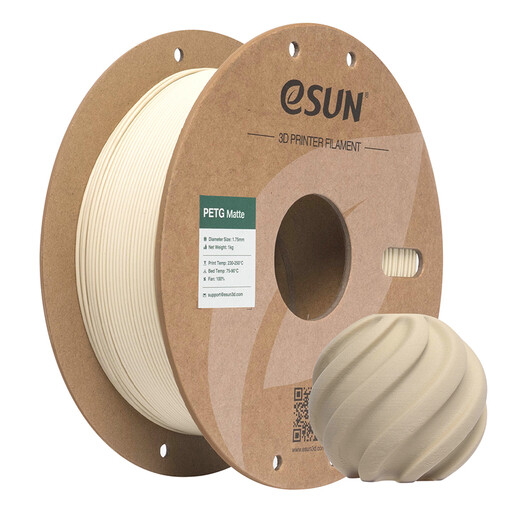
Why this product suits this profile: The 1 kg spool offers an accessible introduction to matte PETG for compatible FDM printers. Light Khaki is suitable for models where a subtle, matte colour effect is desired.
The 1.75 mm diameter and 1 kg weight are clearly stated. This makes it easier to check compatibility with your printer and material requirements.
Matte surface, PETG base and 1 kg spool according to the product description.
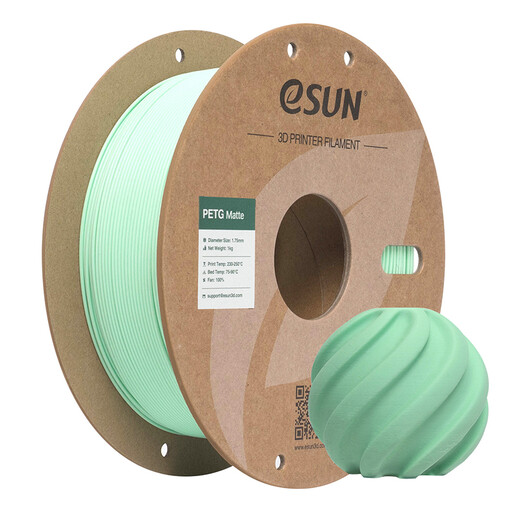
Why this product suits this profile: Mint Green provides a distinctive colour option for visible models, housings and design objects. The product description refers to a matte texture as well as PETG’s typical strength and toughness.
The matte appearance is not mistaken for a guarantee of perfect surfaces. The slicer profile and drying process remain crucial for print quality.
1.75 mm diameter, 1 kg of material and a matte Mint Green surface according to the product details.
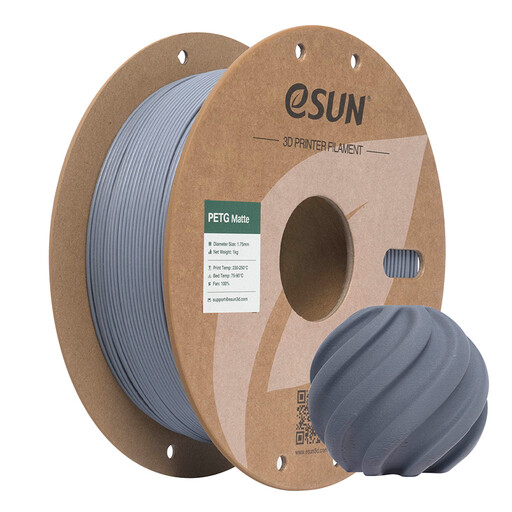
Why this product suits this profile: Dark Grey is suitable for technical housings, prototypes and frequently used functional parts where a discreet surface is preferred.
The advertised water resistance is treated as a material property, not a guarantee for every finished component. The design and layer adhesion must be selected appropriately.
PETG material, matte Dark Grey colour and 1 kg spool according to the product description.
We have put together a complete, regularly updated list of products that fully meet these strict selection criteria and the safety regulations applicable in the EU.
PETG absorbs moisture when stored for extended periods in a damp environment. This can show up as bubbles, inconsistent extrusion or a rough surface. Store an opened spool in as dry an environment as possible, for example in a sealable box with desiccant.
For your first print, a small calibration test is recommended. Start with the settings specified by the manufacturer, then adjust the temperature, speed, retraction and cooling to suit your printer. If you experience adhesion problems, thoroughly cleaning the print plate and adjusting the print bed profile may help.
No. The printer must support both the 1.75 mm diameter and PETG as a material. The extruder, print bed and hotend should also be suitable for the required settings. The specifications provided by the printer and filament manufacturers are the ones to follow.
This depends on the component and the slicer settings. Small decorative objects use considerably less material than large housings or functional parts. Walls, infill, support structures and failed prints have a greater effect on how long the spool lasts than the model’s height alone.
According to the product description, the eSUN matte PETG variants are described as water-resistant or waterproof. However, a finished FDM print is not automatically completely watertight. Pores, seams and print orientation can affect liquid penetration. For applications that carry water permanently, additional design testing and, where necessary, a suitable sealant are required.