
Lieferung heute & morgen

Qualitätsgarantie

Willkommens-Angebote freischalten: KOSTENLOSE Lieferung | Bis zu 80 % RABATT | Kostenlose 30-Tage-JoyPlus-Testphase
App herunterladen
An EV charger must match your vehicle’s charging capacity, the available electrical connection and where you plan to use it. Many poor purchasing decisions are not caused by insufficient power, but by unclear compatibility information, missing installation requirements or confusion between an electric car charger and a 12 V battery charger.
A 22 kW wallbox can only charge at up to 22 kW if three conditions are met: the vehicle supports this AC charging capacity, a suitable 3-phase connection is available and the electrical installation has been designed accordingly. Many electric cars and plug-in hybrids charge more slowly using AC. A 22 kW unit therefore does not automatically mean shorter charging times.
With an 11 kW wallbox, the electrical requirements are simpler for many private garages and parking spaces. The right choice therefore depends on more than just the advertised maximum capacity.
The Type 2 charging standard, widely used in Europe, describes the connection between the vehicle and the charging equipment. However, it does not indicate whether the device is designed to be connected to a standard household socket, a CEE socket or a permanently installed connection.
A portable EV charger with a Schuko plug typically delivers considerably less power than an 11 kW wallbox. Before buying, you should check:
A Wi-Fi charger with app control can schedule charging times, adjust the current and display charging progress. These features are convenient, but they do not replace suitable circuit protection, earthing or professional installation. You should also check whether the app requires a stable Wi-Fi connection at the parking space and what data it records.
With three-phase alternating current, 11 kW corresponds to approximately 16 A per phase, while 22 kW requires approximately 32 A per phase. A device with an adjustable charging current, such as 8, 10, 13 or 16 A, can adapt more easily to different connections. Depending on the model, 22 kW units may offer additional current settings up to 32 A.
The actual charging time is also determined by the battery capacity and the vehicle’s integrated charger. A simple guide is:
Charging time in hours = battery capacity in kWh ÷ charging capacity in kW
Charging losses and any limitation imposed by the vehicle are not included in this calculation.
Look for clearly stated features such as:
Some of the EV chargers listed specify Type B residual-current monitoring with AC and DC components. However, the required protection technology for the entire installation must still be assessed by a qualified electrician. In Germany, permanently installed wallboxes should generally be connected by a qualified electrical installation company. Additional requirements from the grid operator may apply to units above 11 kW.
A 12 V battery charger is not intended for an electric car’s high-voltage battery. It is suitable, for example, for the starter battery of a car, motorbike, van or motorhome. Before buying, check:
An AGM charger or GEL battery charger should explicitly support the relevant battery type. The term “pulse repair charger” does not indicate that a damaged battery will become safe to use again. The function may be ineffective with deeply discharged or defective batteries.
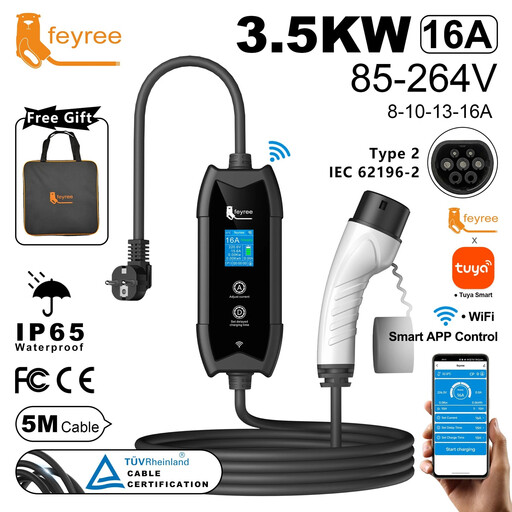
Why this product suits this profile: This portable EV charger is suitable for users who want to charge at home or on the go using suitable connections. According to the product details, the charging current can be adjusted between 8 A and 16 A, with delayed charging and scheduling also available.
The adjustable current helps you adapt the device to the available connection. However, you should check the vehicle connection and circuit protection before buying.
5 m cable, LCD display, app control and current settings from 8 A to 16 A, according to the product description.
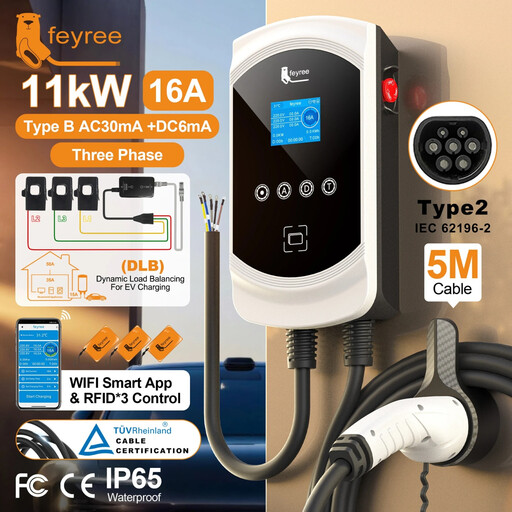
Why this product suits this profile: This wallbox is an appealing option for households where other appliances are running while the vehicle is charging. According to the product details, the DLB function monitors consumption and adjusts the charging current.
The stated load distribution helps address the risk of overloading the household electrical system. You must still confirm compatibility with your home installation in advance.
11 kW, Type 2 compatibility, app control, LCD display and, according to the product description, safety features including residual-current monitoring.
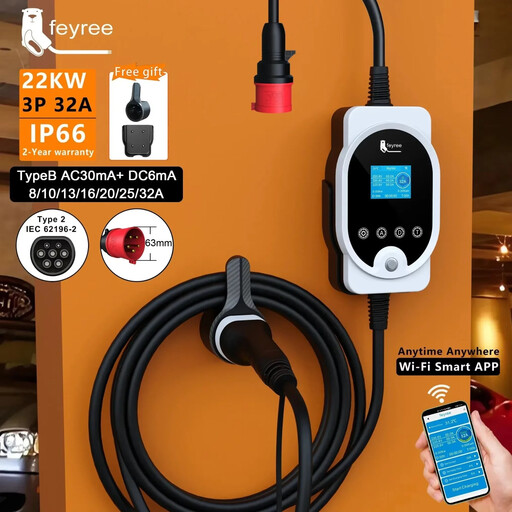
Why this product suits this profile: This three-phase charger is designed for users with a suitable 32 A connection and vehicle who want to use a portable charging station with an additional wall bracket.
The description explicitly states the requirements for a three-phase 32 A circuit and reliable earthing. This clearly highlights the need to check the installation before buying.
Current settings up to 32 A, app-based scheduling, portable or wall-mounted use and an IP66 rating, according to the product description.
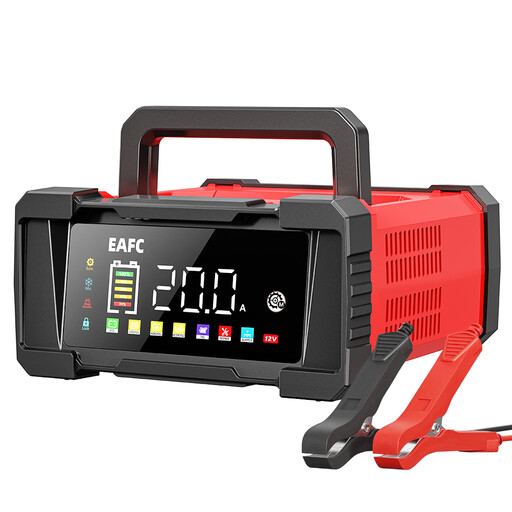
Why this product suits this profile: This device is designed for vehicle batteries and, according to the product details, supports 12 V at up to 20 A and 24 V at up to 10 A. It is therefore suitable for different vehicles and maintenance situations.
The choice of different modes reduces the risk of confusing the voltage and battery type. You must still check the battery specifications and selected mode before connecting it.
12 V/24 V operation, seven charging programmes, voltage and current display and safety features, according to the product description.
We have put together a complete, regularly updated list of products that fully meet these strict selection criteria and the safety regulations applicable in the EU.
11 kW is often a better fit for private charging points, provided that the vehicle and household connection support this capacity. 22 kW can make sense if the vehicle has the appropriate AC charger and a suitable 32 A three-phase connection is available. Before buying, discuss the installation and any notification or approval requirements with a qualified electrician and the grid operator.
That depends on the model. Devices with a Schuko plug are designed to operate from a household socket, but charge at considerably lower power than a wallbox. The socket, wiring and circuit protection must be suitable for the intended continuous load. Extension leads and multiway adapters are generally not a suitable solution for regular charging.
Its service life depends, among other things, on ambient temperature, humidity, cable routing and how intensively it is used. A fully automatic charger with a maintenance mode may be suitable for extended periods when the vehicle is parked, provided the manufacturer expressly states this. Regardless of the model, you should regularly inspect the cables, clamps and housing.