
Lieferung heute & morgen

Qualitätsgarantie

Willkommens-Angebote freischalten: KOSTENLOSE Lieferung | Bis zu 80 % RABATT | Kostenlose 30-Tage-JoyPlus-Testphase
App herunterladen
Purchasing an electric car is a major step, but the question of the right home charging setup often raises questions. With a multitude of options available—from permanently installed wallboxes to portable chargers—the choice can seem complex. This guide is designed to provide clarity, explain the technical differences, and help you make an informed decision on an EV charging station that suits your vehicle and your lifestyle.
The decision for a charging system depends on several factors, including your living situation, vehicle type, and daily driving habits. Here are three key aspects to consider.
The most fundamental decision concerns the type of charging station.
Wallbox (fixed installation): A home charging station that is permanently mounted on a wall in your garage or carport. It is connected directly to the home's electrical system and typically offers higher charging power, for example, with an 11kW wallbox. This allows for significantly faster charging times compared to a standard household socket. It is the most convenient solution for homeowners who want to charge their vehicle daily or overnight.
Portable Charging Station: A portable EV charger offers maximum flexibility. It is not permanently installed and can be carried in the trunk of your car. This allows you to charge your vehicle in various locations—whether at a friend's house, on holiday, or anywhere with a suitable socket. These devices are ideal for renters who are not permitted to make structural alterations, or for drivers who are frequently on the go.
Charging power and speed depend heavily on the type of plug used.
Schuko Charging Cable: Enables charging from a conventional 230V household socket. The charging power is limited to a maximum of 3.7 kW, and in practice, often to 2.3 kW (10A) for safety reasons. This method is slow and is primarily suitable for plug-in hybrids with small batteries or as an emergency charging option.
CEE Charging Cable: Uses industrial sockets (high-power current) that allow for higher and more stable power delivery. A blue CEE cable (camping plug) delivers up to 3.7 kW on a single phase, while a red CEE cable can achieve a charging power of 11 kW or more on three phases. A portable charger with a CEE charging cable is a powerful alternative to a fixed wallbox.
Type 2 Charging Cable: This is the European standard plug on the vehicle side for AC (alternating current) charging. Both wallboxes and most portable chargers for the European market use a Type 2 charging cable to connect to the electric car.
Modern charging solutions often offer intelligent features that optimise the charging process. A wallbox with app control allows you to start and stop charging sessions remotely, schedule charging times (e.g., to take advantage of off-peak electricity rates), and monitor power consumption in detail. Some portable chargers also have this functionality, enabling additional control and efficiency.
Based on the criteria above, we have compiled a selection of charging solutions that cover different needs.
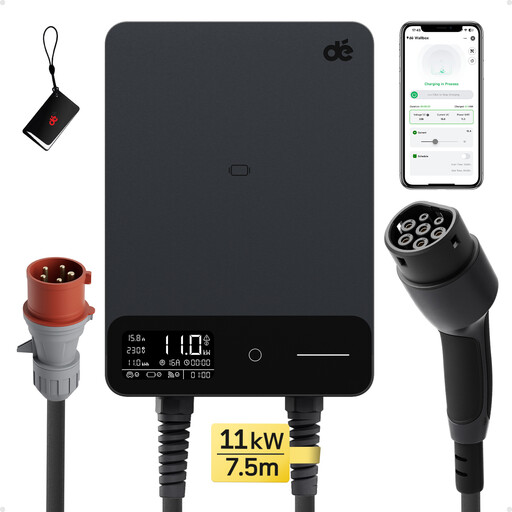
Why it stands out: This wallbox combines a solid 11kW charging power with comprehensive smart features. Control via the Tuya Smart app and access control via RFID card offer both convenience and security. The integrated RCD Type B (residual current device) is an essential safety feature that often needs to be retrofitted externally on other models.
Advantages:
Who is it for? For homeowners looking for a permanent, high-performance, and intelligent home charging station who value integrated safety features and convenient operation.
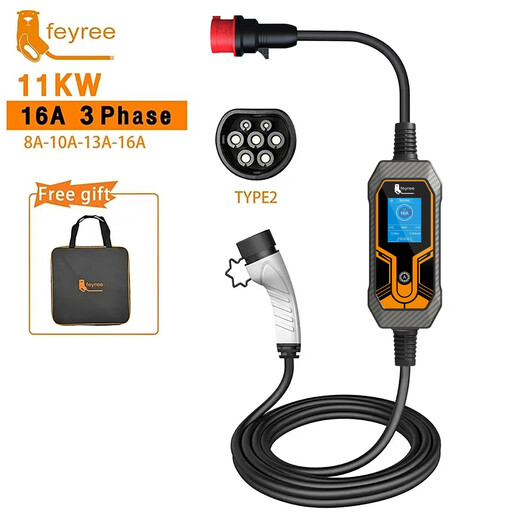
Why it stands out: This portable EV charger bridges the gap between mobile flexibility and high charging performance. With its red CEE plug, it can deliver up to 11 kW of power from a 400V industrial socket—comparable to a fixed wallbox. The integrated LCD display shows all relevant charging data directly on the device.
Advantages:
Who is it for? For EV drivers who have access to a CEE socket at home or at work and prefer a powerful yet transportable charging solution. It is also a great option for campers or tradespeople.
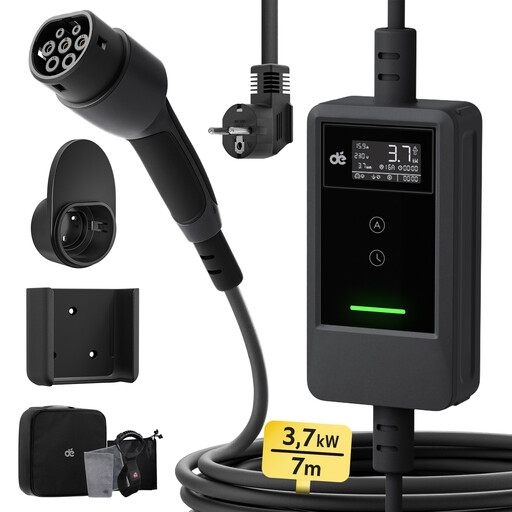
Why it stands out: This portable charger is the definition of plug-and-play. It only requires a standard household socket (Schuko) and is ready to use immediately. Its unique feature is the combination of simple handling and smart control via an app, which is not a given in this device category.
Advantages:
Who is it for? Ideal for renters in apartments without a fixed charging option, for owners of plug-in hybrids, or as a secondary and emergency charger for any EV driver.
If the models presented here don't perfectly match your requirements, there is a wide variety of other charging solutions available offering different performance features or designs. From various cable lengths to specific network functions, the market offers the right EV charger for almost any need.
Discover our full range of EV charging accessories
Yes, for safety and warranty reasons, the installation of a hardwired wallbox, especially an 11 kW or 22 kW unit, must be carried out by a qualified electrician. They will inspect your home's electrical system and ensure a professional and safe connection. In contrast, portable chargers with Schuko or CEE plugs are plug-and-play solutions and do not require installation.
Yes, this is possible with a suitable portable charger equipped with a Schuko charging cable. However, keep in mind that this is the slowest charging method. Furthermore, a household socket should not be subjected to a continuous maximum load. It is recommended to limit the charging current to 10A and have the socket checked by a professional beforehand to ensure it is suitable for continuous use.
An 11 kW wallbox charges using three-phase alternating current. In Germany, it requires registration with the grid operator. For most private households and vehicles, it represents a good compromise between charging speed and grid compatibility. A 22 kW wallbox charges twice as fast but requires approval from the grid operator, which is not always granted. Additionally, the vehicle itself must be able to support 22 kW AC charging, which is not the case for many models.