
Lieferung heute & morgen

Qualitätsgarantie

Willkommens-Angebote freischalten: KOSTENLOSE Lieferung | Bis zu 80 % RABATT | Kostenlose 30-Tage-JoyPlus-Testphase
App herunterladen
An excavator toy for children should look realistic at first glance, but that is not the only important factor. What really matters is whether the toy excavator is suitable for the child’s age, height, intended play area and preferred way of playing. There are clear differences between a small toy excavator for the playroom, an excavator for the sandpit and a remote-controlled excavator when it comes to materials, care and safety.
As a Joybuy Product Recommendation Officer, I filter the relevant product details and show parents, grandparents and other gift buyers what to look out for.
A detailed body says little about the durability of the arm, bucket or rotating mechanism. With frequent play, weak connections, thin plastic parts or a boom that cannot be locked in place can quickly become frustrating. So check whether the excavator with a movable arm is genuinely designed for repeated movement and whether the bucket can be operated properly.
An excavator suitable from age 3 is not automatically appropriate for younger children. Small parts, moving joints and detachable accessories may pose a risk. The age recommendation on the product page and the safety information on the packaging are the key points to consider. For children under three, only use a model expressly designed for this age group. Direct adult supervision remains advisable.
Not every construction vehicle toy is suitable for sand, soil or moisture. Metal excavators may seem sturdy outdoors, but they need protection from prolonged exposure to damp conditions. Plastic models are often easier to clean, while fine joints can become blocked with sand. Follow the manufacturer’s intended-use instructions and dry the vehicle after outdoor play.
For toddlers, large, easy-grip controls and straightforward mechanisms are practical. A model with a central handle may be easier to operate than a vehicle with several small levers. Older children may enjoy more ways to play with a tracked excavator toy featuring a rotating upper structure, or with a 1:16 scale model.
Also check:
ABS plastic is used in many toy construction machines. It is relatively lightweight and may be suitable for both indoor and outdoor play. A metal excavator for children offers a different weight and feel, depending on its construction, but should also have rounded edges and sturdy moving parts.
More important than the material itself are the specific details concerning:
A 360-degree rotation range, height-adjustable bucket or articulated steering are only useful if they work easily in everyday play. Battery-free models do not involve ongoing battery costs. A remote-controlled excavator can offer additional functions, but it requires batteries, space and a certain level of hand-eye coordination.
So think about which type of play matters most: loading sand, acting out construction-site scenarios, collecting vehicles or building a larger play world together with other construction vehicles for children.
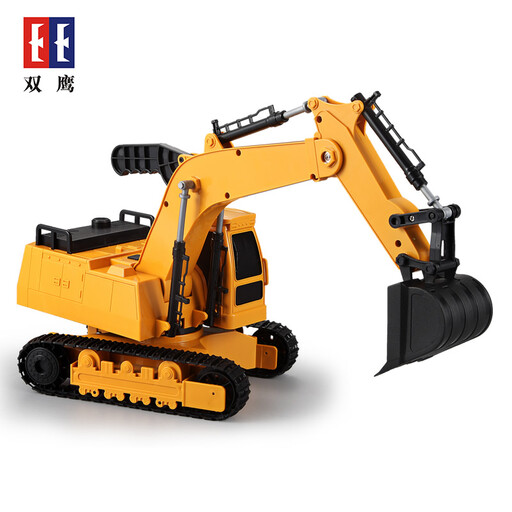
Why this product suits this profile: This manual toy excavator focuses on essential play functions and does not require batteries. According to the product information, it is suitable for children aged 3 and over.
The specifications mention a movable boom with digging and emptying functions, as well as a rotating cab. This places the focus on practical functions rather than purely decorative looks.
Manual operation, rubber tracks and a cab that rotates through 360 degrees according to the description.
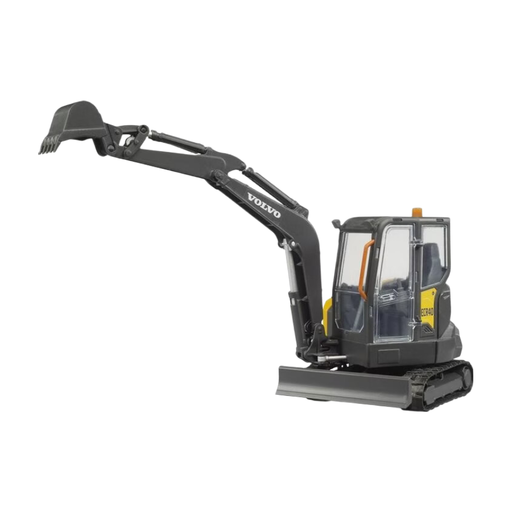
Why this product suits this profile: This 1:16 scale model combines several documented functions with a compact design suitable for the playroom or sandpit.
The short slewing radius, rotating structure and adjustable dozer blade are all clearly specified. This makes them easier to assess than general claims such as “realistic”.
360-degree rotation, angled boom, adjustable and lockable blade, no batteries required.
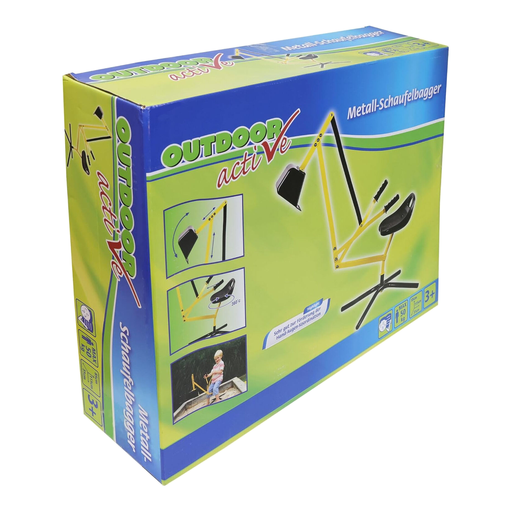
Why this product suits this profile: This ride-on excavator is designed for use in the sandpit and is suitable for children aged 3 and over who want to get actively involved in playing with sand.
The product information specifies the metal construction, rotating seat, intended use and required supervision. This makes it clear that it is not a small model vehicle.
Metal construction, rotating seat, functional digging boom and no assembly required.
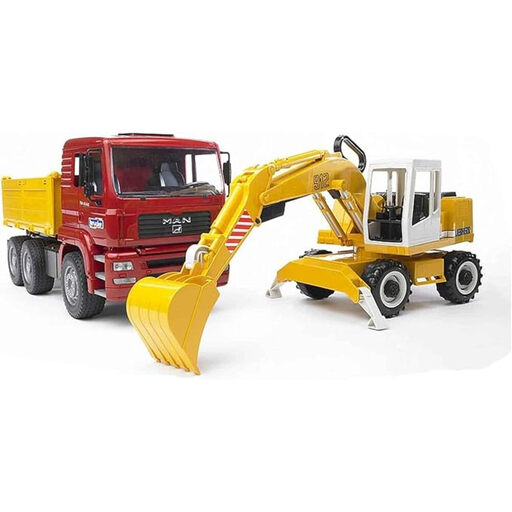
Why this product suits this profile: This set combines a toy tipper truck and toy excavator in one construction-site scenario and, according to the product information, is suitable for children aged 3 and over.
The functions are described in specific terms: tipping load bed, rotating excavator arm, supports and treaded tyres. This makes the possible uses easy to understand.
Two combined vehicles, manual functions, tipping skip and 360-degree rotation of the excavator arm.
We have compiled a complete, regularly updated list of products that fully meet these strict selection criteria and the safety regulations applicable in the EU.
With a sandpit excavator, sand should be removed from the joints, wheels and bucket after play. Plastic models can be cleaned with a damp cloth in accordance with the manufacturer’s instructions. Metal parts must be dried thoroughly. Store the vehicle in a dry place and avoid prolonged exposure to direct sunlight unless the manufacturer recommends otherwise.
Before each use, it is worth checking:
That depends on the individual model. Some vehicles are designed for children aged 2 and over, while others are suitable from age 3 or 4. The manufacturer’s information, any small parts and the child’s motor skills are the deciding factors. The guidance on the packaging and product page should be treated as the main reference.
Plastic is lightweight and usually easy to clean. For an outdoor ride-on excavator, metal may be a suitable option. Regardless of the material, the vehicle should be cleared of sand and moisture after use and stored somewhere dry.
Many manual models, such as classic BRUDER excavators, toy wheel loaders or toy tipper trucks, do not require batteries. A remote-controlled excavator or a model with light and sound functions may need batteries, however. Before buying, check whether batteries are included and what ongoing costs may arise.