
Lieferung heute & morgen

Qualitätsgarantie

Willkommens-Angebote freischalten: KOSTENLOSE Lieferung | Bis zu 80 % RABATT | Kostenlose 30-Tage-JoyPlus-Testphase
App herunterladen
Experiment kits for children combine hands-on activities with an introduction to the natural sciences. However, choosing the right one is not always easy for parents, grandparents and education professionals: some sets only include enough materials for a few experiments, while others require additional equipment or are too demanding for the stated age group.
As a Joybuy Product Recommendation Officer, I therefore focus on clear, practical criteria rather than eye-catching marketing claims. The following tips will help you choose an age-appropriate, practical and safe-to-use experiment kit for children.
Large sets often look particularly versatile on the packaging. However, the key question is how many separate experiments can actually be carried out with the included materials. For example, a crystal-growing set creates a long-term observation process, while a kit for making bouncy balls usually allows several individual shapes to be made.
So check the following:
An experiment kit for children aged 8+ may be designed for this age group, but certain steps may still require assistance. This particularly applies to hot water, heating, chemical mixtures, small parts and batteries.
The age recommendation should therefore always be read alongside the safety warnings. Adult supervision is especially important for chemistry toys and sets containing small components. Children should read the instructions before starting and use the included materials only as intended.
A product can be colourful and creative without explaining many scientific concepts. Look for clear instructions that not only describe the steps, but also explain terms such as gelling, crystal formation, states of matter and light reflection.
This turns a short craft project into an easy-to-understand educational activity.
Many STEM toys are suitable for children aged 8+, including a Galileo experiment kit, a Kosmos experiment kit or a microscope for children. Before buying, check the following:
When choosing a microscope for children, you should also consider the lighting, power supply and specimen-preparation accessories supplied.
A useful selection criterion is the type of activity you are looking for:
A chemistry experiment kit should include clear instructions, materials that can be measured out and suitable containers. For edible projects, you should also check whether the ingredients are explicitly labelled for their intended use and whether allergy information is provided.
Before buying, it is worth checking the product dimensions and the amount of workspace required. Sets involving mixtures or liquids need a wipe-clean surface, while a microscope requires a safe, permanent place to stand. After the experiment, the work surface, moulds and tools should be cleaned according to the instructions, and the materials should be stored out of reach of younger children.

Why this product suits this profile: This set combines a manageable kitchen project with two flavours, moulds and four jars to decorate. It is ideal for families looking for an accessible introduction to science toys for children.
The ingredients, moulds, measuring cup and jars are listed as included in the set. This means fewer additional items are needed for the described activity.
Vegan-declared mixtures, two flavours, several moulds and a guide to gelling agents and states of matter.

Why this product suits this profile: Children can observe crystal formation over several days and document the changes. This makes it a good choice for households looking for a calm, step-by-step learning process.
The instructions explain how to mix, observe and document the process. The experiment is therefore more than just a brief demonstration.
Multicoloured salt crystals, an illustrated step-by-step guide, containers and starter materials; suitable for children aged 8+.
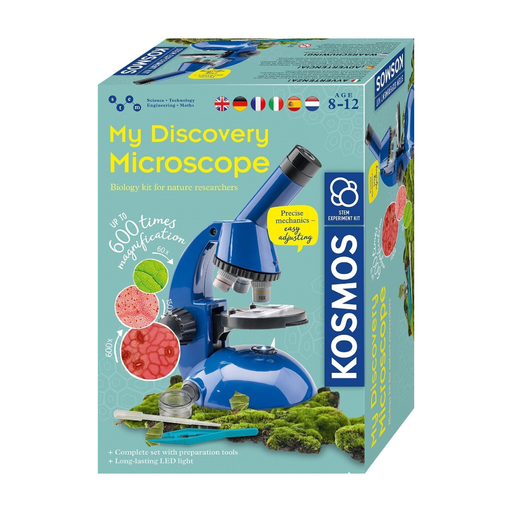
Why this product suits this profile: For children who want to make regular observations and examine their own samples, this microscope offers a wider range of uses than a one-off mixing project.
The set is not limited to a single consumable material. It includes specimen-preparation accessories such as slides, a pipette, tweezers and sample containers.
Up to 600× magnification according to the product description, LED lighting and a colourful instruction booklet; two AA batteries are required and not included.

Why this product suits this profile: This set is designed for children who want to observe daily and take responsibility for an ongoing process.
The large observation aquarium and separate hatching area support longer-term engagement rather than a one-off experiment.
Instructions on care and observation, an aquarium with a detachable section and a recommended age range of 8 to 14 years.
Other suitable options include a Clementoni Galileo Fluorescent Crystals set, a bouncy-ball kit or a slime-making laboratory. For creative educational games with less emphasis on science, construction and logic games may also be worth considering.
We have put together a complete, regularly updated list of products that fully meet these strict selection criteria and the safety regulations applicable in the EU.
Suitable sets have a clear age recommendation, easy-to-understand instructions and manageable steps. Growing crystals, making bouncy balls, simple kitchen experiments and a microscope for children are all different options. When heat, chemicals, small parts or live animals are involved, adult supervision should be planned.
That depends on the type of experiment. Consumables such as granules, gelling agents or slime ingredients usually provide enough material for a limited number of experiments. A microscope, moulds or an aquarium, on the other hand, can be used for longer. Before buying, parents should check which parts need to be reordered and whether the accessories can be reused.
Potential follow-up costs include consumables, batteries, cleaning products or caring for live animals. For battery-operated devices, check whether batteries are included in the delivery. Animal observation sets also require regular care and suitable living conditions.