
Lieferung heute & morgen

Qualitätsgarantie

Willkommens-Angebote freischalten: KOSTENLOSE Lieferung | Bis zu 80 % RABATT | Kostenlose 30-Tage-JoyPlus-Testphase
App herunterladen
Experiment kits for children combine play, observation and their first encounters with scientific questions. However, choosing the right one is not always easy for parents, grandparents and educational settings: age recommendations, accessories and safety information can vary considerably. For example, a colourful set may only allow a few experiments, while a more comprehensive kit may require greater supervision or additional household materials.
This buying guide explains what matters when choosing science toys for children, STEM toys and creative learning sets.
“Lots of experiments” sounds convincing at first. However, what matters is how many experiments can genuinely be carried out with the materials included and whether refill materials will be needed afterwards. For sets containing consumables, the product description should clearly state the quantities included and which household items are required.
An experiment kit for ages 6 and up is not automatically suitable for every child of that age. Reading, following instructions carefully and handling small parts can all present different levels of difficulty. With an experiment kit for ages 8 and up, the subject matter may also involve heat, chemical mixtures, sharp points or batteries.
Warnings such as “not suitable for children under 36 months”, small parts and the need for supervision are not minor details. With a chemistry experiment kit, you should also check whether an adult needs to be present while mixing, heating or tidying up. If a set contains strong magnets, particular care is required: swallowing multiple magnets can cause serious injury.
For younger children aged 6 to 9, structured sets with short, illustrated instructions and everyday subject matter are a good choice. For example, the KOSMOS Student Lab for Years 1 and 2 covers light and shadows, air and water, as well as the senses, and is recommended for children aged 6 to 9.
From the age of 8, the content can become more complex. A chemistry experiment kit or a microscope for children often requires more precise measuring, observation and documentation. The age limit should always be considered alongside the specific safety warnings.
Look for a clear list of what is included:
A set that does not include batteries can be straightforward to use. With the KOSMOS Explorer microscope, for example, 2 AA batteries are required for the LED lighting, and these are not included.
Smooth, rounded plastic parts make cleaning easier. A stable work surface is useful for experiments involving liquids. Also check whether a storage bag or box is included. This helps prevent small parts from getting lost and makes the next use easier.
With magnetic construction sets, the magnets should be permanently enclosed. Regular checks for cracks, loose parts or protruding components are also important. With sets involving live animals, such as a Triops breeding set, it is not just the accessories that matter, but also daily care and suitable conditions.
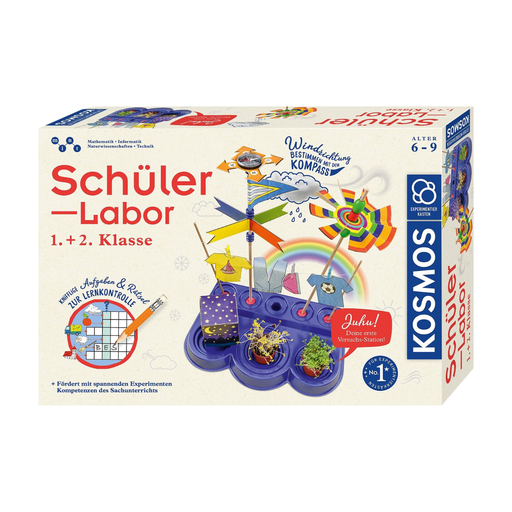
Why this product suits this profile: The topics are designed for children aged 6 to 9 and combine more than 50 experiments with questions about nature and technology from everyday school life.
The product description lists specific topics, the age range and the adult supervision required, rather than making only general learning claims.
More than 50 activities, illustrated instructions and knowledge-based tasks; manual operation without batteries.
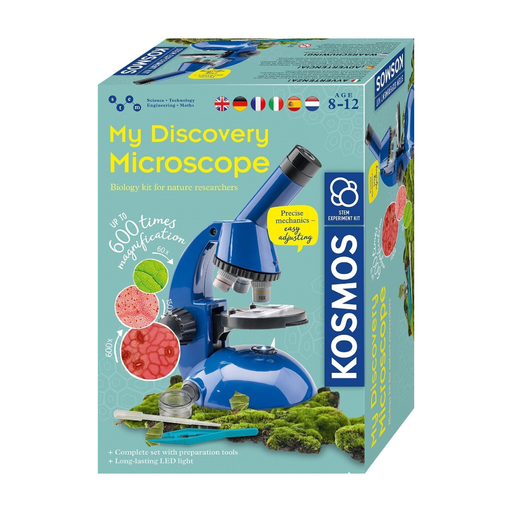
Why this product suits this profile: For children aged 8 and over who want to examine plants, fibres and other samples closely and need a set with the right accessories to do so.
Magnification of up to 600x is complemented by microscope slides, cover slips, a pipette and other preparation tools.
LED lighting, a comprehensive range of preparation accessories and an illustrated instruction booklet; 2 AA batteries required separately.

Why this product suits this profile: The set is aimed at children aged 8 to 14 who want to observe and document the animals over a longer period and take responsibility for their care.
The experience does not end after a single experiment: the aquarium, hatching area and instructions are designed for repeated observation.
Extra-large observation tank with a separate area, plus instructions on care, development and animal behaviour.
Not every educational toy needs to be a traditional experiment kit. For children who prefer building, magnetic building blocks for children or a marble run extension could be a good option. In these cases, the number of parts, compatibility and magnet warnings are particularly important.
For creative chemistry topics, options include the KOSMOS Gummy Candy Lab for ages 8 and over or a Slime Lab. The Gummy Candy Lab involves hot water, so an adult should supervise the heating and pouring. A magic set for children aged 6 or 7 and over, on the other hand, is an option when concentration, dexterity and presentation are the main focus. Clementoni’s MiniMagics sets each include instructions for individual illusions and do not require batteries.
A kit about optical illusions can also be an alternative to traditional mixing experiments. The KOSMOS Brain Tricks includes 3D glasses, a Sphericon and a tilted room scene, among other items, and is designed for children aged 8 and over.
We have put together a complete, regularly updated list of products that fully meet these strict selection criteria and the safety regulations applicable in the EU.
For children aged 6 and over, sets covering simple topics with short experiment steps and illustrated instructions are a sensible choice. The KOSMOS Student Lab is recommended for children aged 6 to 9. Even so, an adult should supervise the experiments and follow the safety warnings.
That depends on what the kit contains. Consumables such as granules, gummy mixtures or chemical ingredients are sufficient for a limited number of uses. Microscopes, building blocks and reusable measuring instruments can be used for longer when stored carefully. With a Triops set, the duration of use also depends on care, the life cycle and the refill materials available.
Potential additional costs may include consumables, batteries or refill sets. Before buying, check whether batteries are included, which household materials are needed and whether the experiments can be repeated several times. With a microscope for children, you should also factor in replacement microscope slides and cover slips.