
Lieferung heute & morgen

Qualitätsgarantie

Willkommens-Angebote freischalten: KOSTENLOSE Lieferung | Bis zu 80 % RABATT | Kostenlose 30-Tage-JoyPlus-Testphase
App herunterladen
An extendable dining table with storage can bring several pieces of furniture together in your kitchen, dining room or flat: a place to eat, a surface to put things on and somewhere to store them. To make this combination work in everyday life, though, you should look beyond the finish and the advertised number of seats. The key considerations are the extended dimensions, weight capacity, access to the storage and the amount of clear floor space in the room.
A table measuring 140 or 180 cm long needs more room than just the tabletop. You also need to allow for chairs, walkways and any doors or drawers when open. In a small room, a dining table that seems space-saving on paper can end up restricting movement.
Measure the space the table will occupy both when closed and when extended. Allow enough room for chairs, too. If the room is too small, you shouldn’t have to leave the table permanently extended for everyday use.
A dining table with built-in storage might have drawers, open shelves, a cupboard or a compartment beneath the tabletop. These options vary considerably in how practical they are day to day. Deep cupboard shelves, for example, are suitable for crockery, while a narrow shelf is better for napkins, placemats or magazines.
Check the following:
Extendable and folding furniture often includes runners, castors, locks or several tabletop sections. If it isn’t assembled accurately, the surfaces may not sit flush or the table may wobble. So don’t assume that “easy assembly” means the furniture will arrive fully assembled.
Before buying, check the estimated assembly time, the number of packages and whether two adults are recommended for particular models.
For an extendable kitchen table, both configurations matter. A model that measures 110 to 140 cm is better suited to a compact dining area than a table that extends from 150 to 190 cm. Round models can create a sociable feel when closed, but their depth means they still need plenty of space.
Compare the table height, too. Most models are around 75 to 77 cm high, so make sure the height works with your existing chairs.
Weight capacity is usually given in kilograms and often refers to the load distributed evenly across the tabletop. Individual shelves may have a lower limit. A table with a stated weight capacity of 60 kg, for example, isn’t necessarily suitable for very heavy objects placed in one spot.
MDF and chipboard surfaces are easy to care for, provided you wipe up spills promptly. Metal frames, adjustable feet and locking mechanisms can help keep the table stable, although it’s still important to place it on a level surface.
With an extendable dining table that stores its extension leaf inside, you won’t need to find a separate place to keep it. Other models use an additional leaf that has to be fitted. A folding table with storage can save space when it’s not in use, but it needs a secure locking mechanism when unfolded.
Check whether:
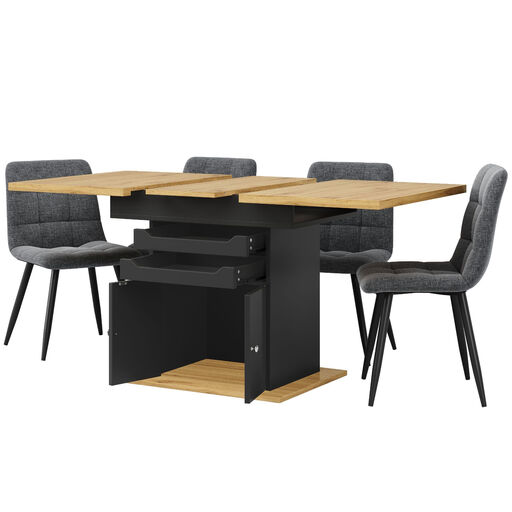
Why this product suits this household: The compact 110 cm table extends to 140 cm when needed. Two extension shelves and a cupboard provide storage for cutlery, table linen and kitchen essentials.
Storage is built into the base, so there’s no need to make room for a separate sideboard. According to the product information, the extension mechanism can be used without tools.
110–140 × 80 × 76 cm, stated weight capacity of up to 60 kg, and soft-close doors and drawers.
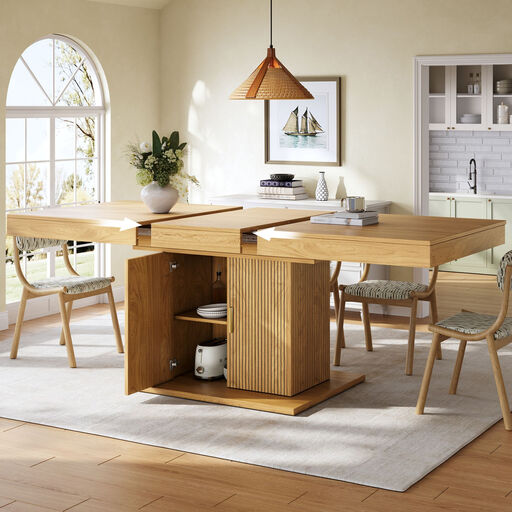
Why this product suits this household: This model combines a 140 to 180 cm tabletop with a closed cupboard and a removable shelf. It’s a good fit for families and open-plan kitchens with regular storage needs.
The storage takes the form of a cupboard, keeping its contents out of sight. The dimensions make it clear how much space you’ll need when the table is extended.
MDF and metal construction, 140–180 × 90 × 75.2 cm, and a stated weight capacity of up to 60 kg.
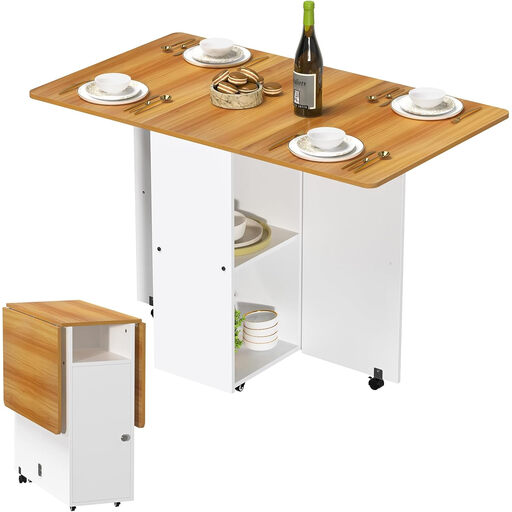
Why this product suits this household: Four castors with brakes make it easy to use as a dining, work or kitchen table wherever you need it. The folding tabletop is designed for small flats and spaces that serve different purposes.
The castors make it easy to move, while the brakes keep the table in place when you’re using it. The lower shelf adds extra storage without cupboard doors opening out in front of the table.
Measures 120 × 70 cm when unfolded, has a scratch-resistant surface according to the product information, and can be used as a table or work surface.
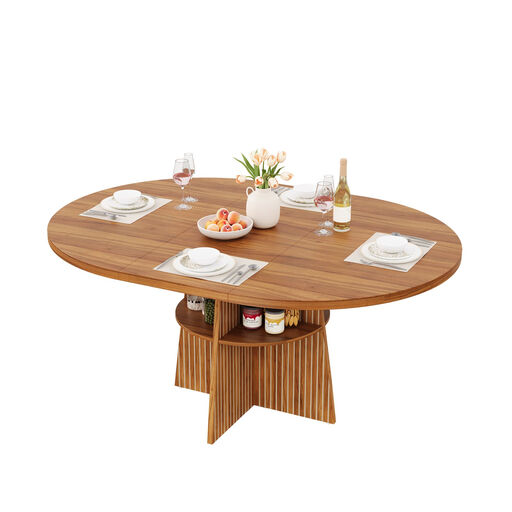
Why this product suits this household: The 110 cm round tabletop extends to 150 cm. An integrated shelf in the cross-shaped base provides space for crockery, spices or kitchen essentials.
The dimensions in both round and extended configurations help you plan your space. According to the product information, it has an anti-tip device and non-slip foot pads.
Walnut look, extends from 110 to 150 cm, with a stated weight capacity of 60 kg for the tabletop and 10 kg for the shelf.
We’ve put together a complete, regularly updated list of products that meet these strict selection criteria and fully comply with the safety regulations in force in the EU.
MDF, chipboard and melamine surfaces should be cleaned with a slightly damp cloth, then wiped dry. Abrasive cleaners can damage the decorative finish. Don’t let liquid collect in joints, runners or around the edges.
If your table has a cupboard or drawers, try to distribute heavy items as evenly as possible. Keep castors, extension runners and locking mechanisms free of crumbs and dust. After assembly, check regularly that screws and fittings are secure.
As well as the table itself, allow for the depth of the chairs and a clear walkway. If the table is 180 cm long when extended, check that cupboard doors and drawers can still open fully.
Its lifespan depends on the materials, construction, assembly and how much it’s used. Distributing weight evenly, operating the extension mechanism carefully and tightening the fittings regularly can help it stand up to everyday use. You can’t determine a precise lifespan from the product dimensions alone.
Extra cupboards, drawers, castors or extension mechanisms usually make a table more complex to design and assemble. Whether the extra cost is worthwhile depends on whether the built-in storage replaces a separate piece of furniture and how often you’ll use the extension. The key factors are the space you have available and your storage needs.