More space for your RAW archive
If most of your older photos are kept in one place and your collection is growing, take stock of what you already have, how much it is likely to grow and how much extra storage you’ll need for a separate backup.


For a growing RAW archive that mostly stays in one place, a desktop HDD is worth considering. If you transfer files frequently or edit on the move, a portable SSD may be a better fit, while a USB-powered portable HDD offers a mix of portability and extra storage. The key factors are the capacity of the specific model, the connection requirements for the speed you want, and the file system. Moving files to another drive is not the same as backing them up: fotowissen distinguishes between moved files and an additional copy, while the Federal Office for Information Security recommends regular backups and occasional checks that files can still be read.
If most of your older photos are kept in one place and your collection is growing, take stock of what you already have, how much it is likely to grow and how much extra storage you’ll need for a separate backup.
If you transfer files frequently or work with active RAW projects, capacity is only part of the picture. The drive, connection and cable you actually use matter too.
If you regularly take files with you, consider a USB-powered portable HDD or a portable SSD. Plan for a separate backup, independent of the drive you take on the move.
First, allow enough space for your archive and a separate backup. Then decide whether frequent transfers or working in different locations make a portable drive more important.
| Buying priority | What to look for | Who is this important for? |
|---|---|---|
| Space for your archive | Work out the size of your existing RAW collection and expected growth in the same units; check the capacity of the specific model. | If I’m archiving a growing collection, I don’t want to look only at the maximum capacity for the product range. Archive space is the top priority for around 33% of consumers. |
| Separate backup | Decide which storage medium will hold the additional copy, and regularly check that the files can still be read. The Federal Office for Information Security recommends regular backups and these kinds of checks. | If I want to do more than just move my RAW files to another drive and want an extra copy too, I’ll plan for a second storage medium or another backup location. Around 27% of consumers prioritise having a separate backup. |
| Speed for active projects | Check that the USB connection and cable meet the requirements of the specific drive; plan separately for your working drive and archive storage. | If I transfer files frequently, I want to know whether my computer supports the drive’s connection. Around 20% of consumers prioritise speed for active RAW projects. |
| Portability and compatibility | Check the power supply and file system for the locations and computers you use; back up your files before reformatting, if required. | If I use RAW files in different locations or on different computers, I need a drive that suits the power supply and file system. Around 20% of consumers prioritise portability and compatibility. |
Once you’ve moved your files, the external drive may hold the only remaining copy. You’ll need an additional copy stored separately and checked to make sure it can still be read.
Keep your archive or working copy separate from your backup. Set up a regular routine and occasionally check that your backed-up files can still be read.
A separate backup takes extra storage and time for regular updates and checks.
Samsung’s advertised maximum speeds for the T7 Shield require a compatible USB 3.2 Gen 2 host, a suitable cable and UASP enabled.
If you regularly transfer RAW files, check that your computer’s connection and cable meet these requirements before you buy.
Toshiba describes the documented Canvio Basics model as formatted in NTFS for Windows, and says it needs to be reformatted for macOS.
Check the file system and make sure you can write to the drive on the computers you use. Back up any existing files before reformatting.
Expansion Desktop is a range of desktop HDDs for archives kept in one place.
Canvio Basics is a range of USB-powered portable HDDs. Toshiba lists a 4-TB model for carrying files with you.
The T7 Shield portable SSD range is designed for use on the move and frequent transfers; the documented German model has a capacity of 2 TB.
Depending on capacity and connection, the following portable external HDDs and SSDs are suitable for extra storage on the move or frequent file transfers. A single drive is not a substitute for a separate backup.
 No image available
A portable external HDD for anyone who wants to carry photos and other files on a single drive.
5 TB, USB-C, USB 3.2 Gen 1 and 2, 2.5-inch format. The description lists Windows and Mac as compatible systems.
 No image available
A portable SSD for anyone who wants to store or transfer files on the move.
1 TB and USB 3.2 Gen 2×2 Type-C. The product description lists sequential speeds of up to 2.060 MB/s for reading and 1.800 MB/s for writing; performance may be lower on systems without USB 3.2 Gen 2×2. Compatible systems listed include Windows, macOS and Android.
 No image available
A portable SSD for anyone who wants a compact drive for files and media.
2 TB and USB 3.2 Gen 2. For this model, the product description lists sequential speeds of up to 1.050 MB/s for reading and 1.000 MB/s for writing, with USB-C-to-C and USB-C-to-A cables included.
 No image available
A portable SSD for anyone who wants to access files and projects in different locations.
1 TB and USB 3.2 Gen 2x2. The product description lists sequential read and write speeds of up to 2.000 MB/s, along with USB-C-to-C and USB-C-to-A cables.
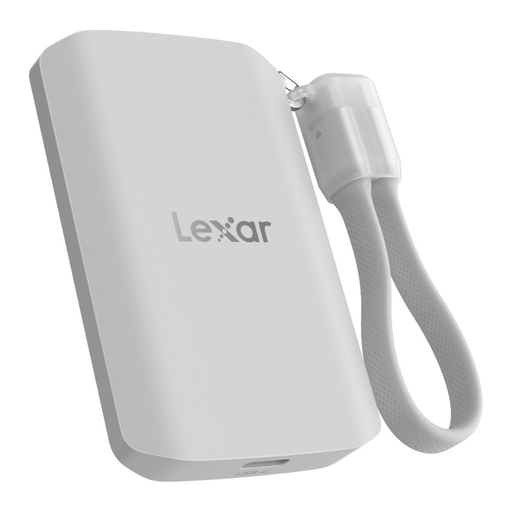 No image available
A portable SSD for anyone who wants to store and transfer files on the move.
1 TB and USB 3.2 Gen 2x2. The product description lists read and write speeds of up to 2.000 MB/s and an IP65 rating. It notes that the drive must not be submerged or exposed to high-pressure water for extended periods.
First, check how much storage your RAW folders currently use, then allow for expected growth and a separate backup. There’s no one-size-fits-all TB figure: check the capacity of the specific model rather than just the maximum for its product range.
No. Adobe explains that Lightroom Classic’s built-in catalogue backup only includes the catalogue file. Back up your photos and exported files separately.
Check the file system before copying anything. For the documented Canvio Basics model, Toshiba specifies NTFS for Windows and says reformatting is required for macOS; Apple explains how to format an external drive for Windows and Mac. Back up any existing files before reformatting.
A separate RAW backup needs extra storage and time for a regular backup routine. For its German Expansion Desktop range, Seagate specifies a power adapter and USB cable for operation; check what’s included with the specific model.