What to consider when choosing
First, decide how you’ll keep your files recoverable and how much space your archive needs. Then check the connections, confidentiality features and transfer speed for the way you’ll actually use it.
| Consideration |
What to check before buying |
Who it matters most to |
| Local recovery |
Whether there’s room for a separate copy and whether you can open files from it. |
If I want to access my recordings even if my archive SSD is damaged or lost, I’ll plan for a separate copy. Around 28% of consumers put recoverability first. |
| Archive capacity |
The size of existing files, planned future recordings and the storage space actually available. |
If my archive is going to grow as I record more classes, I want to choose capacity based on file sizes rather than a general estimate in hours. Around 22% of consumers put having enough archive space first. |
| File confidentiality |
A suitable way to encrypt files or the storage device, and a safe place to keep the key. |
If I’m carrying recordings that might include other people, I want to make unauthorised access more difficult and keep my key safe. Confidentiality is the main priority for around 22% of consumers. |
| Connection compatibility |
Device ports, supplied cables and adapters, and support for external USB storage. |
If I want to use the same archive with devices that have different USB ports, I need a connection that works with each one. Around 17% of consumers put connection compatibility first. |
| Transfer time |
The USB capabilities of your computer and cable, and the conditions behind the manufacturer’s figures. |
If I’m transferring a large batch of recordings, I want to know whether my computer and cable can actually deliver the stated speed. Around 11% of consumers prioritise transfer time. |
External SSDs for local lecture archives
This selection includes 1 TB and 2 TB external SSDs for local lecture archives, including models for different USB connections and carrying stored files around.
 No image available
KEXIN external SSD, 1 TB
For an archive sized to suit the files you already have, with the option to connect to a USB-A device when needed.
1 TB; USB-C; up to 500 MB/s according to the product title. The product description says a USB-C to USB-A cable, an adapter, a protective cover and a carry case are included.
View on Joybuy
 No image available
Samsung T7, 2 TB, Indigo Blue
For a larger local archive and confidential files, if you want to use the encryption feature.
2 TB; according to the product description, a USB-C cable for USB-C and USB-A ports, plus optional 256-bit AES hardware encryption with password protection.
View on Joybuy
 No image available
KIOXIA Exceria Plus G2 Portable SSD, 2 TB
For a larger archive and confidential files, if the connections and features are compatible with your devices.
2 TB; according to the product description, USB-C to A and USB-C to C cables, plus 256-bit AES hardware encryption with password protection. Compatibility may depend on the features of the host device.
View on Joybuy
 No image available
Samsung T9, 1 TB, Black
For a 1 TB archive, if you want to use the drive with devices that have either a USB-C or USB-A port.
1 TB; according to the product description, a USB-C cable for USB-C and USB-A ports, plus protection against drops from up to 3 m.
View on Joybuy
 No image available
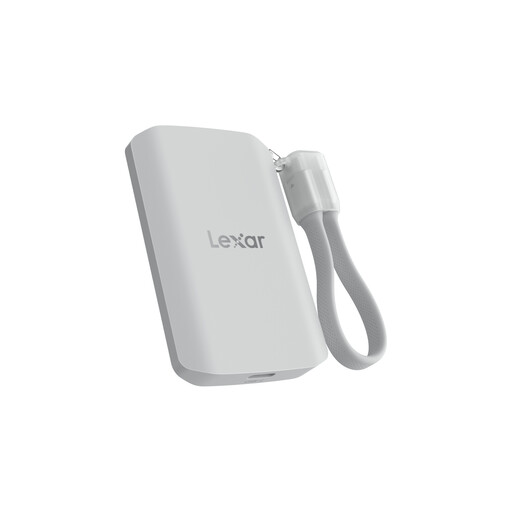
Lexar ES5 Portable SSD, 1 TB
For a 1 TB archive if you’ll be carrying the drive around often and its stated compatibility suits your devices.
According to the product description, USB 3.2 Gen 2x2, IP65 and protection against drops from up to 3 m. The drive must not be submerged in water or exposed to high-pressure water for extended periods.
View on Joybuy
Frequently asked questions
How do I set up an archive without the cloud that can survive an SSD failure?
Save your files to a separate local storage device as well, and check from time to time that you can open them from there. The German Federal Office for Information Security notes that it’s not possible to predict exactly how long a storage medium will last.
Am I allowed to record a lecture myself and keep it on an SSD?
There’s no straightforward yes or no: check that you have permission and find out your university’s rules before recording, particularly if other people may be heard. Section 201 of the German Criminal Code (StGB) concerns the unauthorised recording of privately spoken words; the University of Heidelberg generally advises against recording students. Saving a recording locally doesn’t automatically make it permissible.
Do I need an SSD with built-in encryption for confidential recordings?
Not necessarily. The Federal Commissioner for Data Protection and Freedom of Information describes encryption for both an entire storage device and individual files or folders. Choose an approach that’s practical for your devices, and keep the key somewhere secure.
Does the Verbatim Pocket SSD backup software work on a Mac too?
No. According to Verbatim, the supplied Nero Backup software is only compatible with Windows. Whether the SSD itself works with your device and whether the software is compatible are two separate things.
What should I check about warranties and damage before buying?
Check the terms for the specific version. Kingston states that the XS1000 has a five-year warranty; despite the T7 Shield’s IP65 rating, Samsung says that liquid and dust damage aren’t covered by the warranty. These details apply to the models mentioned and shouldn’t be assumed to apply to other SSDs.


