Large video libraries
If you want to back up lots of footage and project folders, factor in your entire library and any new projects you have planned, so you don’t run out of space too soon.


First, choose an external SSD with enough space for your video library and planned projects. Then check that your computer and cable support the advertised interface. Peak speeds don’t guarantee the speed of a complete backup; Germany’s Federal Office for Information Security (BSI) also recommends keeping backups separately and checking that you can restore them.
If you want to back up lots of footage and project folders, factor in your entire library and any new projects you have planned, so you don’t run out of space too soon.
If you often copy large folders, think about how long a full backup will take rather than relying on an advertised peak speed alone.
If you want to restore projects after a device failure or damage, keep another copy separately and check that you can restore your files. The BSI points out that successful recovery isn’t something you can take for granted.
The right choice depends on what matters most to consumers with large video projects.
| Priority | What to check before buying | Who is it most relevant to? |
|---|---|---|
| Usable capacity | Consider the size of your existing folders, planned projects and the actual storage available on the version you choose. | If I want my library and new projects to fit on one drive, I’ll need more space than my current collection requires. Around 33% of consumers say having enough capacity is their top priority. |
| Speed when copying large files | Check tests of long write operations for the exact model and capacity version; don’t treat peak speeds as sustained performance. | If I regularly back up large project folders, I want to know how long the whole transfer will take. Around 27% of consumers prioritise the time taken to complete large backups. |
| Connectivity and software | Compare the ports on your computer and cable with the SSD, and consider how you plan to back up your files. | If my SSD, computer and backup software all need to work together, I’ll check the interfaces and format requirements before setting everything up. Around 20% of consumers say compatibility is their top priority. |
| Recovery and protection | Keep another copy separately, try restoring some files and, for confidential projects, check that suitable encryption is available and that the key can be stored securely. | If I want to recover my projects after a device failure or loss, I’ll plan to keep a separate copy and test the recovery process. Around 20% of consumers prioritise recoverability and protection. |
After formatting and allowing for other uses, some of the stated capacity won’t be available for storing files.
Work out how much space your library takes up, allow for future projects and compare this with the usable capacity of the specific version.
If you choose an SSD with too little space, you may need another drive sooner than planned.
The peak speed stated by Samsung for the T9 requires, among other things, a computer and cable that support USB 3.2 Gen 2x2.
Check your computer’s ports and the cable you’ll use before choosing an SSD with a faster interface.
Without compatible ports or cables, you may not get any benefit from paying extra for a faster interface.
A fault or damage at the storage location could affect both the original files and your only backup. The BSI recommends keeping backups separately and checking that you can restore them.
Keep another copy separately and test that you can restore important project files.
Without a separate copy, losing both the originals and the backup could leave you unable to access your projects.
Apple recommends APFS or APFS (Encrypted) for new Time Machine volumes. Reformatting will erase any data already stored on the drive.
Decide how you’ll back up your files before setting things up, and copy any existing files to another location.
Formatting the drive will erase the files already stored on it.
The Portable SSD T9 is an option for computers with USB 3.2 Gen 2x2; Samsung Germany lists a 4 TB version.
The XS2000 is available in capacities up to 4 TB and uses USB 3.2 Gen 2x2; the XS1000 offers up to 2 TB and uses USB 3.2 Gen 2.
The Extreme PRO with USB4 is an option for frequent large transfers, provided your computer supports the interface.
The Ultra Compact SSD is designed for compact, portable use, with a direct USB-C connector and capacities up to 2 TB.
The Envoy Ultra is a Thunderbolt 5 option, with stated capacities of 2, 4 and 8 TB.
The following Joybuy products are external SSDs for storing files and making backups. Compare the capacity and connection of each version with your full project collection and computer.
 No image available
Could work as external storage for a smaller collection of files; check that it has enough capacity for the projects you want to back up.
The product title lists USB 3.1, USB-C and speeds of up to 500 MB/s.
 No image available
The 1 TB version could suit you if your video library, with some room to spare, fits within this capacity.
Listed features include USB 3.2 Gen 2, write speeds of up to 1,000 MB/s and optional 256-bit AES hardware encryption.
 No image available
The 2 TB version offers more rated capacity than the 1 TB model; compare your storage needs with the usable space available.
Listed features include USB 3.2 Gen 2, write speeds of up to 1,000 MB/s and optional 256-bit AES hardware encryption.
 No image available
This version could suit you if 1 TB is enough and your computer supports USB 3.2 Gen 2x2.
Listed features include USB 3.2 Gen 2x2 and read and write speeds of up to 2,000 MB/s. Samsung Germany makes these peak speeds conditional on a compatible host and cable, with UASP mode enabled; they aren’t a measure of sustained write performance.
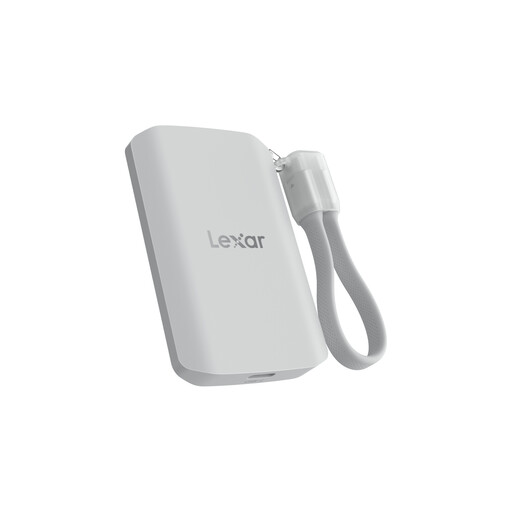 No image available
This 1 TB SSD is an option for storing media and project files on the go, provided its capacity is sufficient and your computer supports the connection.
Listed features include USB 3.2 Gen 2x2, read and write speeds of up to 2,000 MB/s and an IP65 rating. The description notes that performance may be lower on computers without USB 3.2 Gen 2x2.
No. The speeds quoted by Samsung and Kingston are maximum figures under specific connection conditions. The time taken also depends on your computer, cable and data volume, as well as tests of long write operations for the exact model.
No. Apple recommends APFS or APFS (Encrypted) for new Time Machine volumes. Reformatting a Windows volume that’s already in use will erase the data on it, so copy your files to another location first.
After making a backup, try restoring a few project files and keep another copy separately. The BSI points out that being able to restore files isn’t something you can take for granted, and damage at the original storage location could affect several copies kept there.
If needed, allow for another backup kept separately, and check whether the interface you want requires a specific cable. Kingston lists a limited five-year warranty for both the XS1000 and XS2000; this doesn’t guarantee that your files can be recovered.
No. In its guidance dated 26 April 2024, Germany’s Federal Environment Agency notes that waste electrical equipment must be disposed of separately from household rubbish, for example at local collection points or suitable take-back facilities. Before handing over the drive, remove any stored project and personal data, following instructions for the specific model.