
Lieferung heute & morgen

Qualitätsgarantie

Willkommens-Angebote freischalten: KOSTENLOSE Lieferung | Bis zu 80 % RABATT | Kostenlose 30-Tage-JoyPlus-Testphase
App herunterladen
A new extractor hood is meant to keep your kitchen air fresh, but the sheer number of options can be overwhelming. Well-intentioned purchases often lead to disappointment: a unit that's too loud for an open-plan kitchen, or a model with insufficient power to effectively eliminate cooking fumes. These issues frequently stem from common misjudgements. We'll show you the three pitfalls to watch out for and which technical features truly matter, so you can make an informed decision.
Before diving into models and designs, it's wise to understand the typical sources of error. This helps you avoid buying a new appliance that causes more frustration than it solves.
Many buyers focus primarily on the maximum extraction rate, measured in cubic metres per hour (m?/h). A high number seems like a good choice. In practice, however, especially in modern open-plan kitchens, a quiet extractor hood becomes the deciding factor for comfort. A unit that generates over 65 decibels (dB) on a medium setting can significantly disrupt conversations or listening to the radio. A quiet model often operates in the 50 to 60 dB range on its normal setting.
The choice between a ducted extractor hood and a recirculating extractor hood is fundamental and depends on your living situation.
Choosing the wrong system can lead to unnecessary installation costs or inadequate air purification.
A hood that is too weak cannot capture all the cooking fumes. An oversized hood consumes an unnecessary amount of energy. As a rule of thumb for calculating the minimum required power: Room Volume (Length x Width x Height in m) x 10 = Recommended Airflow Capacity in m?/h. Also, pay close attention to the energy efficiency class. A class A+++ appliance uses significantly less electricity than a C or D model, which will make a noticeable difference on your electricity bill over the years.
To find the right extractor hood, you should carefully examine the following technical parameters and designs.
The design determines not only the look but also the ergonomics of your kitchen. Common widths are 60 cm extractor hood for standard hobs and 90 cm extractor hood for wider cooking zones.
Modern extractor hoods offer more than just an on/off switch. Touch controls are hygienic and easy to clean. Some models go a step further, offering an extractor hood with app control or gesture control, which simplifies operation while cooking. Integrated LED lighting ensures the hob is well-lit.
Here are some models tailored to specific user profiles and their requirements.
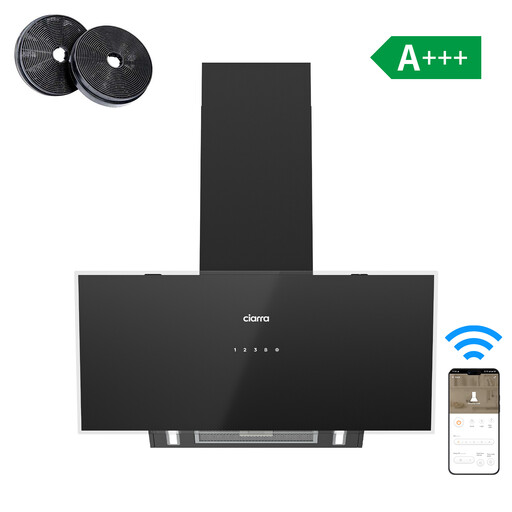
Why it's a great fit: This model combines an elegant black glass design with modern technology. With its 90 cm width, a high airflow capacity of 650 m?/h, and WiFi app control, it fulfils the desire for aesthetics, performance, and smart functionality.
Despite its high performance, the noise level remains moderate at 60 dB on the maximum setting. The A+++ energy efficiency class prevents high running costs, so performance doesn't come at the expense of efficiency.
Control via sensor touch and WiFi app; A+++ energy efficiency class; Dual-Intake System for efficient capture of cooking fumes.
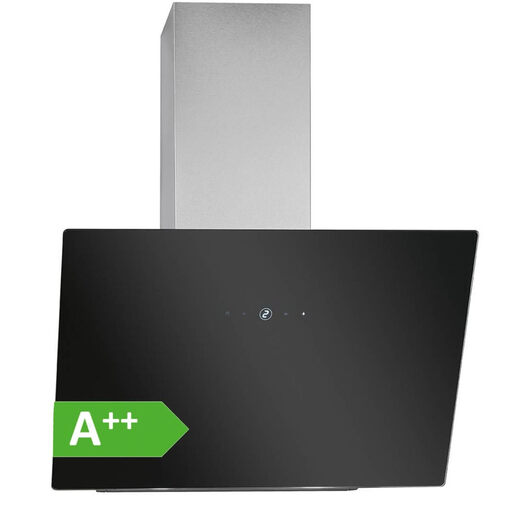
Why it's a great fit: This model is a well-balanced solution for standard kitchens. With its 60 cm width, a modern design of black glass and stainless steel, and intuitive touch controls, it's ideal for modernising an existing kitchen, even in rental properties.
The hood is suitable for both recirculating and ducted operation. This offers maximum flexibility and avoids installation issues, regardless of the structural conditions.
Flexible installation (recirculating/ducted); 9 power levels for precise adjustment; dishwasher-safe 5-layer aluminium grease filter.
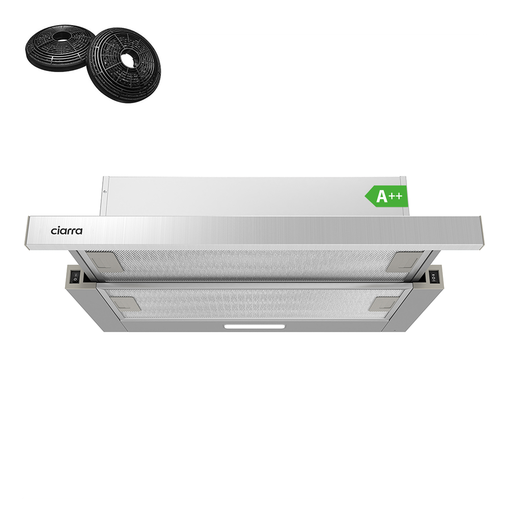
Why it's a great fit: This telescopic hood is designed for small kitchens. Thanks to its extendable design, it can be discreetly integrated into the wall cabinet when not in use, saving valuable space above the hob.
It solves the space problem without compromising on performance. With an extraction rate of 370 m?/h, it is sufficiently powerful for common cooking applications, and the A++ energy efficiency class ensures economical operation.
Space-saving telescopic design; memory function saves the last setting; A++ energy efficiency class.
We've compiled a complete, up-to-date list of products that fully meet these strict selection criteria and relevant safety regulations.
1. How often should you clean the grease filter of an extractor hood? Depending on the intensity of your cooking, the metal grease filter should be cleaned every 3 to 4 weeks to maintain full performance and minimise the fire hazard from grease deposits. Most of these filters are dishwasher-safe, which makes cleaning much easier.
2. How often does the charcoal filter need to be changed in a recirculating hood? With a recirculating extractor hood, the activated charcoal filter, which is responsible for eliminating odours, must be replaced regularly. The lifespan depends heavily on cooking habits but is typically between 3 and 6 months. Some models have a saturation indicator that reminds you when it's time for a change.
3. Can I install a ducted hood in a rental property? Installing a ducted hood requires an opening in the exterior wall. This is a structural alteration that generally requires the landlord's consent in a rental property. Be sure to clarify this before making a purchase. In many cases, a recirculating extractor hood is the more straightforward and permission-free alternative for tenants.