
Lieferung heute & morgen

Qualitätsgarantie

Willkommens-Angebote freischalten: KOSTENLOSE Lieferung | Bis zu 80 % RABATT | Kostenlose 30-Tage-JoyPlus-Testphase
App herunterladen
A Faber-Castell artist pencil set can be a valuable addition to your studio, studies, classroom or hobby. However, the sets differ significantly in terms of pigment type, binder, tip shape, paper recommendation and storage. A large colour selection alone doesn't tell you much about practical suitability.
Before buying, artists, illustrators and keen hobby sketchers should particularly watch out for three typical pitfalls:
Faber-Castell watercolour pencils and watercolour markers use water-soluble pigments. The colour can be applied dry and then activated with a damp brush. This creates gradients and broad watercolour effects. Watercolour paper is usually better suited for this than very thin drawing paper, as it can absorb moisture more stably.
A watercolour marker additionally offers a brush tip for areas and a fibre tip or chisel tip for lines. Before buying, you should check whether both tips are present and whether the ink is explicitly described as water-soluble.
Oil-based Polychromos coloured pencils, on the other hand, are designed for dry, multi-layered colour applications. They are suitable for controlled lines, hatching and illustrations, without needing water for blending.
Lead thickness affects both durability and the level of detail you can achieve. The product specifications listed here mention, for example:
A thicker lead can be more stable under higher pressure and deposit more pigment. For very fine contours, however, a carefully sharpened lead and a suitable sharpener are more important than the sheer colour selection. For soft pastel or charcoal pencils, you should use an appropriate knife or a dedicated sharpener.
Pastel and charcoal materials often require suitable drawing paper with sufficient tooth. A Pitt pastel pencil set can be used for hatching, soft transitions and mixed techniques. Pastel chalk sets are suitable for larger areas, while pastel pencils offer more control for contours.
A charcoal drawing set typically includes charcoal pencils, charcoal sticks, a kneaded eraser and blending stumps, depending on the version. Charcoal can smudge easily. Fixing the finished picture with a suitable fixative can reduce the risk of smudging. Always follow the fixative manufacturer's instructions.
Packaging is also a practical selection criterion: a metal tin protects delicate leads, while a pencil roll allows quick access in the studio or when you're out and about.
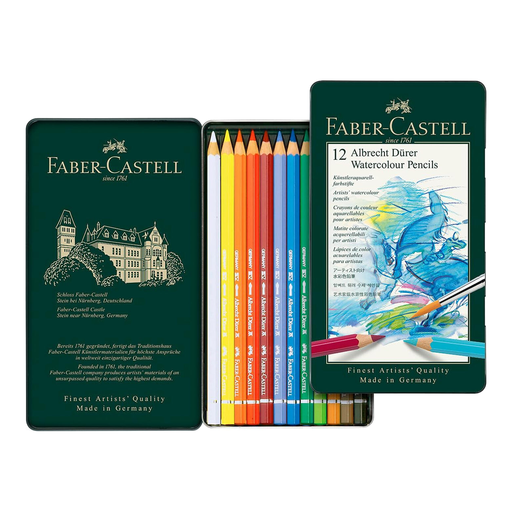
Why this product fits the profile: This set offers a manageable introduction to dry drawing and water-activated watercolour effects. The 12 pencils in the metal tin are ideal for lessons, first illustrations and creative projects at home.
The product details specify the water-soluble formula, the 3.8 mm diameter and a concrete number of pieces. This makes it easier to match the purchase with your intended use.
Water-soluble pigments, dry and wet application, plus metal tin for storage.
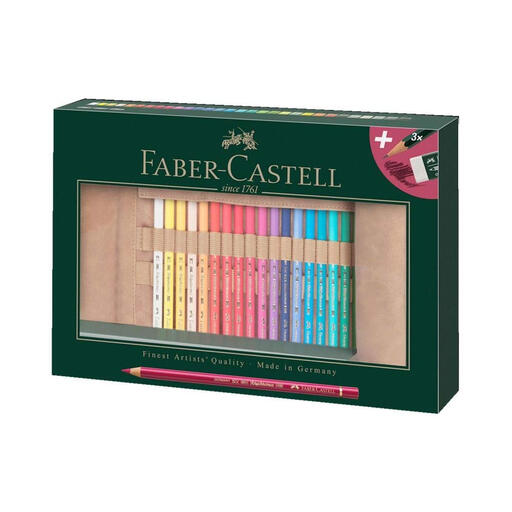
Why this product fits the profile: For colour-intensive illustrations, portraits and multi-layered drawings, this set offers a selection of 30 Polychromos coloured pencils, plus three Castell 9000 graphite pencils and an eraser.
The oil-based lead is designed for dry applications. This avoids any confusion with water-soluble watercolour pencils.
3.8 mm lead, water and smudge-resistant product specification, plus pencil roll for transport and organisation.
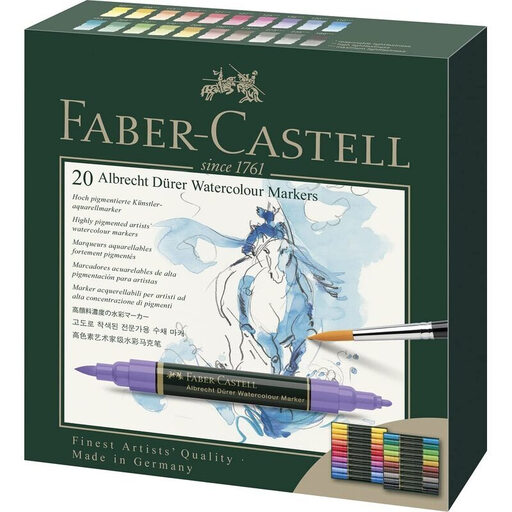
Why this product fits the profile: Illustrators and users on the go get 20 markers with brush and fibre tips. The compact storage is ideal for sketches, travel drawings and working with water on watercolour paper.
The two tips and the water-based, water-soluble ink are explicitly stated. This makes it easy to distinguish the tool from ordinary felt-tip pens.
Brush and fibre tips, 20 colour shades, plus wallet for tidy transport.
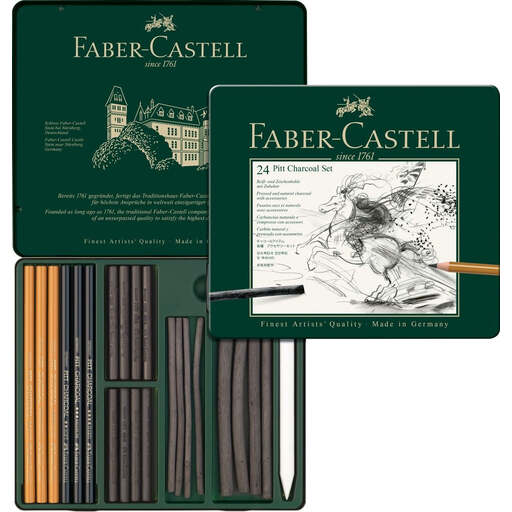
Why this product fits the profile: This charcoal drawing set is aimed at users who want to work with charcoal pencils and sticks in various degrees of hardness, for example in portraits, landscapes or expressive sketches.
Alongside various degrees of hardness, a kneaded eraser and blending stumps are included. This means important extras don't necessarily have to be bought separately.
Multiple forms and degrees of hardness, plus reusable metal tin for storage.
We've put together a complete, regularly updated list of products that fully meet these strict selection criteria and the safety regulations in force in the EU.
For colour-intensive work on dark or coloured paper, Faber-Castell artist coloured pencils from the Black Edition with a triangular shape and 3.3 mm lead could be of interest. If you're planning delicate pastel work, you can choose a Pitt pastel pencil set in a smaller 12-piece or larger 24-piece version. For a broad palette, 36-piece Pitt pastel pencils and a 72-piece soft pastel mini set are also available.
Parents and teachers should pay attention to the stated age group, small swallowable parts and sharp leads when it comes to children's products. The Connector fibre-tip pen set with 80 pens is intended for colouring and building with the interlocking system; it is therefore not comparable to professional artist coloured pencils.
For water-activated techniques, the Albrecht Dürer watercolour pencils or the Albrecht Dürer Watercolour Markers are suitable. The pencils are used dry and then worked with water. Markers additionally offer different tips for areas and lines.
Durability depends on lead hardness, pressure, paper texture, sharpening technique and frequency of use. Soft pastel and charcoal pencils will shorten more quickly with broad application. Protected storage, suitable paper and an appropriate sharpener can reduce breakage and unnecessary material consumption.
For coloured illustrations, suitable artist coloured pencils, drawing paper, a sharpener and an eraser form the basic equipment. For watercolour techniques, brushes and watercolour paper are also needed. For pastel or charcoal work, blending stumps, a kneaded eraser and possibly fixative are useful. A coordinated artist supplies set can simplify the selection, but should always be checked against your specific technique.