Families dealing with frequent footstool spills
An upholstery attachment that’s easy to manoeuvre is useful for small accidents – provided the footstool’s cover can be wet-cleaned.


A spray extraction cleaner is suitable for a fabric footstool only if its care instructions allow water-based cleaning. If the upholstery is not suitable, dry cleaning or a removable cover that can be washed according to its instructions is the right alternative. For individual stains, look for an upholstery attachment that is easy to manoeuvre and can reach edges; if you have several upholstered surfaces to clean, tank capacity, reach and cleaning the machine become more important. The footstool will still need time to dry after you’ve extracted the liquid. Steam does not make a fabric suitable for cleaning.
An upholstery attachment that’s easy to manoeuvre is useful for small accidents – provided the footstool’s cover can be wet-cleaned.
Checking that the cover is suitable for cleaning, using water sparingly and allowing enough time to dry are more important than extra cleaning features.
If you want to clean other suitable fabric surfaces as well as your footstool, pay particular attention to tank design, reach, attachments and how easy the machine is to clean.
This table groups shoppers by the factor that matters most when choosing a stain cleaner for suitable fabric footstools in a family home.
| What matters | What to check before buying | Who is this important to? |
|---|---|---|
| Whether the cover is suitable | Check the care instructions for the specific footstool; only wet-clean it if the instructions allow this. | If I’m not sure whether my footstool’s cover can be cleaned with water, I’ll check its care instructions first rather than risk using an unsuitable method. Around 36% of shoppers put fabric suitability first. |
| Reaching individual stains | Check that the upholstery and crevice nozzles are suitable, and that the hose is long enough to reach the seat, edges and seams. | For small stains, I want to work directly on the seat and seams without having to use a cumbersome nozzle. This matters to around 29% of shoppers. |
| Residual moisture and drying | Allow time for drying after extraction; don’t assume the manufacturer’s guidance applies to every fabric. | If the footstool will soon be needed again, I want to extract the liquid thoroughly while still allowing enough time for it to dry. Around 21% of shoppers say being able to use it again quickly is their top priority. |
| Ease of use and maintenance | Compare the clean and dirty water tanks, cable, hose, and cleaning or rinsing accessories. | If you’re cleaning several areas, you’ll want to factor refilling and cleaning the tanks, brushes and hose into your routine. Around 14% of shoppers focus on ease of use and maintenance. |
Best for: Treating individual stains on a fabric footstool that is explicitly approved for water-based cleaning.
Things to consider: The attachment and hose matter for edges and seams; you may need to refill more often when cleaning larger areas.
Best for: Regularly cleaning other approved upholstery as well as your footstool, especially if you need to work for longer.
Things to consider: Manufacturer specifications vary: Rowenta lists a 2,3 l clean water tank and several brushes for the IN5020F0, while Kärcher lists a 1,7 l tank and an upholstery and crevice nozzle for the SE 3 Compact Home. These figures don’t compare cleaning results.
Best for: Covers that don’t allow wet cleaning, or that can be removed and cleaned separately according to their care instructions.
Things to consider: A stain cleaner can’t make an unsuitable cover safe to wet-clean; removable covers have their own care instructions.
Best for: Only if the care instructions for the specific cover allow the steam treatment you have in mind, and you need this feature.
Things to consider: BISSELL lists the SpotClean HydroSteam Pro at 5,9 kg and 1.000 W; whether you can use the steam mode still depends on the cover.
A machine described as suitable for upholstery doesn’t mean every fabric cover can be wet-cleaned. Hoover recommends checking the care instructions for the specific cover before cleaning.
Check the care instructions for your footstool and its cover before choosing a machine or cleaning product. If wet cleaning isn’t recommended, don’t use a spray extraction cleaner on that footstool.
The approximately 30-minute drying time quoted by BISSELL applies to a specific independent steam mode, not to wet-cleaned furniture in general.
Allow time for the specific cover to dry, and remember that extracting the liquid doesn’t mean it’s completely dry. Ventilation helps clear excess moisture from the room.
You may not be able to use the footstool for some time while it dries.
The clean and dirty water tanks serve different purposes. The right attachments are also important for edges and seams, while reach and ease of cleaning the machine affect how convenient it is to use.
Compare the capacities of both tanks, what’s included, the cable and hose, and any rinsing or cleaning accessories separately.
The wrong attachment or a fiddly cleaning routine could mean extra work after use.
The SE 3 Compact Home is designed for suitable upholstery and medium-sized fabric surfaces.
The Clean It IN5020F0 is designed for localised stains and other suitable upholstered surfaces.
The SpotClean range includes stain cleaners; the HydroSteam Pro 3700N also has a steam option.
The 3000 Series XW3192/11 stain cleaner is described as suitable for soft surfaces such as sofas.
The HS5 HS500 011 is described as a spray, brush and suction cleaner for suitable upholstery and other surfaces.
The following Joybuy products are compact spray extraction cleaners for spot-cleaning upholstery that is suitable for wet cleaning. Always check the care instructions for your specific footstool before use.
 No image available
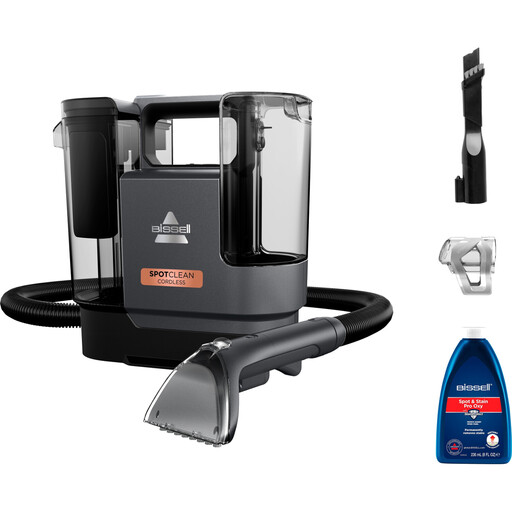
For individual stains on upholstery whose care instructions allow wet cleaning.
Described as cordless, with a 0,9 l clean water tank, a 0,8 l dirty water tank, a Tough Stain Tool and a HydroRinse Tool. It’s listed as offering 20–25 minutes of runtime per charge and weighing 3,4 kg.
 No image available
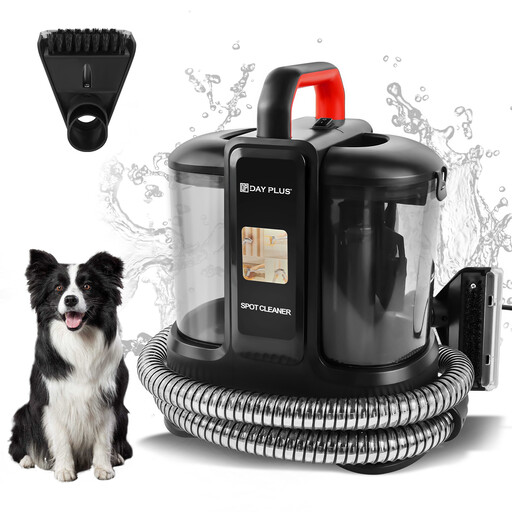
For stains on suitable upholstery when spray extraction and the stated cable and hose reach suit the job.
Described as having a 1,2 l clean water tank, a 0,6 l dirty water tank, a 4,25 m cable, a 1,5 m hose and two brushes. The stated suction power is 15 kPa.
 No image available
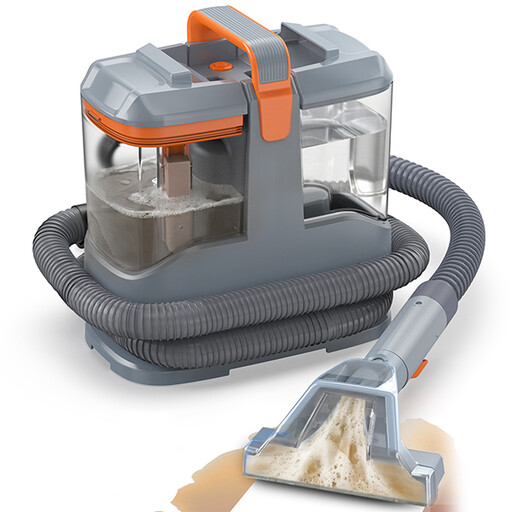
For spot-cleaning suitable upholstery, provided the cover’s care instructions allow wet cleaning.
Described as having separate tanks for 1.000 ml of clean water and 550 ml of dirty water, a 4 m cable and a 1,5 m hose. It’s listed at 450 W and 13 kPa, and weighs 2,6 kg.
 No image available
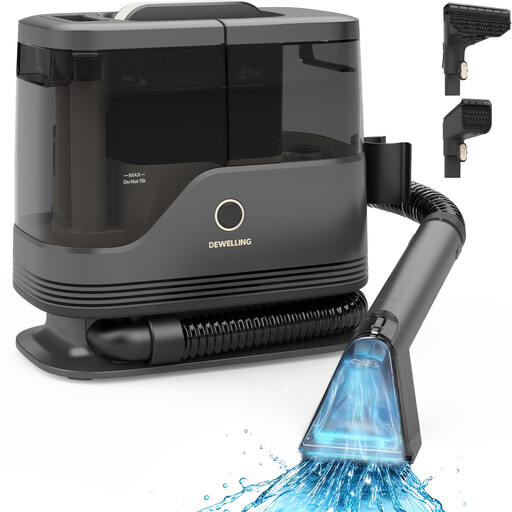
For stains on suitable upholstery when spraying and collecting dirty water are right for the job.
Described as having a 1 l clean water tank, a 0,55 l dirty water tank, a 5 m cable, a 1,15 m hose, and standard and wide nozzles. It’s listed at 400 W and 13 kPa, with a self-cleaning function on the handle.
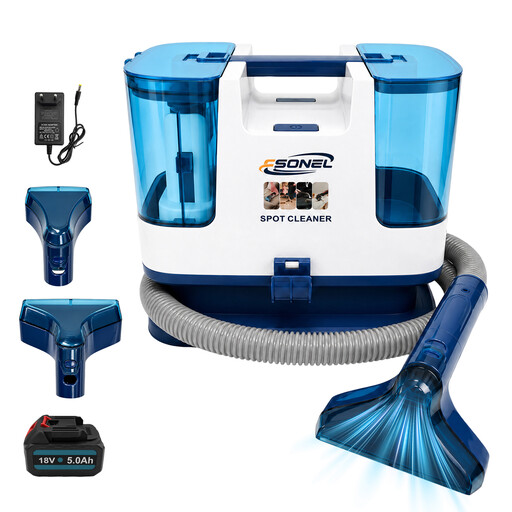 No image available
For spot-cleaning suitable upholstery when cordless operation suits the job.
Described as a battery-powered handheld cleaner with spray and extraction functions. The stated figures are 400 W and 17 kPa; this version is supplied with one battery.
No. The word “fabric” doesn’t mean a footstool is approved for wet cleaning. Check the care instructions for the specific footstool and cover; Hoover says the care label is the key guide to choosing a cleaning method. A removable cover may have its own washing instructions.
Follow the instructions for the cover and the machine, extract the liquid you’ve applied, then leave the footstool to dry before using it. Clean the tanks, attachment and, if needed, the hose according to the machine’s instructions. Ventilation helps remove excess moisture from the room.
Cleaning solution and replacement attachments, if needed, can add to the cost, so check they’re compatible with the model you choose. The Verbraucherzentrale distinguishes statutory rights against the seller from a voluntary guarantee. The specific guarantee terms depend on the offer.
For certain electrical products, the Bundesnetzagentur lists requirements including correct CE marking, identifiable manufacturer details, and the necessary instructions and safety information in German. Check these details on the specific product listing. CE marking is the manufacturer’s declaration of conformity; it isn’t independent proof that a machine is suitable for your footstool cover.
Electrical waste is collected separately. The Umweltbundesamt lists local authority collection points as one option; contact your local council to find your nearest drop-off point.