Families dealing with occasional stains
If individual stains are left on a fabric pouf after a party, and the fabric is suitable for wet cleaning, a suitable nozzle that can reach edges and seams is important.


For individual stains on a pouf, a spray-and-suction cleaner with a suitable narrow nozzle is an obvious choice – but only if the care instructions for the cover allow wet cleaning. If you have several suitable upholstered surfaces to clean, tank handling and appliance care matter too. Steam is only an option if the specific cover is approved for it. Whichever appliance you choose, allow time for drying.
If individual stains are left on a fabric pouf after a party, and the fabric is suitable for wet cleaning, a suitable nozzle that can reach edges and seams is important.
If you regularly clean several suitable upholstered surfaces, it’s worth considering nozzle changes, tank handling and appliance care too.
If you’ll only use it occasionally, weigh up your cleaning needs against the appliance’s dimensions, storage requirements and the work involved after use.
Hoover explains the W, S, W/S and X care codes for upholstery. Check your pouf’s instructions before using water or steam.
| Consideration | What to check when buying | Who should pay particular attention? |
|---|---|---|
| Material compatibility | Follow the cover’s care instructions; check steam suitability separately. | I want to be sure that my specific cover can withstand water before cleaning it; I’ll check steam suitability separately. Around 31% of consumers put material compatibility first. |
| Stains and seams | Check that the attachments and nozzle shape suit the areas that need cleaning. | If there are stains around seams or edges, I need a nozzle that can reach them. Around 31% of consumers prioritise targeted stain removal. |
| Residual moisture | Consider the amount of water sprayed and the suction; plan a suitable place for drying. | If I want to use the pouf again only once it’s completely dry, I’ll allow enough time and space for that. Around 23% of consumers prioritise residual moisture and when they can use the item again. |
| Aftercare and storage | Check how easy the tanks are to access, how to clean the attachments and the appliance’s dimensions. | After the party, I want to be able to empty, clean and store the tanks and attachments without hassle. Around 15% of consumers particularly value straightforward aftercare. |
An appliance’s product description doesn’t prove that a particular cover can withstand water or steam.
Check your pouf’s care instructions first. If it has a removable cover, its washing instructions also apply.
BISSELL specifically says that the drying time of around 30 minutes for the SpotClean HydroSteam 3689N applies to the standalone steam mode.
Don’t assume this time applies to other modes, appliances or pouf covers, and allow plenty of time for drying.
You may not be able to use the pouf again as soon as you’d hoped.
After spot cleaning, you’ll need to care for the tanks and attachments according to the appliance instructions. Extra features don’t necessarily replace every cleaning step.
Before buying, check how easy it is to access the tanks, attachments and, where applicable, the hose.
Emptying, rinsing and drying the tank and attachments take extra time.
Rowenta describes the Clean It IN5011 as a spot cleaner with attachments for different areas of upholstery.
Philips presents the 3000 Series XW3192/11 spot cleaner as suitable for treating stains on soft surfaces.
Hoover describes the HS5 HS530 011 as an appliance that sprays, washes, brushes and vacuums.
The SpotClean range includes spot cleaners for upholstery. According to the manufacturer, the HydroSteam 3689N also offers additional steam modes.
On its international product page, Kärcher describes the SE 3 Compact Home, order number 1.081-534.0, as a spray extraction cleaner for upholstery.
This selection includes spot cleaners for targeted wet cleaning of suitable pouf and upholstery covers. Check the care instructions for the specific cover before each use.
 No image available
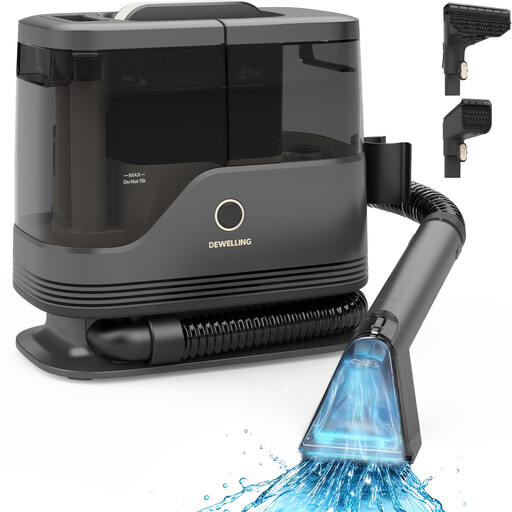
For targeted cleaning of suitable upholstery; only use it wet if the pouf’s care instructions allow it.
The product title lists separate clean- and dirty-water tanks, as well as a self-cleaning function on the handle.
 No image available
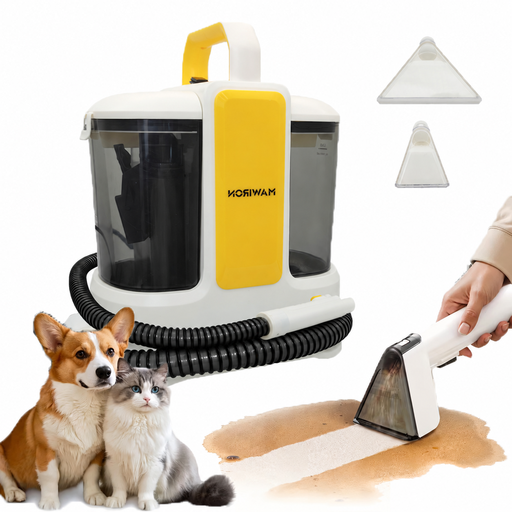
Could be suitable for individual stains on appropriate upholstery, provided the cover is approved for wet cleaning.
The product title lists a 3-in-1 spray, brush and suction function, as well as 15 kPa.
 No image available
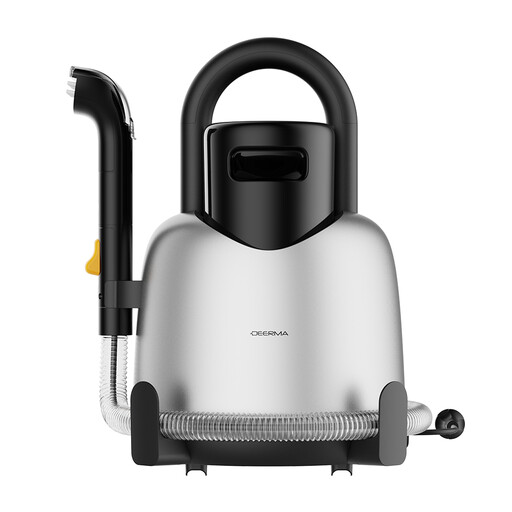
Only consider using the different cleaning modes if the pouf’s care instructions specifically allow each type of treatment.
The product title lists 1,700 W, 13 kPa, 100 °C steam, a 60 °C thermal rinse and a 5-in-1 brush set.
 No image available
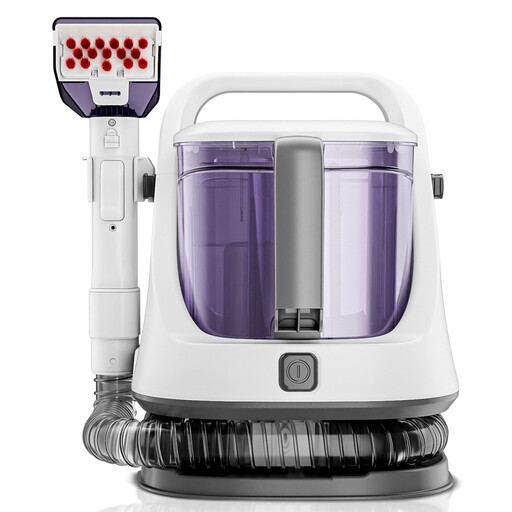
For suitable upholstery; check the pouf cover’s care instructions before wet cleaning.
The product title lists a long hose, a 3-m cable and separate water tanks.
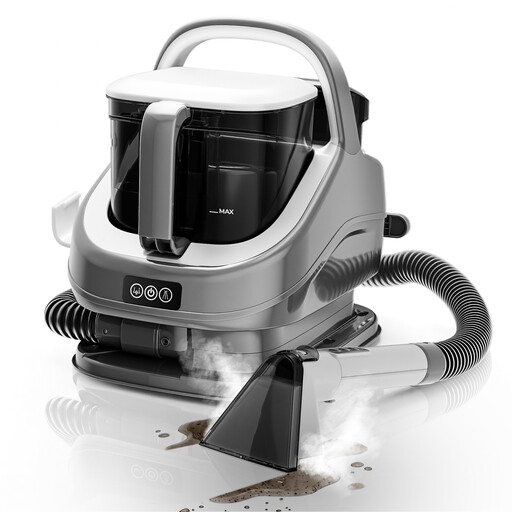 No image available
Only use these modes if the pouf’s care instructions allow the relevant water or steam treatment.
The product title lists cold-water, hot-water and steam modes, as well as separate clean- and dirty-water tanks.
No. The care instructions for the specific cover are what matter. Hoover explains that W means water-based cleaning, S means solvents, W/S means either method and X means no wet cleaning. If the cover is removable, its washing instructions also apply.
Check whether a narrow attachment can reach the affected area. Compare the shape and included attachments with the edges and seams of your pouf; the appliance description doesn’t replace checking the cover’s care instructions.
Not necessarily. BISSELL gives a drying time of around 30 minutes for the standalone steam mode on the SpotClean HydroSteam 3689N. This manufacturer’s claim doesn’t automatically apply to other modes, appliances or fabrics. Allow enough drying time for the specific cover.
Empty and rinse the dirty-water tank, and clean the attachments according to your model’s instructions. The BISSELL instructions for SpotClean and Little Green ProHeat also recommend checking the spray nozzles for blockages. Don’t assume that disassembly steps for one model apply to another.