For accurate colour comparisons
If you compare shades across multiple shots, you should balance window light and artificial light carefully, and check the white balance consistently.


If the window light is enough for a single shot, try softening the shadows with a diffuser or reflector before buying a light. For repeatable shots in changing daylight, a softbox paired with a suitable continuous light source can help. Check the mount, colour performance and what’s included. Very soft, frontal light can make the fabric’s texture less distinct, while mixing window light with artificial light can make it harder to judge colour.
If you compare shades across multiple shots, you should balance window light and artificial light carefully, and check the white balance consistently.
When photographing a larger swatch, even illumination and enough space to position the light modifier correctly are key.
If you want the fibres or raised details to remain visible, consider the direction of the light: very soft, frontal lighting can flatten the texture.
Adobe Lightroom describes combining window light with indoor lighting as a challenge for colour and tone. So first decide what matters most for your shots: comparable colours, an evenly lit surface, visible texture or a straightforward setup.
| What matters | What to check before buying | Who is this important to? |
|---|---|---|
| Comparable fabric colours | Check the colour specifications for the specific light and use a neutral reference to assess the actual illumination. | If I want to compare shades across shots, I need controllable light and a neutral reference. Around 33% of consumers prioritise comparable fabric colours. |
| Evenly lit swatch | Check the size of the swatch against the light modifier’s surface area and the space available for setting it up. | If I want the whole fabric sample to look evenly lit, the light modifier needs to suit its size without making the window setup difficult. Around 27% of consumers prioritise even illumination across the surface. |
| Visible weave texture | Check whether you can adjust the light direction and diffusion for a separate texture shot. | If I want the fibres and raised details to stand out, I need to be able to position the light deliberately off to one side. Around 20% of consumers prioritise visible fabric texture. |
| Compatibility and setup | Check the mount, what’s included and how the specific version attaches to your existing light. | If I want to keep using my existing equipment and keep the setup simple, the softbox must be compatible and include any necessary accessories. Around 20% of consumers prioritise compatibility and ease of setup. |
A good fit if: You’re photographing a few swatches in bright, fairly consistent window light and want to soften the shadows to start with.
The trade-off: You’ll need less equipment, but daylight can change in brightness and colour during a series of shots.
A good fit if: You want to see the lighting effect as you set up and photograph fabric swatches repeatedly under more controlled conditions.
The trade-off: The softbox shapes the light, but doesn’t produce it. You’ll also need to allow for the light, a compatible mount and a stable setup.
A good fit if: You already use a compatible flash system and want to light individual still shots precisely.
The trade-off: The mount must fit and the softbox must be suitable for your specific flash. Unlike continuous light, you can’t assess the effect continuously before taking the shot.
A softbox shapes existing light, but doesn’t necessarily include a light, stand or suitable adapter.
Check what’s included with the specific version and make sure the mount fits the light you plan to use.
Light sources that look white can have different spectrums. On top of that, mixed light by a window can make it harder to judge colour and tone.
Use the manufacturer’s specifications to narrow down your options, then photograph a neutral reference under the same lighting that falls on the swatch.
Diffusion can soften harsh shadows, but it can also make fine raised details less noticeable.
If needed, plan one evenly lit shot for comparing colours and a separate shot that brings out the texture.
Rectangular Bowens softboxes in a range of sizes are one option if you already have a compatible light.
The NS93P is a rectangular, quick-fold softbox with a Bowens mount.
Rectangular quick-fold softboxes with a Bowens mount may be worth considering for flexible photography setups.
The 100x S is a continuous light source that can be paired with a separately purchased compatible light modifier.
The softbox range includes options for different flash and continuous lighting applications.
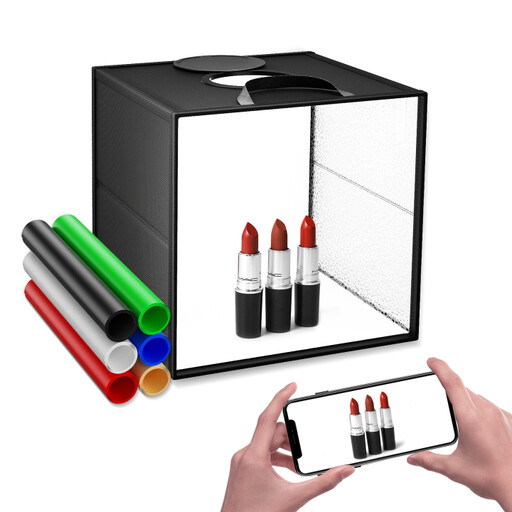
For compact product photography on a table: a foldable mini photo studio with built-in lighting, rather than a separate softbox.
 No image available
For compact product photography on a table. According to the product title, this is a mini photo studio, not a separate softbox light modifier.
Foldable 30 x 30 cm photo studio made from Oxford fabric.
The description lists dimmable lighting, two diffusion layers or an integrated diffuser system, and front and top openings.
The title mentions six coloured backgrounds.
CRI 95+ is a manufacturer’s specification and doesn’t guarantee exact colour reproduction for every fabric swatch.
Photograph a neutral reference under exactly the same lighting that falls on the swatch. Mixed window and indoor light can make colour and tone harder to judge. A white balance setting alone doesn’t guarantee that every fabric shade will be reproduced accurately.
No. The mount and specific model need to be compatible with your light. Also check whether the softbox is designed for flash or continuous light, and which parts are actually included.
Keep the swatch position and lighting consistent for comparison shots, and update your neutral reference if the lighting changes. For an additional texture shot, you can deliberately change the direction of the light and assess it separately from the colour comparison.
No. A softbox shapes existing light but doesn’t produce any itself. Check whether you already have a compatible light and the necessary fittings, or whether they’re included in the listed contents.