Households with face cloths that are regularly damp
If you often have several cloths to dry, consider how many heated hanging spaces you can actually use. Adler lists 18 heating elements for the AD 7821, but this does not give you a set drying time.


For a few face cloths, an unheated airer is an obvious choice, provided you can hang the cloths with enough space between them and the room is well ventilated. A heated model may be worth considering if your cloths often stay damp for a long time. The key factors are the usable hanging space, the room it takes up and its power rating. Heat from the airer does not replace ventilation, and if you choose an electric model, check the applicable requirements and the documentation for that specific appliance.
If you often have several cloths to dry, consider how many heated hanging spaces you can actually use. Adler lists 18 heating elements for the AD 7821, but this does not give you a set drying time.
If your room does not get rid of moisture easily, ventilation should be part of your decision about where to dry your cloths. The German Environment Agency lists damp laundry as a source of moisture and recommends ventilating regularly.
If your drying space needs to fit between appliances or be put away after use, check the dimensions for both use and storage separately. Adler lists different dimensions for the AD 7821 when open and folded; Leifheit describes the Pegasus Bath 12m as an unheated alternative.
First, check whether a non-electric airer with enough space between the cloths and good ventilation will do the job. If you are considering extra heat, compare the hanging space, footprint and power rating of the specific model.
| What matters | What to check before buying | Who is this important to? |
|---|---|---|
| Hanging cloths | The number of spaces you can use individually and the distance between the rails in use. | If I regularly have face cloths to dry, I need enough spaces where they can hang with good airflow, rather than a promised drying time. Around 33% of consumers prioritise suitable hanging space. |
| Room humidity | Ventilation options where you plan to put the airer and the conditions in the room. | If my utility room is damp or poorly ventilated, I need to work out how the moisture can escape first. Around 27% of consumers put managing room humidity first. |
| Floor and storage space | The dimensions when set up for use, as well as the folded dimensions or space needed for installation. | If the airer needs to fit between other appliances and be stored afterwards, I need dimensions that work both in use and when put away. Around 20% of consumers prioritise the space it takes up. |
| Extra electricity | The power rating of the specific model and how long you plan to use it. | If I only have a few cloths to dry, I want to avoid using extra electricity where possible; an unheated airer does not need electricity to work. Around 20% of consumers put avoiding extra electricity use first. |
The German Environment Agency describes clothes airers and washing lines as an energy-efficient way to dry laundry. A manufacturer's wattage figure describes the power of a model, not its electricity use per drying session or the cost of running it.
A heated airer still releases moisture from the cloths into the room. Heat at the drying spot alone will not remove that moisture from the room.
Check the ventilation at the exact spot where you plan to put the airer. Assess a cool basement room separately rather than assuming it ventilates like any living room.
Technical details about heating elements or temperatures do not prove how long your cloths will take to dry in your room and conditions.
Start by comparing the number of cloths you need to dry with the usable hanging space. Treat drying-time claims as manufacturer information, not independent test results.
A larger heated airer may offer more hanging space, but it also takes up more room. For just a few cloths, a smaller or unheated model may be a better fit for your needs.
Measure the available space where you plan to put it and think about how many cloths you want to hang at once before choosing a design.
The AD 7821 is a folding, heated winged airer for several cloths and other small laundry items.
The models mentioned come in different heated designs, including a compact airer and a heated towel rail with a timer.
Foxydry Pro is a wall-mounted warm-air drying solution designed to free up floor space and hold additional laundry.
The Pegasus Bath 12m is an unheated alternative if you would rather avoid extra electric heat to begin with.
The following Joybuy products are electric towel warmers or heated clothes airers. Before choosing, check that the installation type and dimensions suit your utility room. Electric appliances within the scope of the EU Low Voltage Directive must meet the relevant safety requirements. The German Federal Network Agency explains that the CE marking is a declaration made by the manufacturer under its own responsibility, not an independent quality mark.
 No image available
A wall-mounted design may suit you if you want a heated place for towels without an additional floor-standing airer.
The product description lists dimensions of 58,5 × 55 cm, touch controls, a digital temperature display and a top shelf.
 No image available
This folding winged airer may suit you if you occasionally have other laundry to dry alongside face cloths and have space to set it up.
The product details list 230 W, a heating function with a temperature range of 45–55 °C, fold-out side wings and a load capacity of up to 10 kg. Its dimensions when open are 144 × 53 × 96 cm.
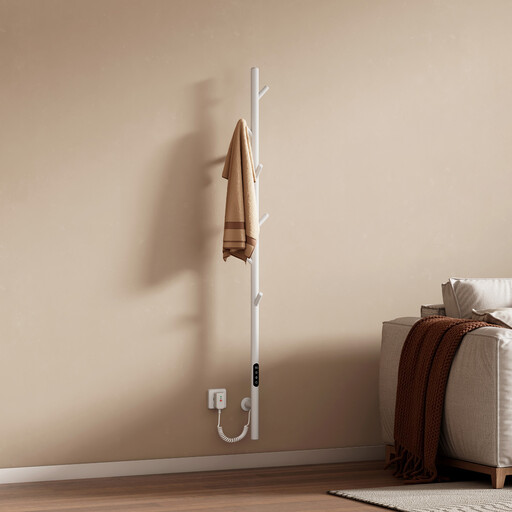 No image available
A rail with additional hooks gives you different ways to hang your cloths if you would rather not drape them all over a single rail.
The product details list 100 W, a height of 150 cm, adjustable temperature and a timer.
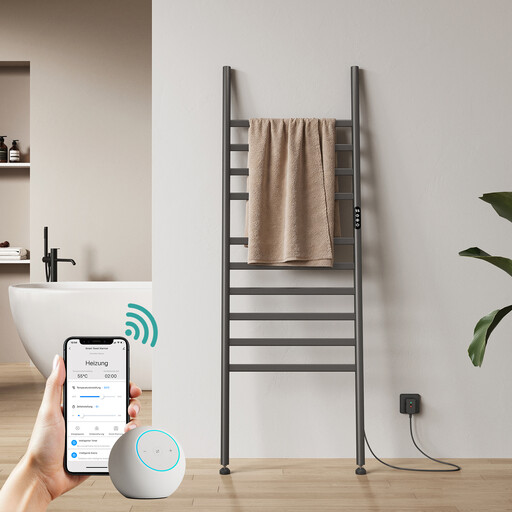 No image available
The freestanding design may suit you if you do not want a wall-mounted model and have the required floor space.
The description lists app and voice control, temperature selection, a timer from 1 to 24 hours and a 160 cm power cable.
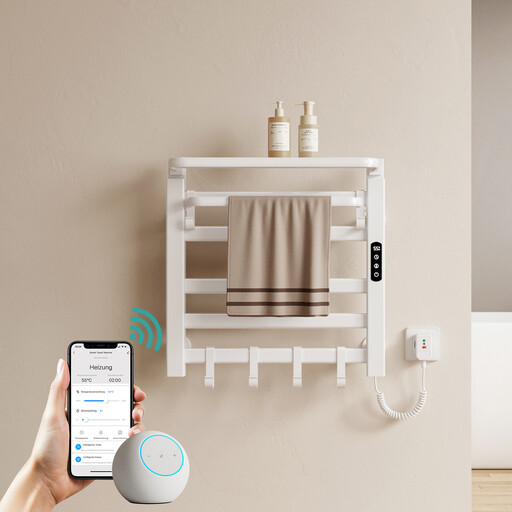 No image available
The compact size may suit you if you are looking for a heated towel space with an additional shelf.
The product description lists a folding shelf, six unheated hooks, a timer and overheat protection. The hooks are not heated.
No. The German Environment Agency lists damp laundry as a source of moisture and recommends regular ventilation suited to the room and how you use it. In a basement room, you should also take account of conditions near cold walls.
No, drying is not the same as washing. The German government information service infektionsschutz.de recommends washing flannels at a minimum of 60 °C with a heavy-duty detergent containing bleach; a manufacturer's rail temperature does not prove that the face cloths have been disinfected.
The cost depends on how long you use the airer and your electricity tariff. The listed power ratings of 100 W for the HOMCOM 850-032 and 220 W for the Adler AD 7821 relate to those specific models; they are not cost or energy-use figures per drying session.
Electric appliances within the scope of the EU Low Voltage Directive, which covers AC appliances from 50 to 1.000 V, must meet the requirements set out in the Directive. The German Federal Network Agency explains that, by applying the CE marking, the manufacturer declares under its own responsibility that the relevant requirements have been met; CE is not an independent quality mark. Check the documentation for the specific appliance.
Allow for both the dimensions when the airer is in use and the space needed to store it. Adler lists dimensions of 148 × 52,5 × 90 cm for the AD 7821 when open and 113 × 52,5 × 8 cm when folded; also check the instructions for the specific model.