Fairtrade-conscious shoppers on the go
You want to be able to tell when buying chocolate on the spur of the moment whether that particular product has a Fairtrade certification. A general sustainability claim about the brand isn’t enough for you.


If Fairtrade is a priority for you, check the label on the specific chocolate rather than relying on the brand’s reputation or its cocoa programme. For eating on the go, also consider how much you want to take with you and eat. Check the ingredients, nutritional information and allergens separately, whatever the Fairtrade status.
You want to be able to tell when buying chocolate on the spur of the moment whether that particular product has a Fairtrade certification. A general sustainability claim about the brand isn’t enough for you.
You’re looking for chocolate to take with you, but want to decide for yourself how much to eat. To do that, compare the pack size, nutritional information and ingredients of the specific varieties.
Before buying, you need to check which allergenic ingredients a variety contains and whether the pack carries a ‘may contain’ warning. The information for another variety from the same brand isn’t a substitute.
A Fairtrade label tells you about sourcing, not whether the chocolate is right for you in terms of portion size or ingredients. If you’re considering chocolate for a quick breakfast on the go, check these points separately.
| Criterion | What to check when buying | Who it matters to |
|---|---|---|
| Fairtrade certification | Look for the Fairtrade mark or clear product-specific certification on the pack itself. A brand’s cocoa programme alone doesn’t meet this requirement. | When I buy chocolate in a hurry on the go, I want to be able to see that Fairtrade applies to that specific variety. For around 42% of consumers, this proof comes first. |
| Amount to take with you | Compare the pack size and how the chocolate is divided into pieces. Consider the nutritional information per 100 g in relation to the amount you actually want to eat. | I want to choose an amount I’ll actually eat before I set off, rather than assuming an entire bar is one portion without checking. Portion size takes priority for around 33% of consumers. |
| Ingredients and allergens | Check the ingredients list, highlighted allergens and, where applicable, ‘may contain’ warnings on the current pack of the variety you’ve chosen. | If I need to avoid certain ingredients, I want to know exactly what’s in the variety before making an unplanned purchase. This check is the main priority for around 25% of consumers. |
These claims answer different questions. A brand’s cocoa programme doesn’t automatically prove that an individual chocolate product is Fairtrade-certified.
If Fairtrade is a must-have for you, check the mark or explicit certification for the variety you’ve chosen on the current pack.
Depending on the recipe, the ingredients may include milk, soya or nuts; there may also be a ‘may contain’ warning. You can’t tell what the label says from the product name or another variety.
Before buying, read the ingredients list and allergen information on the pack you’re actually planning to take with you.
Nutritional information per 100 g doesn’t automatically tell you how much you’ll eat on the go. A large bar may be divided into several pieces, but those pieces aren’t necessarily labelled as portions.
Decide how much you want to take with you, then compare the nutritional information on that basis. Check how the bar is divided if you don’t plan to eat it all.
Fairtrade claims and cocoa programmes don’t automatically apply to every chocolate made by a brand. The label on the variety you’ve chosen is what matters.
REWE explicitly describes Die Gute Schokolade Zartbitter as Fairtrade-certified in its product description.
REWE highlights Fairtrade products in its range, including chocolate. However, a retailer’s range doesn’t tell you whether an individual own-brand bar is Fairtrade-certified.
In its 2023 Cocoa Report, Ritter Sport describes its own approach to cocoa sourcing and supply chains.
Lindt describes the Lindt & Sprüngli Farming Program as part of its cocoa sourcing.
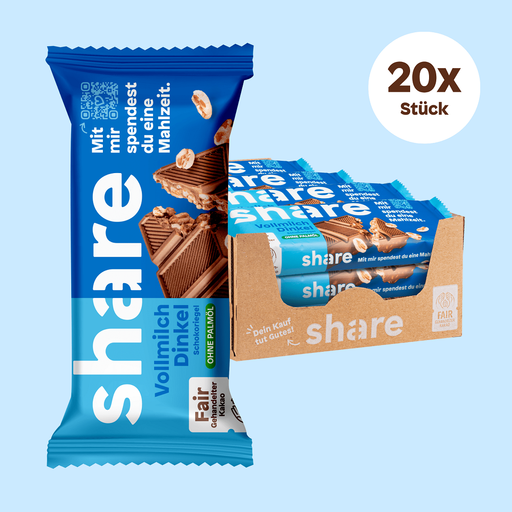
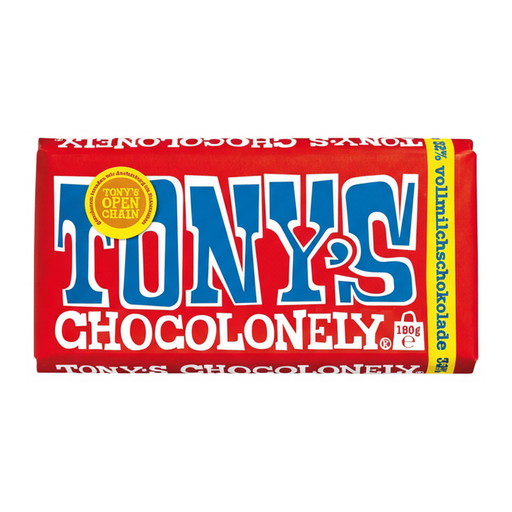
Here you can choose between a pack of 20 bars at 45 g each and a 180-g bar. If you specifically want to buy Fairtrade-certified chocolate, check the label on the current pack of either product.
 No image available
If you want to take a set amount with you, you can choose a 45-g bar from the pack before you set off.
If Fairtrade certification is a must-have, check the label on the current pack: a claim that the cocoa is Fairtrade alone doesn’t confirm that the whole product is certified. Also read the ingredients and allergen information for the variety you’ve chosen.
 No image available
Before taking the 180-g bar with you, decide how much you want to eat on the go; it isn’t labelled as a single breakfast portion.
The product description states that it is Fairtrade-certified. Check this against the current pack, and read the ingredients and allergen information there too.
Look for the Fairtrade mark or explicit product-specific certification on the chocolate you’ve chosen. REWE explains how to recognise the mark and describes Die Gute Schokolade Zartbitter as Fairtrade-certified in its product description.
No, not if you specifically want Fairtrade-certified chocolate. The programmes described by Ritter Sport and Lindt provide information about their respective sourcing approaches, but don’t prove that every individual variety is certified.
Check the ingredients list, highlighted allergens and, where applicable, any ‘may contain’ warning on the current pack. The German Food Federation explains that allergens which must be declared are highlighted in the ingredients list; this information can vary between varieties.
No. Fairtrade labelling doesn’t tell you the sugar content or how much would be a suitable amount to eat. To check these, compare the nutritional information for the specific chocolate per 100 g and, if provided, per portion with the amount you want to eat.