
Lieferung heute & morgen

Qualitätsgarantie

Willkommens-Angebote freischalten: KOSTENLOSE Lieferung | Bis zu 80 % RABATT | Kostenlose 30-Tage-JoyPlus-Testphase
App herunterladen
A folding transport trolley can make it much easier to move shopping, gardening supplies, camping gear or crates of drinks. However, not every model offers greater convenience in everyday use. Buyers often focus only on load capacity or storage space, overlooking important details such as wheel width, brakes and folded dimensions.
Check these three common buying pitfalls before you order:
Choose a load capacity that suits how you plan to use the trolley. For shopping and light gardening, a smaller folding trolley with a capacity of around 80 to 120 kg is often enough. For family outings, crates of drinks or larger gardening jobs, 132 to 150 kg may be more suitable. Models rated for 200 kg or more are designed for particularly heavy loads and need stable, level ground.
Also check the storage capacity. A 120-litre trolley is suitable for bags, groceries or smaller garden tools. A transport trolley with a high load capacity and a volume of 200 to 300 litres can hold considerably more equipment, but may be harder to pull and turn when loaded.
Try to distribute the load as evenly as possible. Place heavy items low down and in the centre of the trolley. An open tailgate is useful for longer items, but it changes the weight distribution.
A wheeled folding trolley for tarmac needs different features from a camping trolley for sand, gravel or grass. Wide tyres help prevent the trolley from sinking into soft ground. Ball bearings or other fitted bearings can make the wheels roll more easily, but they’re no substitute for careful handling.
360-degree swivel wheels make it easier to manoeuvre in tight spaces, such as when shopping or on a garden path. Larger fixed wheels, on the other hand, often provide steadier handling in a straight line.
A hand trolley with brakes should have a clearly described parking brake. On the models featured here, the brakes are intended to keep the trolley safely parked, not to control its speed while moving. On a slope, stop the trolley, secure the load and apply both brakes, if fitted.
A folding wagon should be easy to set up and pack away without needing excessive force. Check that the frame locks securely when unfolded and that you can keep your hands clear of moving parts while folding it.
Oxford polyester, such as 600D or 800D, is used in many outdoor trolleys. The number describes the fabric’s density, but it doesn’t on its own guarantee overall durability. Seams, frame joints, reinforced bases and wheel fixings matter just as much.
For the garden, beach and camping, a wipe-clean or removable fabric liner is useful. Let the trolley dry completely before folding it, so moisture doesn’t get trapped inside.
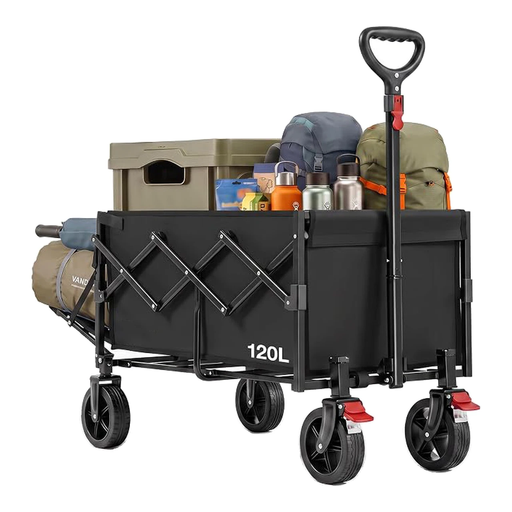
Why this product suits this profile: This compact model is designed for shopping, smaller gardening jobs and occasional outings. According to the product details, it weighs 6 kg and can be stored in a vehicle.
The folding tailgate makes it easier to carry longer items. 360-degree swivel wheels help with manoeuvring, while two front parking brakes help keep the trolley in place.
120-litre capacity, stated load capacity of 100 kg, removable Oxford fabric and wheels that can be removed without tools.
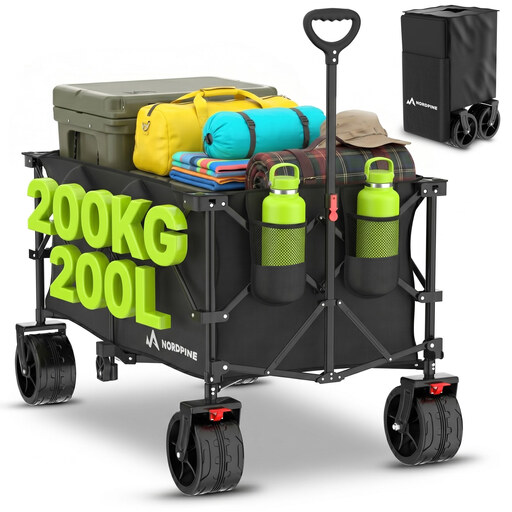
Why this product suits this profile: This trolley combines generous storage with wide PU tyres and a stated load capacity of 200 kg. It’s well suited to regular camping trips, gardening or family outings.
The folded dimensions are clearly stated as 62,5 × 37 × 25 cm. This makes it easier to check whether the trolley will fit in your car boot or storage space before you buy.
200 litres of storage, stated load capacity of 200 kg, height-adjustable handle, parking brake and carry bag.

Why this product suits this profile: With a 300-litre capacity, PU wheels and an open tailgate, this trolley is ideal for festival essentials, camping gear and longer garden equipment.
The stated folded dimensions of 35 × 26 × 80 cm make it easier to plan where to store the trolley. Removable wheels also make cleaning and replacement easier.
300-litre capacity, stated load capacity of 132 kg, PU wheels with bearings, two brakes, side pockets and cup holders.
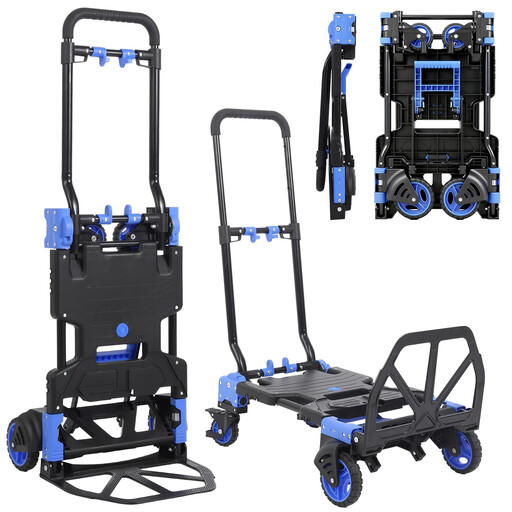
Why this product suits this profile: Combining a platform trolley and a dumper trolley, this model is a useful choice for moving house, workshops, warehouses or regular household transport.
The stated conversion time of around three seconds means less time spent changing the setup. The maximum load capacity varies by mode of use, so check the relevant limit.
Aluminium frame, weighs 7 kg, carries up to 150 kg in platform trolley mode, height-adjustable handle and parking brake.
We’ve put together a complete, regularly updated list of products that meet these strict selection criteria and fully comply with the safety regulations in force in the EU.
Its lifespan depends on the load, the surface it’s used on, storage and care. Regular overloading, damp conditions and sand in the bearings can speed up wear. Check the wheels, seams and frame joints regularly.
For sand and unpaved paths, wide wheels, a sturdy frame and a wipe-clean fabric body are useful features. A large capacity is handy, but the trolley will weigh more when fully loaded. On soft ground, pull it slowly and as straight as possible.
A parking brake stops a stationary trolley from rolling away. It doesn’t replace careful control while pulling it. On slopes, slow down, secure the load and don’t leave the trolley unattended.