
Lieferung heute & morgen

Qualitätsgarantie

Willkommens-Angebote freischalten: KOSTENLOSE Lieferung | Bis zu 80 % RABATT | Kostenlose 30-Tage-JoyPlus-Testphase
App herunterladen
Looking for board games for the family may seem straightforward at first. In practice, however, many games do not suit the players’ actual age range, attention span or the time available. Attractive packaging says little about whether a game will regularly make it onto the table.
A game labelled “from 8 years” may be challenging for a child with little playing experience, while older children may quickly find it too easy. So don’t just check the recommended age; also consider:
For games containing small parts, you should also follow the manufacturer’s warning. The Azul board game, for example, is designed for 2 to 4 people aged 8 and over and contains small game pieces. It is therefore not suitable for children under three.
Descriptions such as “educational”, “strategic” or “for the whole family” are not particularly meaningful without further details. With educational games for children, it should be clear what activity is actually at the heart of the game: matching, counting, creating patterns or tactical planning.
For example, a number game may support the connection between numbers and shapes. Whether it suits your child, however, depends on their motor skills, age and interest in playing. Parents should supervise children using children’s games with small components and keep the information on the packaging.
A game lasting 30 to 45 minutes requires different planning from a quick game for a spare moment. The playing area is also important: chess, Connect Four and tile-based strategy games need a sturdy table and enough room for the board, pieces or cards.
The recommended age is a guide, not an individual assessment of a child’s development. Families with children of different ages will often benefit from clear rules and short rounds. Board games for ages 8 and over, on the other hand, may include several layers of decision-making.
Pay attention to the details given for each product:
With educational games, the intended learning content should match the game mechanics. A shape board with numbers, for example, combines sorting, recognition and hands-on placement. A pattern puzzle, by contrast, focuses more strongly on visual design and repeatable arranging.
For children who enjoy planning ahead logically, strategy games such as chess or Azul may be appealing. Anyone who prefers quick rounds will find Connect Four easier to get into, with a straightforward format and direct interaction.
Small parts must not be put in the mouth and should be kept out of the reach of children under three. For games made from wood or plastic, cleaning according to the manufacturer’s instructions is generally sufficient. Moisture, intense heat and harsh cleaning products can damage materials and colours.
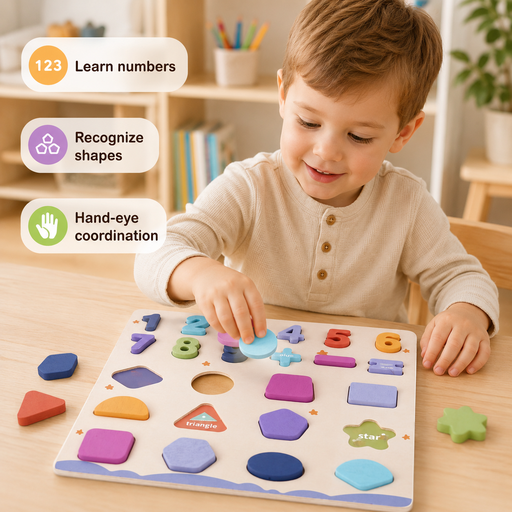
Why this product suits this profile: The shape board combines numbers and shapes in a manageable indoor activity that can easily become part of quality family time.
The product description specifies the approach using numbers and shapes rather than relying solely on general educational claims. The pack contains 1 piece.
Numbers and shapes activity, easy to use, suitable for family playtime and indoor play.
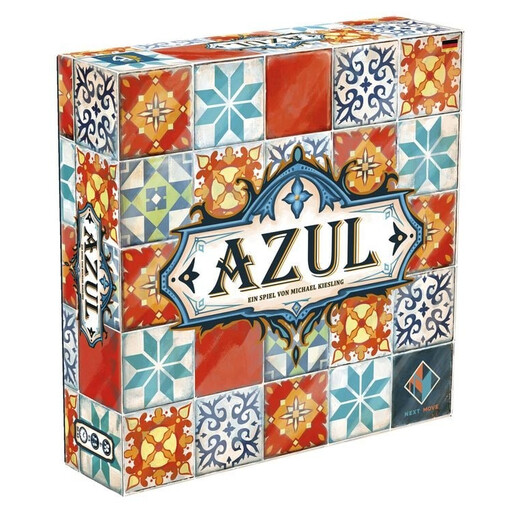
Why this product suits this profile: This tile-laying game offers clearly explained rules, tactical decisions and a stated playing time of 30 to 45 minutes.
The number of players, recommended age and playing time are all clearly stated. This makes it easier to check whether a game fits into the family time available.
For 2 to 4 people, from 8 years, German edition, tactical tile-laying.
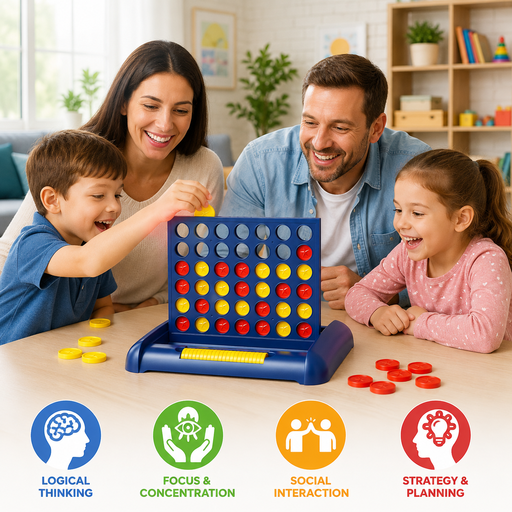
Why this product suits this profile: The game is designed for quick family rounds and a direct logical challenge. This makes the format suitable for regular short games.
The stated use focuses on family activities and creative play. This makes its purpose clearer than a purely promotional educational-game description.
Short rounds, two-player format, suitable for family time, indoor play and as a gift idea for children.
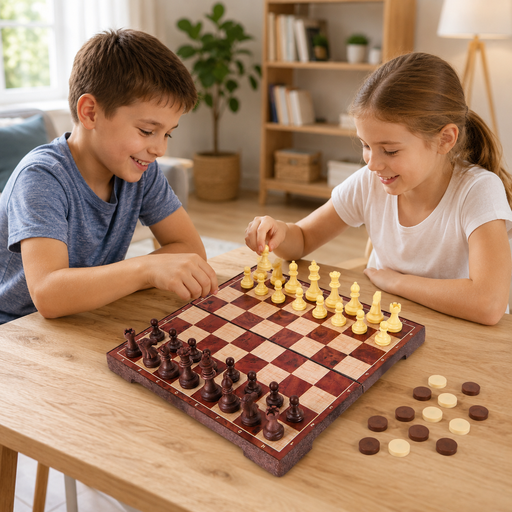
Why this product suits this profile: This classic chess set is designed for two players and is suitable for families looking for a board game focused on planning, with a gameplay format they can return to time and again.
The product description identifies the classic chess format and its suitability for family and indoor play. Before buying, you should check the dimensions and contents.
Two-player game, classic design, suitable for logical planning and quality time together.
If board games are used frequently, it is worth choosing a permanent, dry storage location. A two-tier kitchen shelf can be used not only for spices and pans but, depending on its size, for game boxes too. When buying, consider the dimensions of 40 × 40 × 35 cm, the steel and plywood construction, and the fact that self-assembly is required.
For family gatherings, a serving board with bowls can keep snacks and dips separate. The bamboo board described measures 30 × 10 cm and comes with three ceramic bowls. As ceramic is fragile, hand-washing is recommended to help protect it, despite the stated dishwasher suitability.
A chopping board with draining function can also be useful in the kitchen. The Suncha model measures 400 × 280 × 20 mm and, according to the product details, is made from rice-husk material with a silicone edge. The draining function does not replace hygienic cleaning; after use, the surface and edge should be allowed to dry completely.
Anyone looking for a different product category, such as a Pilates Reformer Board for home workouts, should assess the folded dimensions, footprint, weight capacity and safe use separately from the process of choosing a board game.
We have put together a complete, regularly updated list of products that fully meet these strict selection criteria and the safety regulations applicable in the EU.
It depends on the child’s age, playing experience and preferred game length. For short rounds, simple matching or tile-laying games may be suitable. For children aged 8 and over, Azul, chess or other strategy games may be a good choice if they enjoy planning and competition. Before buying, check the manufacturer’s information on age suitability, number of players and small parts.
Lifespan depends mainly on the quality of the materials, storage conditions and how the components are handled. Store all playing pieces in a complete, dry and preferably organised manner. Damaged or missing small parts can restrict gameplay. A dedicated storage box helps prevent components from getting lost among other household items.
The price should be considered in relation to the materials, contents, number of players and intended use. An inexpensive game is not automatically suitable if its rules or age recommendation do not match your family. Conversely, a game with replayable gameplay may be used more often. Before buying, compare the equipment, playing time and possible uses rather than looking at the product price alone.