Family interviews with minimal set-up
You want to get started without fuss and check that everyone’s voice is clear from their intended seat.


For a straightforward family conversation, a handheld recorder with built-in microphones is a natural place to start, provided a test recording confirms that everyone’s voice is clear from their seat. If you want to record several people using separate microphones or have more control over their individual voices, a recorder with the right separate inputs is a more flexible, but more involved, option. Check you have permission before recording, then back up the files afterwards.
You want to get started without fuss and check that everyone’s voice is clear from their intended seat.
You want to record two voices using individual microphones and are prepared for extra connections and more set-up.
You want to plan storage, power and file transfers in advance for longer sessions.
| What matters | What to check before buying | Who it matters most to |
|---|---|---|
| Clear voices | Record with everyone in their intended seats, then listen back to the test recording. | If I want to make sure everyone can be heard clearly from their seat, I test the actual seating arrangement; around 33% of consumers put clear voices first. |
| Separate microphone channels | Check the exact model for the number of microphones you need, the available connections and, where necessary, phantom power. | If each person needs their own microphone, I plan for the right equipment and the extra set-up; around 27% of consumers prioritise recording voices separately. |
| Easy recording controls | Try the controls, recording indicator and playback during a test run. | For a personal family conversation, I want to be able to check easily that recording has started; around 20% of consumers prioritise ease of use. |
| Storage and file management | Check available storage, power and file transfer for the planned session length, and plan a backup. | For longer storytelling sessions, I want to be able to find and back up the recordings afterwards; around 20% of consumers prioritise storing longer recordings. |
A recording format doesn’t prove that voices will be clear with your actual seating arrangement and room acoustics.
Before the conversation, make a test recording with everyone in their planned seats and listen back to it.
Separate microphone channels need compatible inputs and accessories; their set-up differs from using a single handheld recorder.
Before you buy, decide whether one shared recording position will do or whether each person needs their own microphone.
Separate microphones may also require compatible microphones, stands and cables.
Storage, power and transfer options all affect how you save and back up a recording after the session.
Check these before you start, then make a backup copy afterwards.
If the recorder needs a memory card, remember to get a compatible one.
The H1essential is a compact handheld recorder with built-in X/Y microphones. Zoom also describes using it on a tripod for face-to-face conversations.
The DR-05XP is a handheld recorder with built-in microphones, while the DR-40XP adds two XLR/TRS combo inputs.
The ICD-UX570 is a voice recorder with built-in storage and direct USB file transfer.
The LS-P5 combines a compact recorder with internal storage and the option to expand it with a microSD card.
The RØDECaster Duo is designed for a more extensive, stationary two-person set-up with external microphones.
The following Joybuy products are handheld recorders with built-in microphones, suited to voice recordings that need minimal extra equipment.
 No image available
For voice recordings using built-in microphones, this device could be a good fit if you want to keep extra equipment to a minimum; test how clear voices sound from the actual seats.
The product specifications list 64 GB of storage, 30 hours of battery life and four MEMS microphones.
 No image available
If you’re recording a conversation without separate microphones, its built-in microphone set-up could work well; a test recording will show how it picks up voices from the intended seats.
The product description lists a three-microphone system, a Speaker Mode and up to 20 hours of recording time.
 No image available
For voice recordings without separate microphones, its built-in microphone set-up is one option; test how clear the voices are in the room.
The product specifications list 64 GB of storage, up to 20 hours of recording time and a three-microphone system.
 No image available
This device could suit recordings with several voices and minimal extra equipment; test how well it picks up voices from the actual seats.
The product specifications list 16 GB of storage, two omnidirectional microphones, 360° recording and up to 22 hours of recording time.
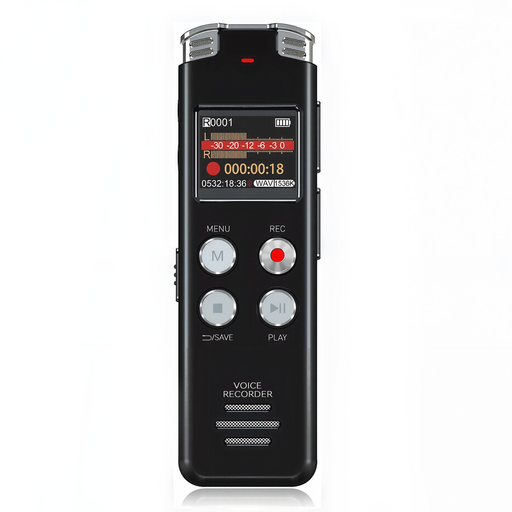 No image available
This device could be a good option for longer voice recordings using its built-in microphone; plan your storage and file transfer around the length of your session.
The product specifications list 128 GB of storage, up to 35 hours of continuous recording and USB-C.
Make a short test recording with everyone speaking from their planned seats, then listen back to it. A practical guide from PEGEL & BLENDE suggests both recorders with directional microphones and a lavalier microphone for each person as possible set-ups for quiet interviews; this doesn’t mean one particular type of device is always required.
No. Zoom and Tascam list 32-bit float as a recording feature on their respective models, but only a test in the room will show whether voices are clear from the intended seats.
Under § 201 Abs. 1 StGB, recording another person’s non-public speech without authorisation is a criminal offence. Check you have permission before you start and get the speakers’ consent for the planned family conversation; being related does not remove the need to do this.
Discuss any planned sharing separately with everyone involved. The Federal Commissioner for Data Protection and Freedom of Information explains that processing personal data generally requires a legal basis; the data protection obligations for a particular publication depend on the circumstances. § 201 StGB also covers the use or sharing of a recording made without authorisation.
Check storage, power and file transfer before the session, then play back the saved file afterwards. If you plan to use a memory card, check that it’s suitable for the exact model.